
Buying a saw for square aluminum tube batches is a decision about accepted parts, not a promise that every stroke produces the programmed length. A bundle may contain nominally identical lengths yet still fail at assembly because the datum moved, one end was damaged, short pieces were mixed with accepted pieces, or the packing count cannot be reconciled. Treat stock approval, cut-part acceptance and counted pack release as three gates. The purchase trial should follow one order from incoming stock to a labelled, counted pack.
This guide is for a factory cutting straight extruded square tube into repeated lengths. It helps the buyer define the actual part family, witness the cut, separate rejects and remnants, and compare quotes on the same delivery boundary. It does not set a universal tolerance or claim a result for any Jiurun configuration. Use the drawing and the receiving station’s acceptance method to establish those values.
Define the accepted square tube batch before selecting equipment
Start with the released part drawing and order mix. Record outside dimensions, wall thickness, corner form, alloy and temper, surface condition, supplied bar length, required cut lengths, batch quantities, and which face or end becomes the assembly datum. A square section is not automatically symmetrical in use: a visible face, pre-finished surface, hole pattern, or connector orientation can make two apparently identical cuts different parts. The buyer should mark whether the saw receives plain stock or already processed tube and whether any subsequent drilling, deburring, finishing, or assembly occurs elsewhere.
ASTM B221 covers many extruded aluminum and aluminum-alloy products, including tubes. It is a material-supply reference, not a substitute for the finished cut-part drawing or a machine acceptance test. If the order uses another product form, confirm its applicable purchase specification rather than attaching B221 by habit. Incoming bow, twist, wall variation and end condition should be recorded so a trial does not silently treat a stock defect as a saw result.
Separate stock, cutting, inspection and packing boundaries
Compare a bought-to-length tube kit with in-house cutting at the same receiving stage. A saw quote may appear cheaper if it stops at a cut falling into a bin, while the bought kit includes inspection, identification and protected packing. Write down who owns incoming stock inspection, loading, changeovers, first-off approval, routine measurement, burr removal, reject segregation, remnant handling and final pack release. If one of these remains manual, count its space, staff time and controls in the comparison.

For the saw itself, specify how a long bar is supported before and after the blade, how the chosen reference face meets the fence or clamp, how the last usable length is handled, and where accepted pieces leave the cutting zone. The square tube clamping trial guide goes deeper into support and contact. This article follows the complete accepted batch beyond the clamp.
Trial plan for square aluminum tube batches
Give each shortlisted supplier the same small trial pack: drawings, stock samples, lengths and quantity mix, the datum convention, the agreed measurement method, permitted cut-end condition, and the receiving format. Include the smallest and largest relevant section, a typical length, a short piece if the order contains one, and a realistic changeover between at least two jobs. Do not ask only for a photogenic first cut. Witness first, middle and last positions in a run, plus restart after a stop where that is part of production.
Ask the supplier to show the actual configuration proposed in the quote: loader or manual infeed, supports, clamping surfaces, blade, guards, length setting, discharge and any part-count or identification function. A demonstration on a different model can explain a process, but it cannot establish that the quoted machine has those options or produces the same result. Record every trial deviation and the condition under which it could be retested.
Measure the right part and reconcile the count
Agree the finished-part dimension, datum and instrument before cutting. State whether length is checked between two cut faces, from a pre-existing feature to a new end, or at an assembly fixture. Write the permissible condition of burrs, corner damage, wall collapse and surface marks in the drawing or trial sheet. A feed-system number is not the same as accepted finished-part accuracy. The buyer should inspect physical parts, not infer acceptance from a control-screen readout.
Measurement also needs a repeatable method. NIST’s gauge repeatability and reproducibility guidance explains why the gauge, operator and measurement process matter. In a trial, keep the instrument, contact points, part temperature context, operator and recording method consistent enough that two suppliers are compared fairly. If the method changes, annotate the difference before drawing a conclusion.
Reconcile the batch as a material balance: starting bar identity and quantity; accepted parts by drawing revision and length; first-off or destructive samples; nonconforming pieces; kerf and unusable ends; and reusable remnants. The counts should lead to a physical pack, not just a machine counter. If the supplier’s screen says the target quantity is complete while inspection holds three pieces, define whether the machine, an operator or a downstream system replaces them. Keep accepted, suspect and rejected pieces in visibly different locations.
Release packs that the next station can actually use
For square aluminum tube batches, the accepted output may be a loose tote, a protected layer stack or a member kit. Specify which one the next station needs. A practical pack label identifies part number and revision, cut length, quantity, alloy/temper or material lot as required, inspection status, and destination. The pack design should protect visible faces and cut ends without making counting impossible. The illustrative photo below shows a packing step; it does not document this article’s batch or acceptance result.
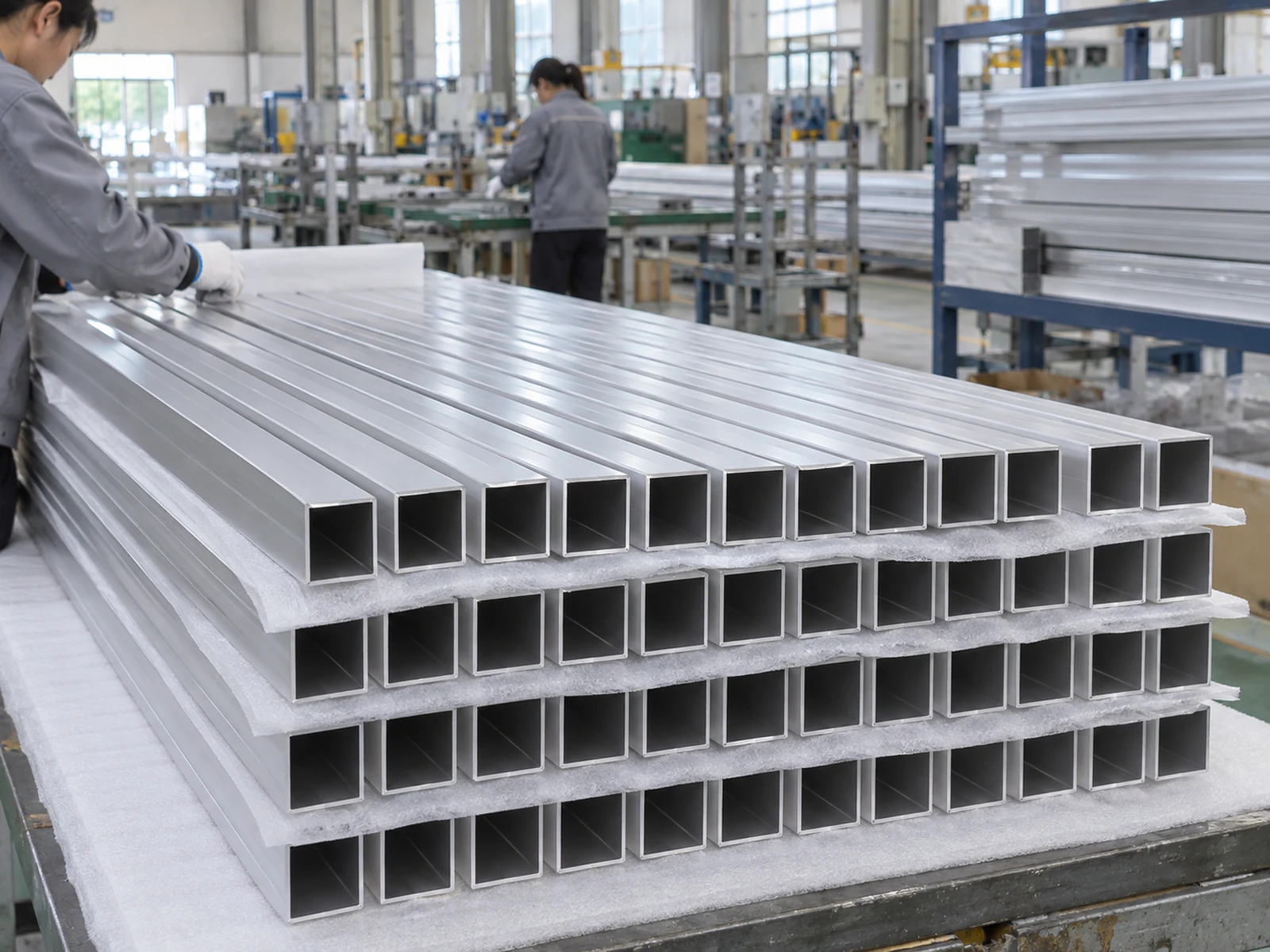
For a kit of multiple lengths, define whether one label covers the entire kit or each sub-bundle carries its own count. Check what happens when a shortfall is found after packing: who can open the pack, replace parts, re-inspect and sign the new count? For a line that only drops one class of production part into a bin, the part stacking decision is a separate choice. The purchase boundary here is a released, identifiable batch ready for its receiving station.
Use equipment footage as context, not test evidence
The Jiurun video below shows general footage of an enclosed JR-550CNC angle saw and its working area. It is a general equipment example only. It does not show the square tube material, quoted configuration, customer order, trial, measurements, accepted count or performance described in this guide. Ask for a witnessed test on your stock and drawing before treating any configuration as suitable.
A quote comparison that leads to a decision
- Input and scope: drawing revision, tube family, stock condition, maximum bar envelope and supplied length.
- Cut and measurement: accepted dimensions, datum, check instrument, sample positions, cut-end criteria and hold/retest rule.
- Flow: loading, changeover, discharge, manual interventions, rejection route and remnant disposition.
- Accepted delivery: piece count, bundle or kit format, label fields, pack protection and receiving sign-off.
- Commercial comparison: included configuration, excluded work, training, spare blade/consumables, installation, documentation and the agreed acceptance test.
A supplier that cannot yet quote the complete boundary can still provide a useful conditional proposal. Mark the missing drawing, stock sample or acceptance rule instead of converting a brochure specification into a guarantee. The selected machine should be judged against the factory’s released batch, not against an isolated cut on convenient material.
Send a workable RFQ pack
Send JiurunCut the square-tube drawings, alloy/temper and incoming-stock description, the length-and-quantity mix, surface and cut-end requirements, datum and measurement method, pack handover requirements, and photographs or samples that may be shared. Ask us to identify the proposed saw configuration and the trial evidence needed for your acceptance. Contact JiurunCut with your RFQ pack.