
Rooflight aluminum frame cutting begins with a purchasing boundary: are you buying a complete approved rooflight, a prepared frame kit, or straight cut members for your own factory? A saw can make eligible aluminum blanks. It does not establish the fit, glazing, weather performance, or approval of the finished rooflight. Use the seven checks below to turn a rooflight project into a testable cut-member request for quotation (RFQ).
Rooflights do not all use one frame construction. For example, Kingspan’s LB plus product information describes an aluminum and thermally separated PVC profile system with several glazing options. That is an example of system variation, not a specification for your project or for a Jiurun machine. Obtain the approved profile and member drawings from your own system owner before selecting a saw route.
1. Define the delivery stage before asking for a cutting quote
Write down the object the supplier must deliver. A complete rooflight may include glazing, seals, thermal breaks, hardware, and tested system interfaces. A prepared frame kit may already include machined features and assembled corners. A cut-member kit contains identified lengths and ends but leaves those later operations to another owner. Compare prices only at the same accepted delivery stage.
Ask: which aluminum members remain in your factory’s saw scope, which are purchased ready, and who accepts the assembled glazing system? Do not include glass, polycarbonate, seal installation, roof attachment, or weather testing in a saw output promise.

2. Release a member list for every rooflight family
A request such as “cut the frame for a two-meter rooflight” is not a manufacturing release. Give each perimeter, glazing bar, cover, and other eligible metal member its own part number and drawing revision. State the assembly or kit to which it belongs. If a family has flat, faceted, opening, or curved variants, mark which members are truly straight saw-cut stock and which must be supplied by another process.
Include quantities by family, handed or mirrored parts, replacement demand, and the agreed method for managing revisions. This prevents a nominal rooflight size from silently becoming the cutoff length for every part. A complete released member list is also the basis for a representative trial and a usable-kit yield calculation.
3. Confirm the actual stock and finish entering the saw
Identify each input by supplier, section drawing, alloy and temper where specified, stock length, and incoming condition. Some approved frame systems combine aluminum with polymer components or thermal breaks. Verify whether the saw receives a plain extrusion, a joined section, or a finished visible surface; do not infer this from a product photograph. Separate any bought-in gasket, insert, or cover from the metal blank being cut.
If stock is anodized, painted, or otherwise finished before cutting, agree on contact protection, end exposure, labeling, and downstream finish responsibility. The handoff in our guide to cutting before anodizing illustrates why cut stage and finish stage should be named separately. The same boundary should be explicit if finishing happens first.
4. Specify the cut datum and end geometry on the drawing
For each eligible member, show the measurement datum: outside-to-outside, long point, short point, or another approved reference. Show the required cut orientation and which face must remain outward in the assembled frame. Record whether the end is square, mitered, or left for a later feature operation. Do not convert roof pitch or glazing dimensions into a saw angle by guesswork; use the system owner’s released end geometry.
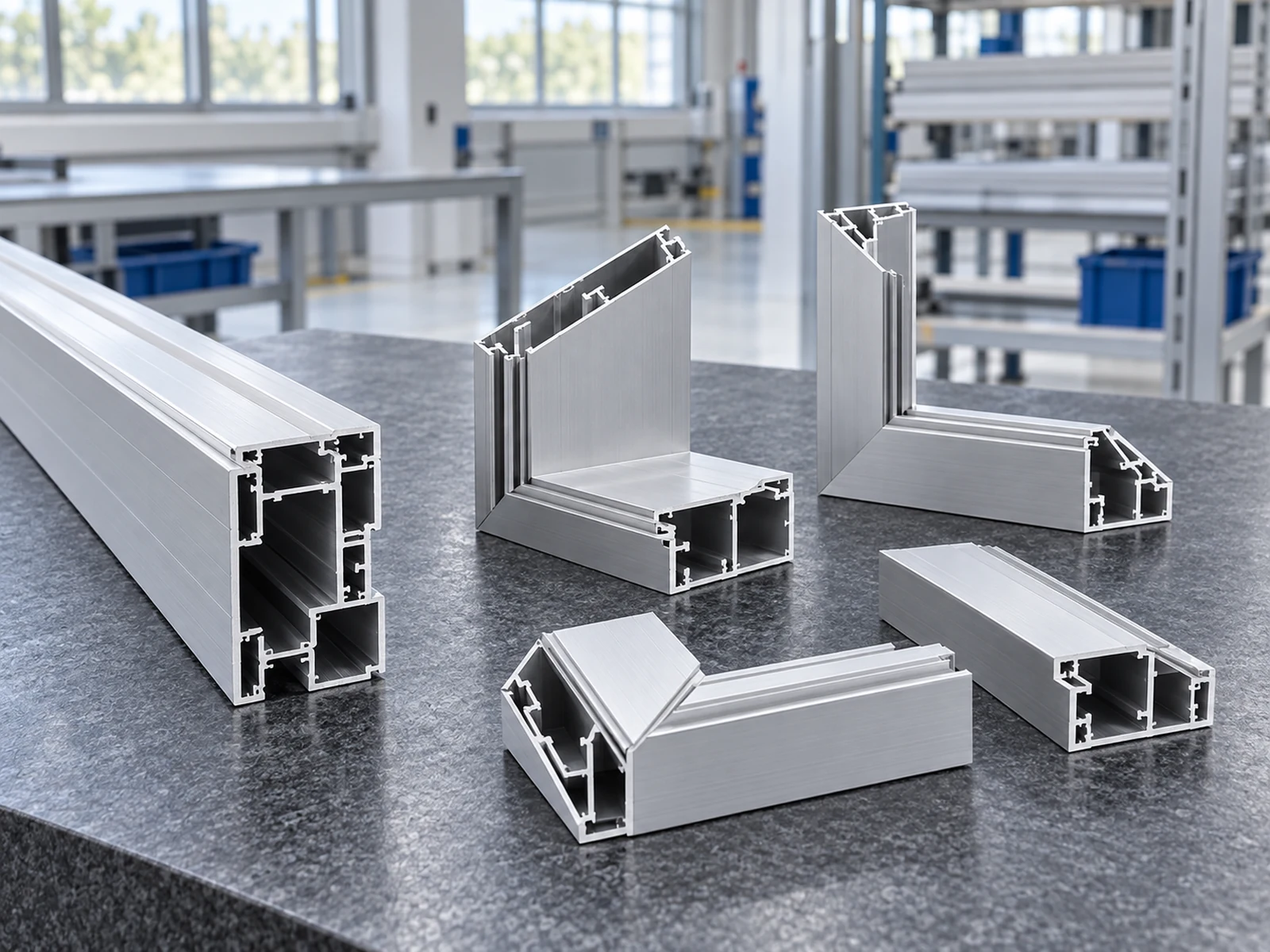
For a mitered set, ask for at least one trial pair and a documented dry-fit against the approved corner detail. A visually plausible angle alone does not prove gasket path, cover alignment, or final assembly fit.
5. Trial the real section, support, and visible face
Take the actual extrusion or approved sample to a supervised machine trial. Review the safe guarded opening, section orientation, clamp contact, stock support, and clearance for projections or fragile lips. Include both the longest practical member and a short repeat part if the order contains both. Compare the full cycle, including loading, measurement, first-off inspection, part identification, and removal.
For rooflight aluminum frame cutting, the trial should record observed cut-end condition, visible-face handling, and any distortion relevant to the released drawing. A clean photograph or a generic machine specification is not a substitute for a sample of the actual section. For machine-fit questions, the guarded-opening trial guide offers a related purchasing checklist.
Related Jiurun angle-saw footage
The following video from Jiurun’s own YouTube channel shows an industrial aluminum angle-saw example. It is a related machine demonstration only. It does not show this article’s rooflight material, approved member geometry, customer order, machine configuration for this RFQ, or verified rooflight performance.
6. Accept a complete member kit, not isolated cut pieces
Define what the receiving team needs to build or hand over one frame: the full member set, quantity, part and revision labels, face/orientation marks where required, protected surfaces, and a first-off fit record. Separate a raw cut blank from drilled, notched, joined, glazed, or sealed output. Put each remaining operation and inspection owner on the order rather than leaving it implied.
Inspect a representative first-off kit against the approved assembly fixture or system detail. If the frame does not fit, preserve traceable part identities so the cause can be assigned to cutting, stock, downstream machining, or the released design. A saw supplier’s cut sample cannot certify the finished rooflight or site installation.

7. Compare quotes using the same accepted output
Ask every bidder to quote the same approved stock, member mix, finishing stage, trial samples, inspection records, and delivery boundary. Include setup, tooling, handling, scrap from representative lengths, labor, rework, and external operations in the comparison. A low price per cut may be a high price per accepted kit if short parts, finish protection, or secondary features are excluded.
For a saw investment, request a documented trial on the real straight and angled member mix. Review the capacity of the whole route rather than one headline cycle time. The final machine choice should follow the approved drawings and observed sample results; no model, tolerance, yield, or lead-time guarantee follows from this general guide.
Rooflight aluminum frame cutting RFQ checklist
- Approved rooflight family, system owner, and drawing revisions
- Delivery stage: complete unit, prepared frame kit, or identified cut-member kit
- Eligible aluminum member list, quantities, lengths, end geometry, and datum
- Actual stock construction, finish stage, visible faces, and excluded nonmetal parts
- Longest and shortest representative trial parts, support and clamp review
- First-off end inspection, corner fit, labeling, packing, and receiving sign-off
- Separate owners for drilling, joining, glazing, sealing, testing, and site approval
Next step: For rooflight aluminum frame cutting, send Jiurun your released metal-member drawings, section samples or clear section photos, cut list, and required delivery stage through the contact page. We can discuss a suitable aluminum profile cutting trial against that material and scope. Keep rooflight system approval with your qualified system and project teams.