
Passive vs active heat sinks describes a cooling choice, not a choice between two guaranteed power ratings. A passive arrangement uses natural air movement. An active arrangement uses driven airflow, such as a fan or blower. Compare them using the conditions inside the product you are building.
For an industrial buyer, three situations make the discussion practical: fans are excluded, fans are permitted, or fan operation varies during use. Identify your situation first, then ask the thermal designer for evidence that matches it.
On this page
Passive vs active heat sinks: the cooling difference
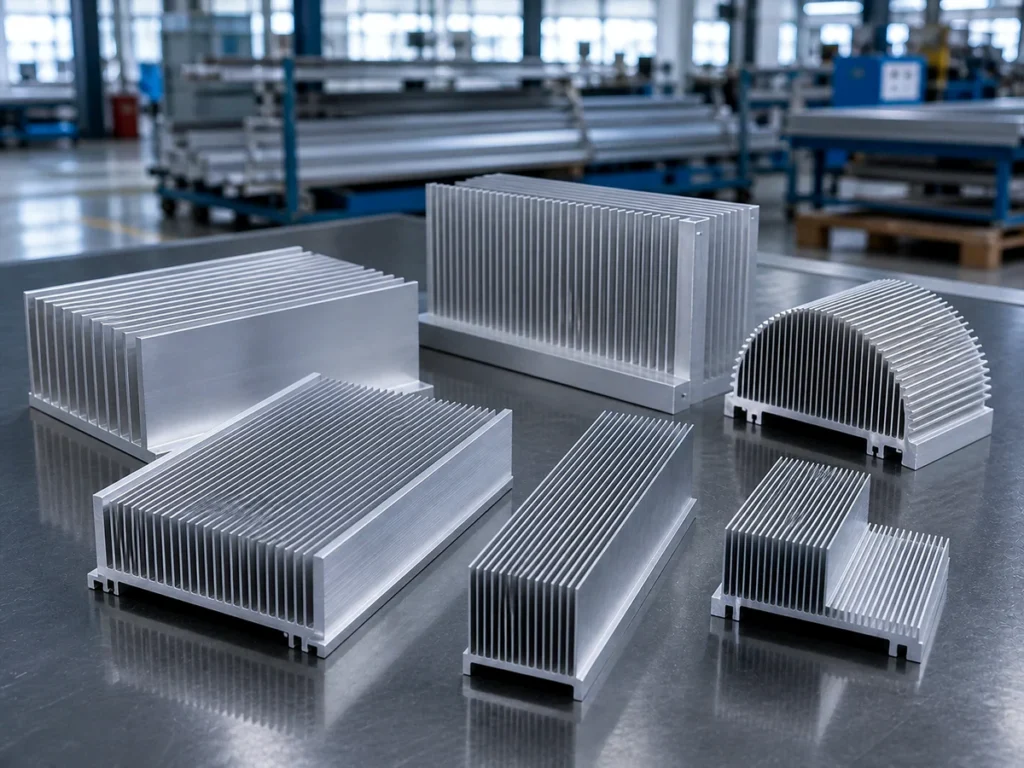
Advanced Thermal Solutions explains natural convection through buoyancy: air heated near a surface rises, and cooler air takes its place. The article also identifies geometry and orientation relative to gravity as relevant to that cooling behavior.
For a driven-air example, Eaton’s heat sink assemblies overview describes combinations of fabricated heat sinks and axial fans, with mounting and configuration options. That is an assembly example, not a rating for an arbitrary aluminum profile.
In this comparison, passive and active refer to airflow at the heat sink. State whether a separate enclosure fan supplies that airflow; a fan need not be attached directly to the sink for the thermal assessment to include driven air.
Choice 1: the product must be fanless
Write “no fan or blower in the cooling arrangement” as an explicit design requirement. Record the reason when it affects the supplier’s proposal, such as an acoustic target or a product architecture requirement.
Give the designer the actual installation orientation and surrounding enclosure geometry. Mark where air can enter and leave, along with adjacent components that occupy the same space. Ask for the assessment in that arrangement rather than accepting a photograph of an isolated profile.
ATS’s plate-fin discussion considers fin spacing and fin height together for natural convection. This supports asking about the proposed geometry; it does not supply one ideal fin spacing for every enclosure.
Confirm which mounting orientations are included in approval. If the product can be installed in several positions, list them individually in the review. Keep any unassessed position visible as an open design question.
Request the thermal result for the required operating conditions and the proposed mounting arrangement. Describe the temperature limits and measurement locations the responsible designer uses to accept the assembly.
Choice 2: a fan is permitted
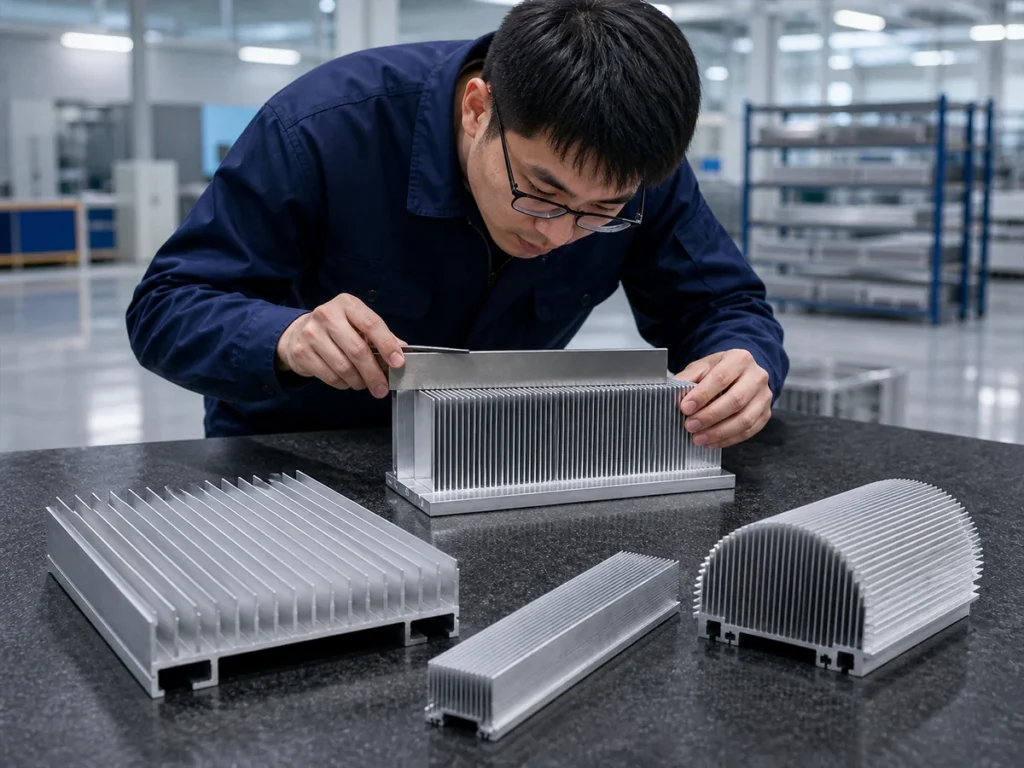
Define the fan as part of the proposed cooling arrangement. Ask which fan, control condition and installation layout support the submitted thermal result. Include ducts, guards and other components that form part of that layout.
Separate the fan’s identification from the complete assembly’s acceptance. Request a drawing that shows the intended air path and how the sink is installed. Keep the relevant thermal report connected to that drawing revision.
Discuss the purchase boundary: are you buying a cut aluminum profile, a machined sink, a sink-and-fan assembly, or the complete cooling solution? Assign responsibility for mounting hardware, interface materials and thermal approval before comparing prices.
For maintainable products, ask how the specified fan is identified and replaced. Record the approved replacement and the responsible service procedure. A substitute selected only because it fits the opening should return to the engineering review.
Review acoustic requirements separately from thermal acceptance. Specify the conditions under which an acoustic result is required so the supplier knows which operating state the evidence should cover.
Choice 3: fan operation varies during use
ATS notes that a fan failure changes the airflow regime. The purchasing implication is to identify which operating states the product designer must assess instead of treating the normal fan state as the whole requirement.
List the intended control states, such as a reduced fan setting or a permitted fan-off mode. Identify which states need continued operation, which need a reduced load and which require the product’s defined protective response.
Let the responsible system designer define those responses. A heat sink supplier’s component quotation should not silently become approval of the finished product’s fault handling.
| Situation | Question for the cooling review |
|---|---|
| Fanless product | Which heat load, enclosure and installation orientations are included in the natural-convection assessment? |
| Fan permitted | Which fan, air path and operating condition match the submitted assembly result? |
| Fan state changes | Which operating states are approved, and what response is defined outside normal cooling? |
Convert the cooling decision into a clear purchase
Once the thermal geometry is selected, make the manufacturing information equally clear. Provide the profile drawing, material requirement, finished length, mounting details and required surface condition.
Identify dimensions that matter to installation and interface contact. Explain which features arrive in the extrusion and which require later machining or assembly. The thermal resistance review helps keep performance evidence connected to its stated conditions.
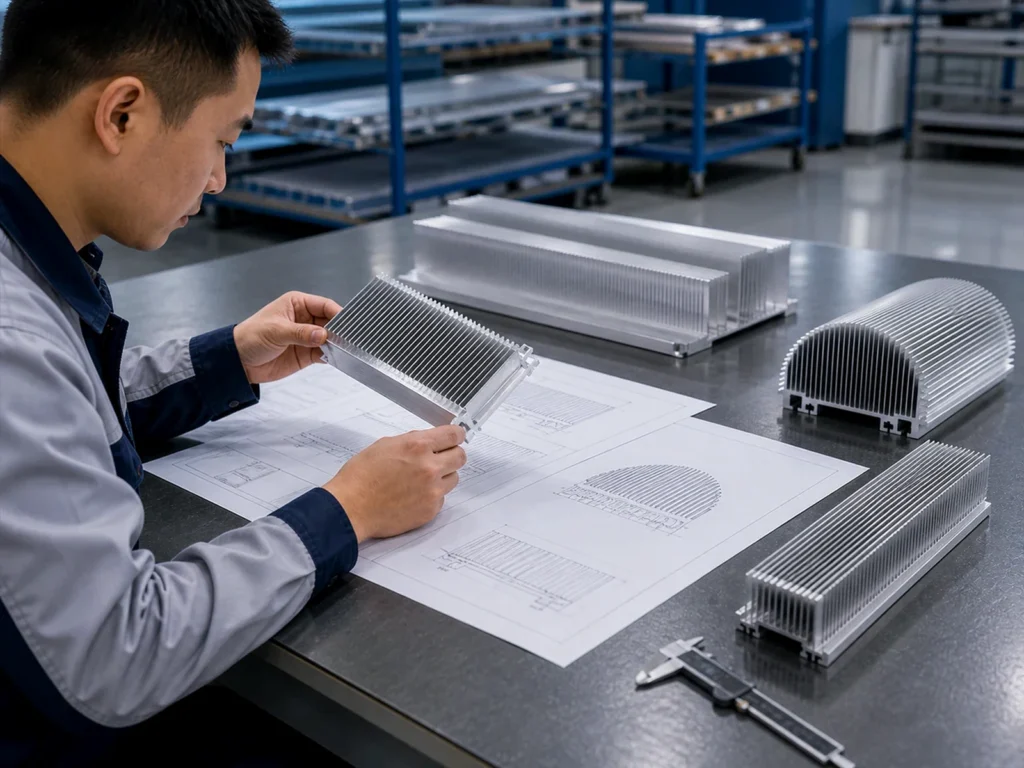
For cut profiles, specify how the fins and base may be supported during cutting and handling. Review a representative sample against the drawing before agreeing a production setup. See the thin-fin cutting guide for that separate manufacturing discussion.
Questions buyers ask
Are passive heat sinks always smaller or cheaper?
Compare actual proposals that meet the same product requirements. Size, manufacturing scope, installation and acceptance evidence belong in that comparison; the cooling label alone does not settle the purchase.
Can I add a fan to an existing profile and call it approved?
Identify the revised airflow arrangement and obtain the required thermal assessment for that configuration. Keep the revised assembly drawing and operating conditions with the result.
Does an extruded heat sink have to be passive?
The construction method and airflow arrangement describe different aspects of the solution. State both in the enquiry so the supplier assesses the intended assembly.
What should I send for a cutting-machine review?
Send the selected section drawing, stock length, finished cut lengths, material description and fin-handling requirements. Keep thermal-system approval with the responsible designer.