
Parcel sorter chute frame cutting is a purchasing question only after the sorter builder has identified which support members are approved aluminum extrusions. The divert mechanism, chute surface, conveyor, guarding and controls may come from different suppliers. A saw can produce drawing-controlled blanks; it cannot prove that a finished chute will sort parcels correctly or safely. The useful RFQ starts at the interface between the released frame kit and the rest of the sorting system.
A parcel line may have several destinations with different chute positions. Toyo Kanetsu’s parcel sorter example describes a sorter with multiple chutes, while Scaletronic’s sortation overview distinguishes the main line, divert and chutes. These are application examples from other suppliers, not Jiurun installations or evidence that every chute uses aluminum. Obtain the actual project drawing before quoting any cut member.

Locate the chute boundary before listing cuts
Begin with a controlled layout showing the discharge point, assigned destination, chute mouth, receiving surface, support points and access envelope. Ask the system integrator to identify which supplier owns the sorter, which owns the chute surface and which owns the stationary support. The answer can differ between a new line, a replacement chute and a relocation project. A request for “one aluminum chute frame” is insufficient when its legs, mouth brackets, side guides and anchors have different design owners.
Do not infer frame material from the word chute. Some chutes are sheet metal slides or non-powered roller conveyors. Even where a product uses aluminum profiles, its rollers, plates, plastic liners, fasteners, motors and site fixings are separate purchasing objects. A released aluminum extrusion schedule should be the input to a saw RFQ. If the approved structure is welded steel or a bought complete module, the aluminum saw may have no work in that purchase route.
Parcel sorter chute frame cutting: define the member schedule
For every approved aluminum member, record the chute or destination ID, drawing revision, section drawing, alloy and temper where specified, stock finish, length datum, end form, quantity and assembly stage. Identify handed left and right pieces rather than assuming the same cut fits both sides. A replaceable rail can look similar to a structural cross member while having a different mounting face or hole pattern. Give those lines separate part numbers and acceptance rules.
The frame schedule should also say whether the saw supplier is delivering loose blanks, a labeled cut kit or prepared parts with later drilling and joining handled elsewhere. Do not convert the final chute opening or incline into a raw cut length without the approved joint detail. Mitered ends need their own long-point or short-point reference. A straight end may require a different datum and stop arrangement. The design team, not the saw vendor, must release those dimensions.
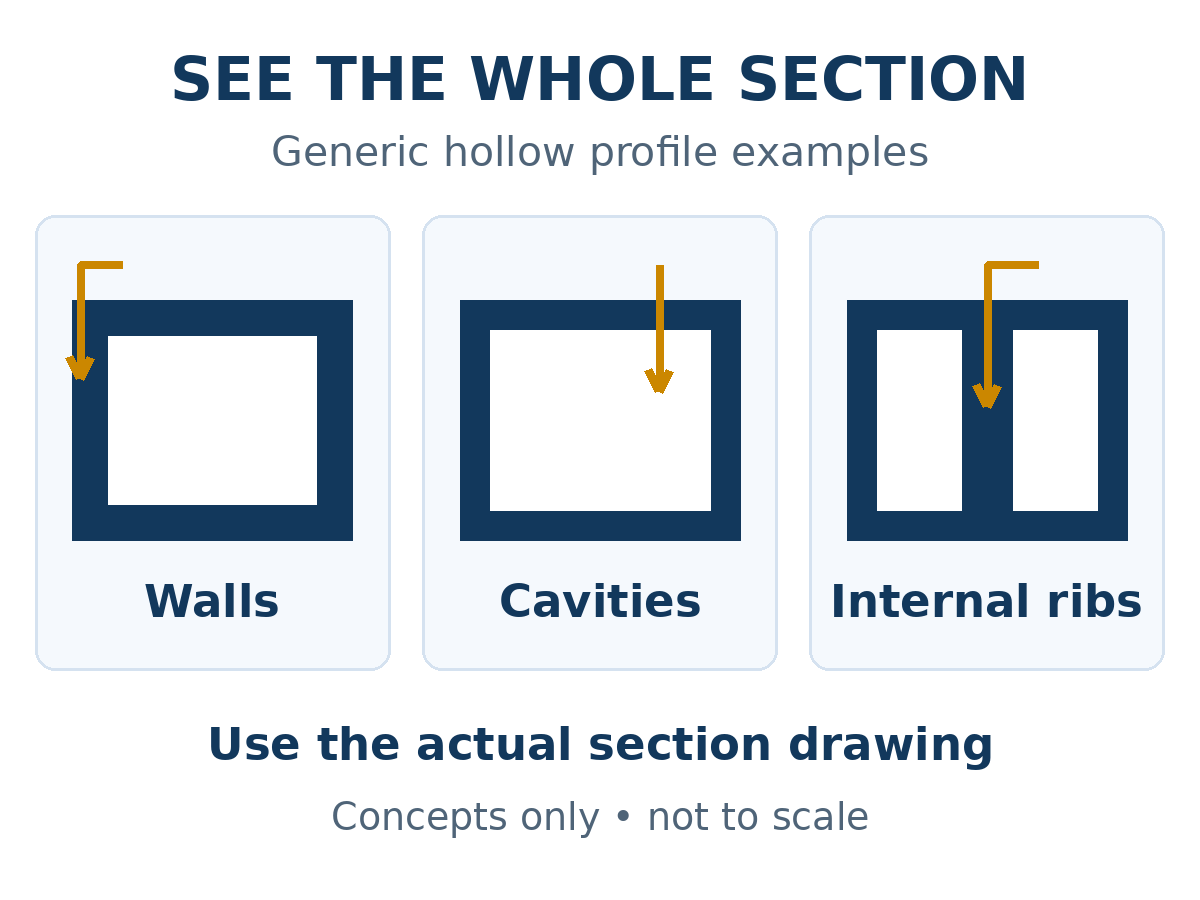
Send the real section and contact faces to the saw supplier
A nominal extrusion series does not tell a supplier enough about the profile that meets the blade. Send the complete section drawing and a representative physical sample. Mark the outside envelope, wall thicknesses, internal ribs, surface that may be clamped and face that must remain visible after assembly. Include the longest incoming bar and the shortest finished blank, as well as the ordinary production mix. Ask the machine supplier to state its proposed infeed, clamp, blade and outfeed arrangement for those specific sections.
Thin walls can be damaged by a contact position that works on a thicker rail. An open section may need support at a different face from a closed tube. Finished anodized or coated surfaces can impose handling limits. The buyer should compare the proposed contact arrangement with the part’s acceptance drawing and trial pieces. A photograph of a saw, a catalog capacity or a general statement that it cuts aluminum is not a qualified setup for the chute kit.
Trial the awkward blanks and the receiving joint
Choose samples by risk instead of submitting only an easy straight rail. Include the largest section, a narrow or flexible member, the shortest blank, any angled end and a piece with an important visible face. Log the stock batch, blade, machine, clamp location, feed setup and operator instructions actually used. Measure finished length from the defined datum, inspect the end form and burr, and check for visible deformation or surface damage. Let the assembly owner fit the sample into its released bracket or joint.
If the destination variant changes the chute mouth or support position, trial the affected member again rather than carrying forward an unrelated sample result. A successful fit on one joint does not approve every chute position. The test can establish only the cut attributes that were measured for that material and setup. It does not validate divert accuracy, throughput, parcel damage, fall protection, guarding or site structural loading. Those are separate system acceptance responsibilities.

Compare a saw purchase with bought cut kits
The economic comparison should use the same accepted handover point. If the integrator already buys complete chute modules, it may need an assembly supplier acceptance process rather than another saw. If it buys labeled cut members and performs joining in-house, compare that quote with an in-house saw route. Include stock procurement, changeover, first-off inspection, offcuts, labeling, handling space and the cost of correcting a wrong variant. A machine price alone cannot answer the decision.
Ask each bidder for a scope list: saw, blade, clamping fixtures, stock supports, part removal, any marking step, commissioning trial, training and the sample evidence to be delivered. Record items supplied by the buyer or downstream builder. The quoted saw must be demonstrated on the actual member family and accepted output, not assumed compatible because another machine in the workshop cuts a similar rail.
Release a complete, traceable chute kit
Mark every bundle with project, sorter line, chute destination, variant, drawing revision, member IDs, quantities and receiving assembly stage. Separate replacement spares from a complete new-build kit. A kit should not be labeled complete while a handed rail or special bracket blank is missing. The receiving team must be able to reconcile the bundle with the released schedule before drilling, fastening or installation. Our guide to saw output traceability explains that handoff in more detail.
For related structural purchasing boundaries, see the industrial equipment frame guide. Its general frame advice does not replace the chute-specific destination, discharge and interface records above. Keep the chute revision and system approval with the responsible integrator.
Six RFQ questions to send now
- Which chute and sorter variants have a released aluminum member schedule?
- Which parts are extruded saw-cut blanks, and which are sheets, rollers, brackets or complete bought modules?
- What are the section drawings, reference faces, end forms, longest stock and shortest accepted blanks?
- Which clamp, support, blade and part-handling configuration will be trialed on representative stock?
- Who accepts the cut sample and joint fit, and who approves the complete sorter and site installation?
- How will complete kits, handed parts, replacements and revision changes be labeled and received?
Related equipment video
The following video from the Jiurun Machinery channel shows general aluminum saw equipment activity. It does not document this parcel sorter, chute material, proposed configuration, customer job, sample result or performance guarantee.
Need a cutting proposal? Send the released chute support member schedule and representative profile drawings through our contact page. We can discuss a saw trial for those blanks while the qualified integrator retains responsibility for the complete sortation system.