
A correctly sized panel may still be difficult to seat if its aluminum edge member was cut from the wrong reference. For noise barrier aluminum edge extrusions, the buyer first needs the approved system drawing: which aluminum member captures an edge, where the gasket sits, and whether the member is cut square, mitered, drilled, or fitted after cutting. A saw quote for a loose extrusion blank covers only the stated cut operation. It does not establish the installed barrier’s acoustic, structural, or weather performance.
This guide is for a fabricator comparing an aluminum saw or purchasing cut aluminum members for a noise barrier panel kit. It uses published installation examples to show why the cut list must follow the actual system. It is not a fabrication instruction for either example system, and no Jiurun machine has been qualified here against those products.
Identify noise barrier aluminum edge extrusions by role
“Noise barrier” describes the assembled job, not one interchangeable aluminum extrusion. One published ACRYLITE Soundstop masonry-wall installation sequence refers to a bottom aluminum support, gaskets, and aluminum members fitted to panel edges. A different Acoustiblok panel system presents extruded aluminum T-bar and corner connectors. Those examples establish that the metal part and its interface vary by system; they do not supply dimensions for your project or prove that either part is made on a Jiurun saw. See the ACRYLITE Soundstop installation information and Acoustiblok’s connector overview.
Ask the system designer or approved fabricator to identify each extruded member on a current revision of the assembly drawing. Is it a bottom support, a vertical edge retainer, a T-bar between panels, a corner connector, or a separate cover? Is it supplied as a long extrusion, as a cut and drilled component, or as part of an assembled panel? If the purchased item is a finished cassette or a preassembled edge, a loose-stock saw trial may be the wrong purchase test.

Keep three dimensions separate on the cut list
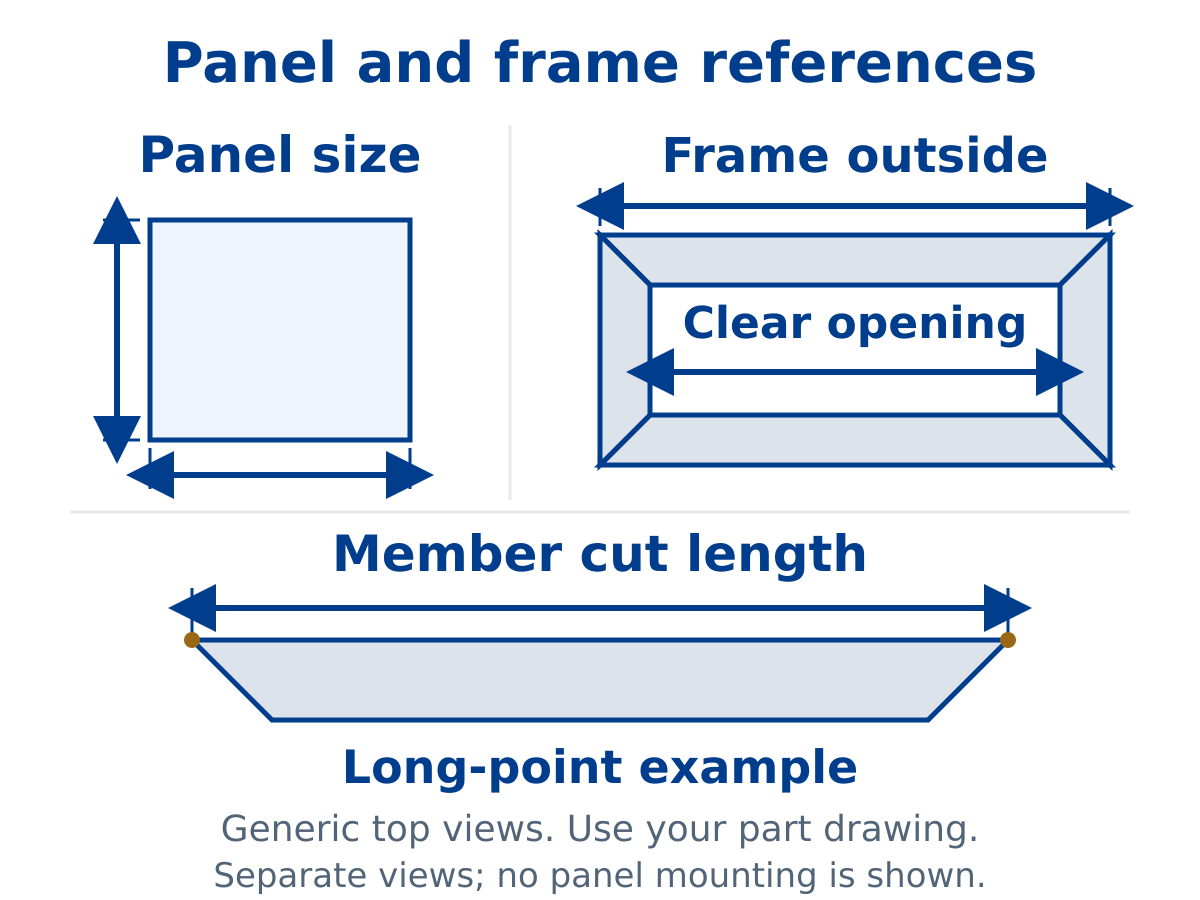
A panel outside dimension, the clear opening between supports, and the saw-cut length of an aluminum member can all be different. The relationship depends on the released section, edge engagement, gasket compression, end joint, and installation method. Do not subtract a convenient allowance from a panel width and call it the saw program. Put a dimensioned drawing or approved cut schedule beside every member code.
For each member, state the reference points: overall long point or short point for a miter, flat cut face for a square end, and the datum face used by the stop or feed system. Mark left and right hands where the section is asymmetric. A cut length that passes on the wrong reference may still leave the panel edge unsupported, close the wrong joint, or place the next drilling operation in the wrong location. The saw operator should not infer the panel fit from a photograph.
Separate saw work from gasket, drilling, and installation work
Make the handoff explicit before a machine is selected. A saw may produce an aluminum cut blank with specified length, end angle, and cut-face condition. It does not automatically drill anchor holes, cut or place a gasket, press the edge member onto a panel, or verify the completed barrier. In the ACRYLITE example, the published installation sequence distinguishes the bottom support, gasket preparation, panel-edge work, and later positioning. That is a useful reminder to list these stages separately, not a universal sequence or dimension for every barrier.
- Incoming stock: record the extrusion drawing, alloy and temper if specified, finish, stock length, and allowed contact faces. Confirm whether any gasket, insert, fastener, or panel is already attached. A trial of bare metal cannot silently approve cutting an assembled part.
- Saw output: name the member code, quantity, end form, measurement datum, length tolerance from the released drawing, permissible burr or edge condition, and how short offcuts are separated.
- Downstream operations: assign drilling, gasket cutting, edge assembly, sealing, anchoring, and installed-system inspection to the responsible party. Require its acceptance criteria in the project documents.
For an outsourced cut kit, the pack list should preserve the member code, revision, hand, quantity, and accepted sample identification. A frame assembler needs to know which blank belongs to which bay. Mixing similar-looking supports and covers can defeat a perfectly accurate saw cut. If a site team intends to trim a member to fit, say whether that is permitted and who owns the resulting cut-face protection and fit check.
Run a saw trial against the real aluminum section
Choose representative stock from the intended supply route, including the longest or most awkward member and any thin lip or open channel that changes clamping. Photograph the section orientation and the intended jaw contact. Check that the support and clamp hold the metal without crushing a groove or marking a visible surface. Then inspect length from the stated datum, end angle where applicable, burrs at the panel-contact edge, and repeatability across a short sequence. Keep the actual accepted pieces for the frame-fit review.
A useful trial has a rejection rule. If an edge member rocks in the fixture, if a cut leaves a burr where a gasket must seat, or if a finished face is visibly marked beyond the project allowance, record the condition and revise the fixture or process before approval. Do not convert a generic catalog saw image, a single clean sample, or a claimed machine specification into a signed result. The selected blade, clamping method, stock condition, and output inspection must be witnessed for the intended part.

Buy for the member portfolio and the handoff
One barrier project may have a few long, straight members; another may include short connectors and multiple handed pieces. Ask whether the planned saw can support the longest stock, clamp the least stable section, reach the specified end forms, and keep part identity through outfeed. The economic comparison should include accepted pieces per shift, changeover and inspection time, waste from the last stock length, and the labor needed to sort the cut kit. A higher nominal cut rate is not useful if the assembly team must remeasure every part.
Do not presume the same machine should cut transparent panel, gasket, aluminum extrusion, and installed assembly. Their materials and acceptance routes differ. If your company only makes the aluminum blanks, scope the quote to that work. If the same supplier will provide a complete panel kit, request a separate, documented assembly and field-fit responsibility. For another example of that boundary, see our acoustic test enclosure frame RFQ guide; for a replacement decision, see the panel-versus-frame review.
What the equipment video actually shows
The following video from Jiurun’s own channel shows an aluminum saw from the JR-455Q family as general equipment context. It does not show a noise barrier member, a specific panel or gasket system, a customer application, or an accepted cut test for this article. Use it to discuss access and workholding, then request a trial with your released section.
Send a cut-member RFQ that can be checked
Send the approved system and extrusion drawings, the revisioned member schedule, sample stock, finish and visible-face rules, required end form and measurement datum, anticipated quantities and longest length, and a drawing-based cut acceptance sheet. Say which downstream party owns gasket, drilling, panel assembly, and site installation. Ask the saw supplier to return actual part-trial observations and any fixture or blade conditions needed to meet the defined output. Keep installed acoustic and structural acceptance with the project’s qualified system parties.
If you are specifying aluminum edge members for a noise barrier project, send Jiurun the released extrusion section and cut schedule. We can review the proposed saw-cut scope and what a representative trial would need to demonstrate before a machine recommendation is made.