
JR-510CNC-3A-1S tail pulling is a quotation question, not a shortcut to a waste percentage. The catalog calls this a tail-pulling automatic crosscutting platform and also uses no-tail cutting language. Those phrases do not, by themselves, tell a buyer what happens to the final piece of a real bar, which gripping arrangement is included, or how the remaining material will be counted. Ask the supplier to show the sequence for your profile and cutting list before treating either phrase as an accepted result.
This checklist is for a purchase decision on the JR-510CNC-3A-1S. It focuses on the last-bar operation and the contract boundary. For the broader accounting of kerf, trim and usable remnants across any saw, read our guide to zero-tail claims and material waste. The two questions belong together, but they are not the same question.
1. Reconcile the catalog label with the quoted configuration
Jiurun’s catalog page 9 places the JR-510CNC-3A-1S in a tail-pulling machine family. The entry also describes no-tail cutting. The site’s energy-storage machine-direction page treats this model as a possible direction for changing cutting lists and calls it a tail-pulling configuration. It explicitly leaves the final machine, support, clamp and trial scope to an engineering review. A buyer should therefore request the catalog revision, the precise machine and option list, and a written explanation of what each tail term means for that release.
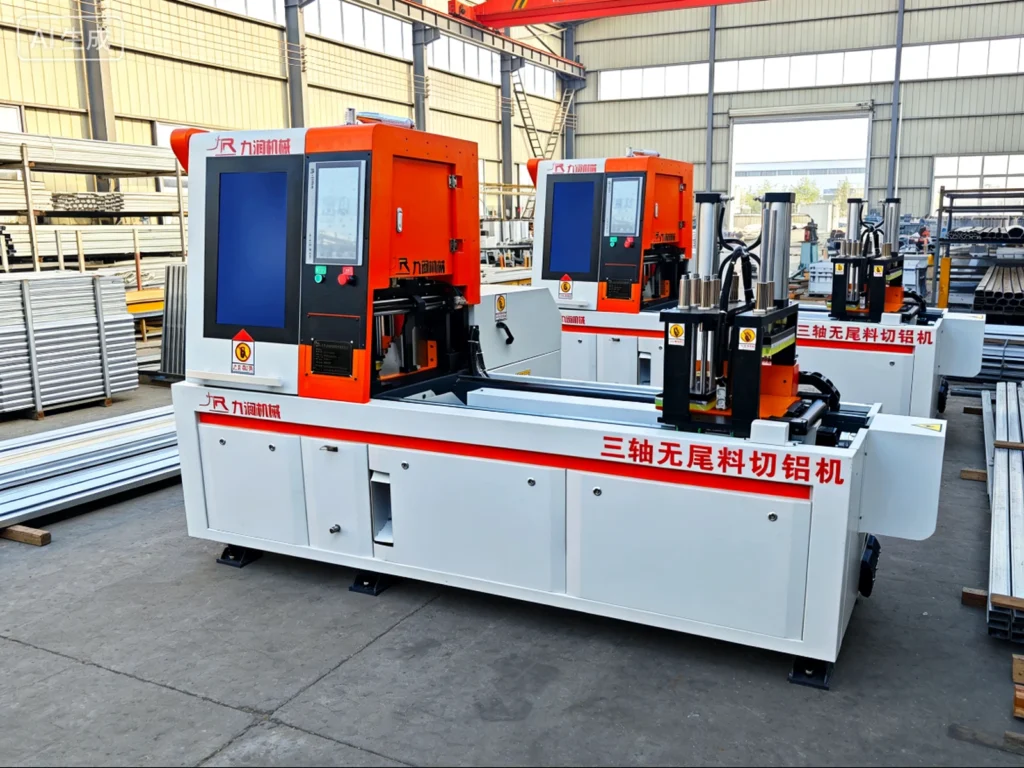
Ask for one drawing or short operation sequence showing the gripping point, movement of the bar near its end, the cutting position, and the route taken by the finished part and any remnant. Ask which movements are automatic, which require an operator, and what the machine does when the remaining length cannot produce another accepted part. The answer should identify the exact configuration in the offer. A photograph of a similar saw cannot establish its installed gripper, sensors, software sequence or guarding.
2. Follow one bar from the first trim to the last accepted part
Use a real stock length and a complete order list, rather than a single demonstration cut. Record the starting bar length and condition, the first-end trim rule, each required finished length and quantity, the blade kerf allowance, any required end re-trim, and the rule for accepting a leftover as reusable stock. Keep reusable offcuts separate from unusable tail and rejected parts. This lets the supplier explain where each piece of material goes without claiming that no-tail handling eliminates the saw kerf or guarantees full use of the bar.
The most revealing point is the transition into the final cuts. Which surface or datum does the puller grip after the normal feed sequence is nearly exhausted? Is the last target length still positioned and held under the same agreed method? How does the machine release an accepted part, and where does any remainder land? Ask the supplier to demonstrate the exact last-bar state, including an interruption or a bar too short for the next programmed part. Record what an operator must do to recover safely. Do not infer those steps from the machine-family name.
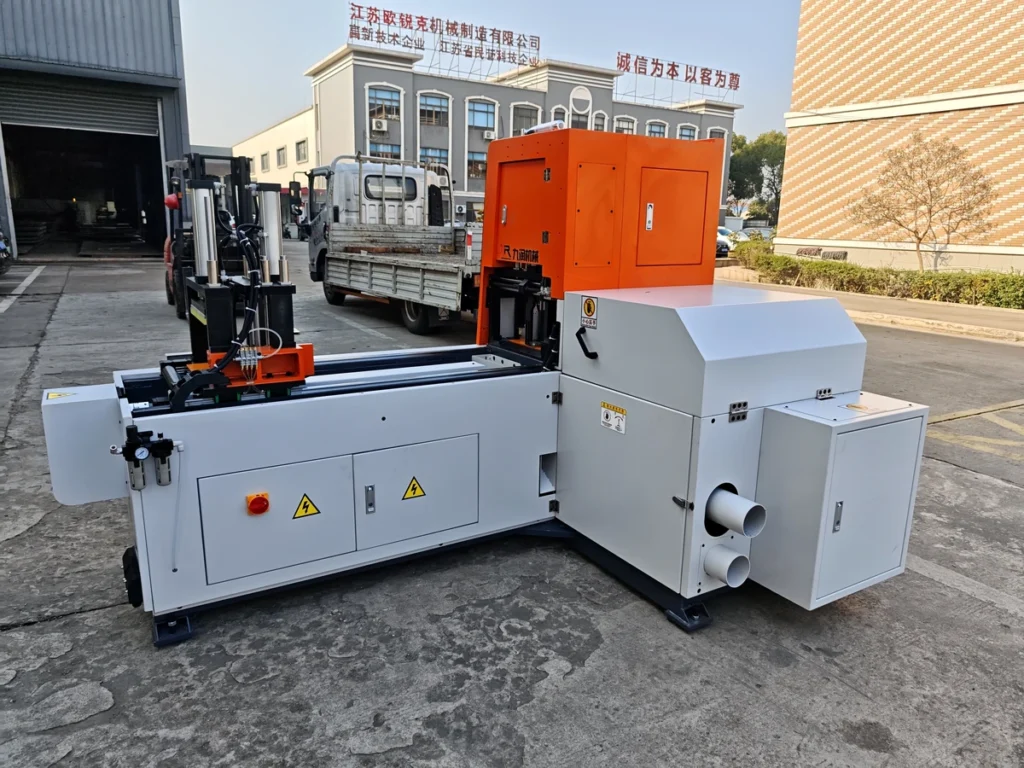
The following equipment view shows a saw and clamp area only. It does not document the JR-510CNC-3A-1S tail-pulling sequence or a tested last-bar result.
A useful purchase record has four columns: planned event, observed action, resulting piece, and disposition. For example, the final accepted cut may produce a finished part plus a reusable remnant, or it may leave a non-reusable short piece. Record the actual result of the representative trial; do not fill it in from a promised saving percentage. If several stock lengths are purchased, repeat the calculation for the stock lengths that materially change the final-cut condition.
3. Separate feed stroke from finished-part length
The model’s catalog family has feeding-stroke data, and the current energy-storage page lists a 1,000 mm single-feed stroke for its JR-510CNC-3A-1S reference. That number describes one machine movement under the cited configuration. It is not automatically the maximum finished-part length and it is not a finished-part measurement result. A long part may require a different handling or repeated-feed plan, while a short part may still be difficult if its section cannot be supported and gripped reliably. Ask the supplier to show the proposed sequence against both your shortest and longest accepted parts.
The same site presents cutting height and width as separate maxima and warns that they are not a guaranteed rectangular envelope for every profile. Send the actual cross-section, wall thickness, cavities, protected surfaces and stock straightness requirement. Mark the desired cut orientation and where clamps may touch. A drawing review should decide whether your section can be supported without deformation or unacceptable marks through the last-bar stage. Do not combine numbers from other machines in the catalog table or quote the model name alone as proof of fit.
4. Design a last-bar acceptance trial that can fail clearly
Agree on trial stock, the cutting list and inspection method before a supplier runs the saw. Include at least one common profile and the profile most likely to challenge clamping or support. Include a normal repeated length, the shortest finished length that matters, and a mixed-length sequence if the real production order contains one. State the raw-bar lengths, required quantities, cut orientation, accepted end condition and the disposition rule for remnants. If the project involves a frame, identify the assembly datum and one mating check.
During the run, observe the normal feed, transition to tail pulling, last accepted cut, part collection and leftover handling. Keep a count of accepted parts and the mass or length of each remaining category under a defined measurement method. If a piece is reclassified as reusable, state its minimum acceptable length, condition and identification procedure. If a cycle stops, note the cause and the required restart steps. These observations are more useful to a buyer than a clip showing a single clean cut.
Finished-part quality needs its own checks. Measure the agreed finished length from the agreed datum, inspect the cut face and visible surfaces, and compare consecutive pieces where repeatability matters. The catalog’s accuracy wording should not be converted into a blanket guarantee for every finished part, profile and setup. Write the acceptance limit and measurement method for your job into the trial plan. Where the downstream frame or fixture is available, check that a representative cut part actually fits its mating interface.
For context, the official ISO 230-2:2014 scope concerns positioning accuracy and repeatability of numerically controlled axes. That scope is different from accepting the length, surface and assembly fit of your sawn parts. Use the agreed finished-part drawing and inspection method for the buying decision.
Related equipment video from JiurunMachinery: the clip below shows a general automatic aluminum-saw example. It does not show the JR-510CNC-3A-1S configuration quoted here, the buyer’s profile or customer, a last-bar trial, or any performance result.
5. Put the result into the quotation, not only the sales conversation
Ask the seller to attach a configuration schedule to the offer. It should identify the exact JR-510CNC-3A-1S release and revision, saw and control arrangement, pulling or gripping equipment, stock support, clamps, part collection, remnant handling, guarding, extraction interface and any optional racks. List what the buyer must supply: raw stock, electricity and air requirements as confirmed for the release, floor space, extraction or bins, operators and inspection tools. An illustrated brochure component is not automatically included in the priced machine.
Include the representative cutting list and acceptance method as a separate annex. Name who supplies trial stock, who witnesses or receives the trial evidence, which pieces are retained, how rejected and reusable leftovers are identified, and what happens if the observed sequence cannot meet the agreed part or handling requirement. If the production mix changes before purchase, identify which assumptions must be rechecked. This makes a later comparison between two offers possible without comparing unlike equipment scopes.
The decision rule is practical: approve the machine direction only after the supplier can explain and demonstrate the last-bar sequence for your stock, profile and finished-part requirements, and the price includes the equipment needed to reproduce that sequence. If the evidence is incomplete, request a configuration answer or representative trial rather than treating “tail pulling” or “no tail” as a guaranteed outcome.
Questions to send with the JR-510CNC-3A-1S RFQ
- Which catalog revision and exact configuration does this offer use, and what does “tail pulling” mean in its operating sequence?
- Which gripper, clamp, support and collection components are included in the quoted price?
- How are the last accepted part, reusable remnant and unusable tail separated and measured for our complete cut list?
- What is the sequence for our shortest and longest parts, and what operator action is required at an interruption?
- Which profile faces may contact guides or clamps, and how will our accepted cut-end and finished-length criteria be checked?
- What evidence will be delivered with the trial: cutting list, machine settings, part IDs, measurements, photos or witnessed samples?
Send JiurunCut your profile drawing, stock length, finished lengths and quantities, protected surfaces, and target output through the engineering contact page. Ask for a version-specific JR-510CNC-3A-1S configuration schedule and a last-bar trial proposal. The result should describe what is supplied and what is actually verified on your material.