
A double-head aluminum saw can prepare both ends of a profile in one planned production route, but a two-head photograph does not define the finished-part length you will receive. For a JR-505CNC inquiry, the useful buying question is more specific: which two end planes, datum, profile orientation and inspection method will the quoted machine reproduce on your actual part family? Answer that before treating a catalogue length range or a positioning figure as an acceptance promise.
This guide is for buyers who already have a candidate double-head direction and need a measurable quotation and trial. If you are still deciding whether one or two cutting heads suit the work, first read the single-head versus double-head comparison. The steps below turn a selected part drawing into a test that an engineer can quote and a buyer can witness.
1. Confirm which JR-505CNC arrangement is being quoted
Jiurun’s catalogue uses the JR-505CNC name on adjacent machine descriptions. One page describes a multi-head angle-cutting application; another describes a double-head automatic corner saw. Do not combine their drawings, angle statements, cycle descriptions or capacity figures into one guaranteed machine. Ask the supplier to name the exact release, machine layout, head arrangement, control version and optional equipment in the offer. Request the drawing or configuration schedule that belongs to that release.
The double-head catalogue table gives a listed finished-length range of 600–2600 mm for its stated arrangement. Treat that as a prompt for a version-specific capacity check, not a promise that your shortest, longest or most difficult profile can be clamped and cut to acceptance. The part’s section, miter direction, fixture, support and working clearance all matter. If the seller proposes a different head or feed arrangement, obtain a separate answer for that configuration rather than transferring the table across versions.
Ask for a cycle description in plain steps. Which head moves? Where is the first end located? How is the second end established? Does the part stay in one orientation, or does an operator turn it? Who handles the finished part and offcut? These answers reveal what the price actually buys. They also let your team compare another supplier’s quotation on the same work, rather than comparing two machines that solve different tasks.
2. Put both end cuts and the length datum on one drawing
Mark the finished part as End A and End B. For each end, record its required angle, viewing direction, acceptable face and the side of the profile that must remain protected. Draw arrows showing the loading orientation and the direction in which each angle is measured. A label such as “45 degrees both ends” is incomplete if it does not tell the operator whether the miters oppose each other, run in parallel, or refer to an inside or outside face.
State the finished-length datum separately. Is the required dimension between the outermost points of two miters, between their short points, between defined functional planes, or from one machined feature to an end face? A machine can repeat a programmed movement while an inspector measures a different geometric span. Give the supplier a marked drawing and a sample measurement sketch. If a mating bracket, battery-tray side member or frame corner sets the functional length, identify that interface. The JiurunCut EV cutting solution likewise frames model choice around section, datum, support and fixture contact, rather than a model name alone.
Do not turn a catalogue positioning statement into an unconditional finished-part tolerance. Sawing adds blade, clamp, thermal, profile and inspection effects. Define the acceptance band on the finished drawing, agree the gauge or method, and measure actual cut pieces. If your plant uses an axis-positioning standard, keep its scope distinct from acceptance of the sawn component; ISO 230-2:2014 concerns positioning accuracy and repeatability of numerically controlled axes.
3. Make a representative two-end cutting list
One easy specimen cannot represent the whole order. Prepare a small trial matrix with the profile identifier, alloy or temper if relevant to the job, cross-section drawing revision, raw stock length, finished length, End A angle, End B angle, cut quantity and protected surfaces. Include the shortest and longest requested parts, a frequent production length, and the angle combination most likely to challenge access or clamping. Where more than one profile family shares the proposed saw, include the one with the most awkward wall, cavity or visible face.
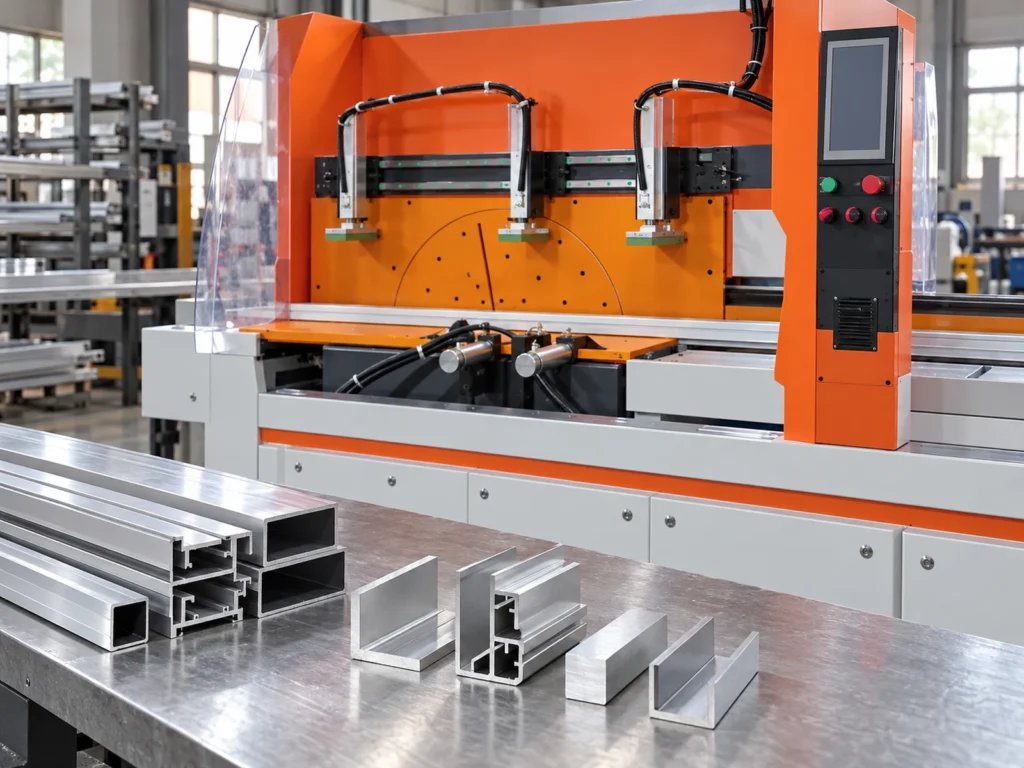
For each row, add the datum and inspection method. Identify which offcut is acceptable for reuse and which is scrap. Record a planned sequence of lengths, not only isolated settings, so the supplier can show changeovers, handling and leftover classification. Ask who supplies stock for the trial and whether a sample is retained by both sides. Without this list, the seller may demonstrate a convenient profile and leave the order’s limiting case unanswered.
Do not assume that a short listed part is feasible merely because its nominal length lies inside a brochure range. The head travel, fence, guarding, part collection and clamp footprint need room around the real section and both saw paths. Ask the supplier to mark any rows that require a different fixture, manual intervention or a revised cutting route before a quotation is accepted.
4. Check contact, support and the end-to-end sequence
The position of each clamp matters to surface quality and length stability. On the drawing, shade cosmetic faces, coatings, sealing lands, thin walls and features that cannot carry a clamp load. Ask the seller to show the proposed contact faces and supports at both heads. A large or hollow section may need support between the heads or beyond the cut; a visible extrusion may need pads or a different orientation. These choices belong in the quoted configuration and trial plan.

Observe the complete route: place and orient the stock, locate End A, close the required clamps, cut the first end, position or transfer for End B, cut the second end, release and collect the part. Note whether the cut sequence creates a trapped piece, an unsupported offcut or a surface contact you did not approve. Then stop the cycle at a planned point and ask the operator to restart. The restart path should preserve part identity and prevent an unnoticed repeat cut or reversed orientation.
Related equipment video from JiurunMachinery: the clip below is a general automatic aluminum-saw example. It does not show the JR-505CNC double-head arrangement, the buyer’s profile or customer, a two-end trial, measured parts, or any performance result.
For a changing production mix, request a timed demonstration of the necessary setup actions only if throughput is a real buying criterion. State what the timing includes: loading, angle change, clamping, two cuts, unloading, inspection and disposal of offcuts. A single machine-only cycle number cannot describe an operator’s full production route. Record what you actually observe; do not accept a performance claim inferred from a video or an illustration.
5. Inspect the output as a pair of ends
Label consecutive trial parts with their cutting-list row and sequence number. Measure the agreed finished-length datum on each. Check End A and End B angle orientation and cut-face condition separately. Where assembly fit matters, test a representative cut part against the mating fixture or component. A part can meet a length reading yet fail at a corner because a miter faces the wrong way or a protective face was marked.
Agree who measures, with which tool, under what setup and at what point after cutting. Record the actual observations beside the acceptance limits, including rejects and adjustments. If the supplier changes a program or fixture during the trial, note the change and repeat the affected rows. A collection of attractive cut-face photos is useful context, but it does not replace identified parts, measurements and a witnessed sequence.
Ask the supplier to explain any row the proposed double-head route cannot complete. It may still be the right machine for the majority of work, but the remaining operation must be included in your production plan and price comparison. The decision is about the complete part family and purchased scope, not the head count by itself.
6. Write the result into the JR-505CNC quotation
Attach the drawing revision and trial matrix to the request for quotation. Ask the offer to identify the exact JR-505CNC version, two-head arrangement, angle and length range for the quoted release, clamps, profile supports, guarding, control functions, part collection and any optional fixtures. Separate included equipment from buyer-supplied stock, extraction, utilities, inspection gauges and handling space. Do not infer that a component pictured in a catalogue or media-library illustration is included.
State the acceptance route in the same annex: which trial rows will be run, how the two end cuts and finished length will be measured, what physical samples or records will be delivered, and what happens if a row fails. Ask the supplier to answer deviations before the purchase order. This makes the trial a purchasing decision tool rather than a sales demonstration with undefined success criteria.
Questions to send with your two-end saw RFQ
- Which JR-505CNC catalogue page, machine release and head arrangement does this offer actually price?
- Which point or plane defines finished length for each of our mitered parts, and how will you measure it?
- Can the proposed clamps and supports hold our shortest and longest profiles without touching protected faces?
- How will the machine produce our End A and End B angle directions in the required loading orientation?
- Which parts of the two-end cycle, setup, inspection and offcut handling require an operator?
- What identified trial parts, measurements and configuration records will we receive before acceptance?
Send JiurunCut the profile section, the two-end drawing, your cutting list and protected-face notes through the engineering contact page. Request a version-specific double-head proposal and a representative trial plan. The resulting offer should make clear what is supplied and what has actually been verified on your material.