
Ice rink dasher board frame cutting is a small but consequential part of an engineered rink package. A saw can prepare drawing-approved aluminum frame members. It cannot, by itself, qualify the assembled board, its anchors, gate, shielding, impact response, or installation. If your team is buying a saw or outsourcing cut blanks, the useful question is exactly which members you are allowed to make, under whose released design, and what evidence will release the first batch.
System designs vary. Athletica’s PRO Series overview describes aluminum box-extrusion frames and concealed mechanical fasteners, while Becker Arena’s system overview describes aluminum or steel welded frame options. Their details belong to those suppliers, not to Jiurun equipment or an interchangeable standard. Athletica’s installation manual assigns panel locations by shop drawing and panel number. Use these sources to understand why an approved system drawing must lead the cutting RFQ; do not copy a supplier’s member dimensions or joint design into another system.
1. Define the purchased output and design authority
Write one line at the top of the RFQ: cut aluminum blanks, position-labeled frame-member kit, fabricated frame, or complete installed dasher panel. These are different purchases. The first may need only cut length and end condition; later stages can include holes, fasteners, welding, facing, gate hardware, shielding interfaces, and final system acceptance. Ask the board-system owner to release the drawing revision and state whether your shop may produce replacement members at all. For proprietary or certified systems, obtain written approval for the part, process, inspection and installation route before pricing an independent cut. A saw demonstration is not permission to alter an engineered assembly.
2. Split the panel map into real member families
A rink package can contain straight panels, curved perimeter sections, player and service gates, return pieces, and transitions to shielding. Do not turn the overall rink perimeter into one generic cut-length list. Start from the approved panel schedule: panel number, location, orientation, frame-section identity, each member’s position, and the mating components. Identify the quantity of each family and any pieces that cannot be made from ordinary straight stock. If a supplier delivers prepared panels, distinguish their bought-in work from the aluminum blanks your shop will retain.

Keep source stock and finished cut members separate in the quote. The source bundle may have a nominal length and extrusion lot; the output requires part marks and an accepted cut length. This distinction affects nesting, short-piece handling, traceability, packaging and the real cost per accepted panel kit.
3. State the length datum and end geometry
For every member family, supply a released drawing that identifies the measured length datum. Is it cut face to cut face, centerline to centerline, or a joint-related assembly dimension? Are the ends square, angled or prepared for a system-specific connector? The answer must come from the approved design, not from a convenient sample or a general 45-degree assumption. If end plates, concealed fasteners or weld preparation are needed, specify whether they are outside the saw operation and who performs them. The inspection plan should name how length, end angle, burr and visible-face condition are checked on the actual section.
Protect the revision identifier. A design change to a gate, end plate or panel joint can change the member length even if the nominal rink outline is unchanged. Reject unlabeled sketches and mixed revision bundles before a stop is set. For a separate example of how frame supply routes affect a saw RFQ, see our square-tube kiosk frame guide; its construction is not a rink-board specification.
4. Trial support and clamping on the approved extrusion
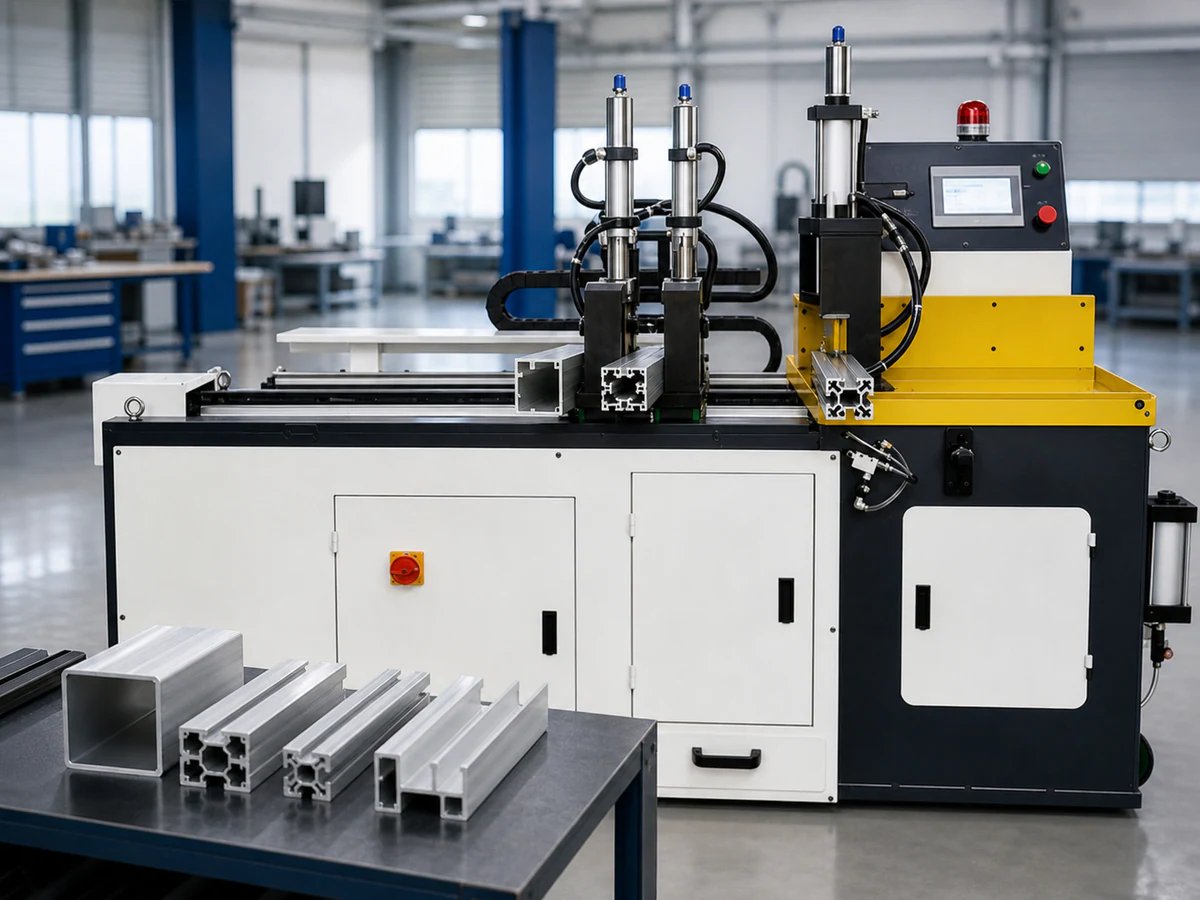
Ask for a representative profile sample and the manufacturer’s permitted contact faces. A hollow box section, an open channel and a finished cap-bearing section can react differently to clamping. In the saw trial, document the fence datum, top/side support, clamping location, the shortest retained piece, and any finish-protection method. Watch for rotation, tube-wall deformation and burrs where later joints or facing parts will sit. A pass on a thick shop offcut does not prove the approved rail or its longest/shortest production lengths. Our back-fence contact checklist gives a general method for recording this machine-side evidence.
5. Separate cutting from holes, joints and facing work
List every operation after sawing: drilling or slotting, end-plate preparation, fastener installation, frame assembly, facing and kick-plate fitting, gate hardware, shielding supports and any finishing or packing. Mark the responsible supplier and inspection handoff for each. A straight-cut blank is not an assembled panel. In Athletica’s manual, panel locations and subsequent alignment are controlled by shop drawings and installation steps; that reinforces the need to preserve member identity through downstream work. It does not turn an ordinary profile saw into a board-system production line.
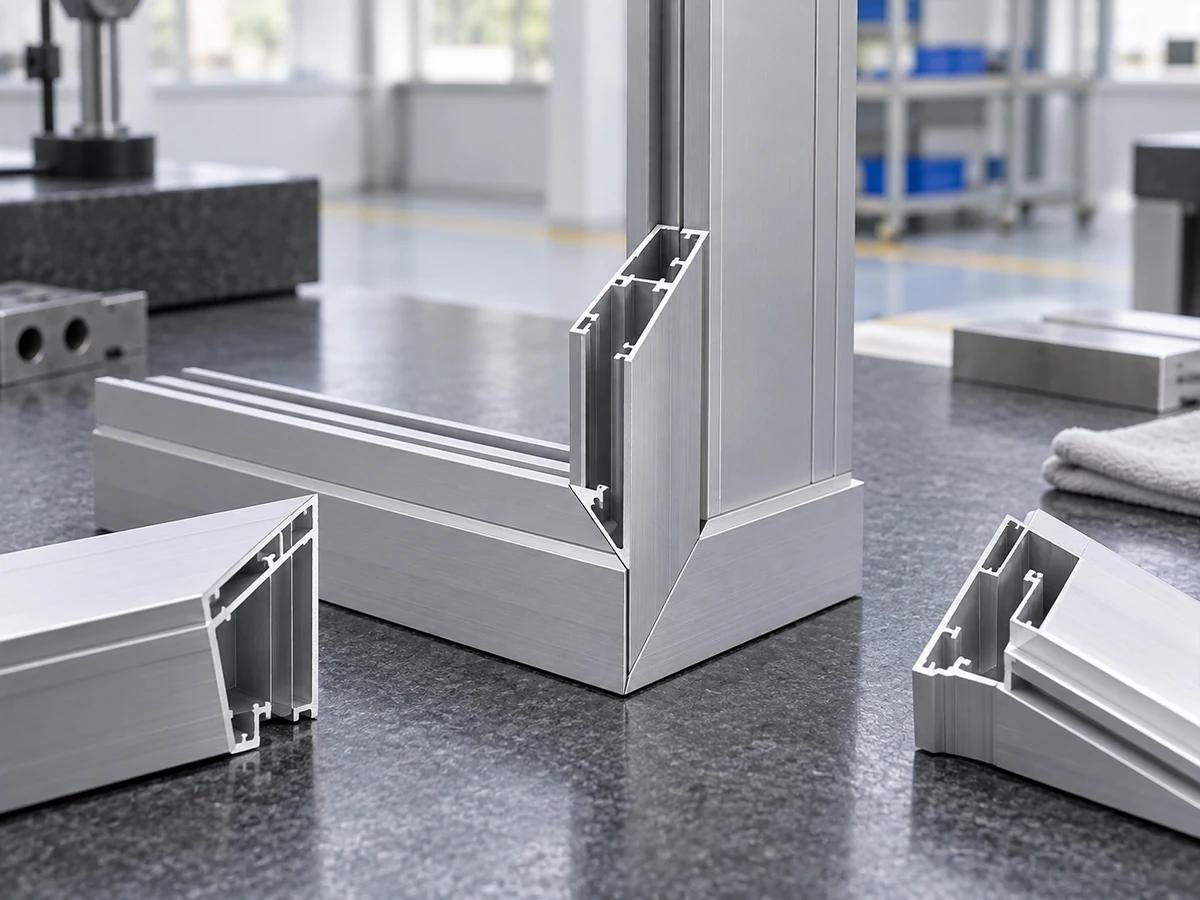
Joint geometry deserves special care. The image below illustrates an aluminum frame corner, but another industry’s mitered corner should never be substituted for a rink supplier’s mechanical fastening or welded detail. Request the real joint drawing and first-off inspection points before specifying saw angle capability.
6. Accept a first-off member set, then the system owner’s panel trial
Define a first-off set by panel number, section revision, member position and orientation. Check each cut member against the released drawing, including length datum, end condition, surface damage and readable identification. Then the authorized board-system owner should assemble and assess the representative panel with its actual joint, facing and installation interfaces. Record the approved change, if any, as a revised drawing and cut list. Do not bury a recurring correction in a saw offset or treat a good-looking frame as proof of board or player safety.
For replacement work, make the acceptance question narrower: does the new member match the approved spare-part identity and the documented panel revision? Keep removed parts, damage photographs and installation records with the purchase order when the system owner asks for them. The saw supplier can show what it cuts; the rink-system owner must decide whether a replacement part and resulting assembly are acceptable.
7. Compare cost per accepted kit at the same boundary
Get quotes on the same output unit: a cut blank, a labeled member set, or a fabricated panel. Include the stock form, extrusion lot or finish handling, length mix, trial material, changeover, tool and clamp setup, inspection labor, rejected pieces, labeling, packaging and freight handoff. State who bears the cost of drawings, approved components and downstream assembly. A lower saw cycle price is not a lower installed-board price when it omits these operations.
Ask each supplier to show the exact profile trial it will run and the acceptance report it will return. A quote that assumes all sections are identical, omits short retained pieces, or prices a frame without joint approval is not comparable. Keep performance or compliance claims tied to the board manufacturer’s own verified system evidence; do not transfer claims from an unrelated rink design or machine video.
Ice rink dasher board frame cutting: what to send with the RFQ
- Approved system owner, drawing revision, permitted manufacturing scope and panel schedule.
- Profile sample and part identity for each member family, including finish and stock condition.
- Position-labeled cut list with length datum, orientation, end geometry and quantities.
- Allowed support/contact faces, shortest piece, visible-surface limits and burr criteria.
- Named owners for holes, joints, facing, gates, shielding, assembly and installation.
- First-off member inspection plan and the separate panel-assembly acceptance route.
Related equipment footage: The following Jiurun-channel video shows an automatic aluminum-profile saw and feeding process. It is an equipment illustration only. It does not show an ice-rink dasher board, the frame section in this RFQ, an approved configuration, customer work, or structural and safety test evidence.
Need to qualify ice rink dasher board frame cutting? Send Jiurun the authorized frame-section drawing, physical extrusion sample, labeled member schedule and agreed first-off criteria. We can discuss the saw trial and quote the cutting stage. Contact JiurunCut with the profile and scope; obtain all assembled-system approval from the responsible board supplier or engineer.