
EV aluminum frame sample cutting is a purchase question only after the buyer defines which released members the saw will actually prepare. A convincing cut on one extrusion does not show that a complete frame sample kit can be identified, cut, inspected and handed to the next operation. Conversely, a prototype assembly may contain prepared or purchased members that a proposed saw will never touch. Before comparing machine quotations, separate those two cases.
JiurunCut’s new-energy-vehicle application guide discusses battery-tray rails, threshold profiles, crash beams and multi-angle structural members as different cutting situations. Those examples are a menu of possible jobs, not a statement that every vehicle frame contains all of them. Hydro’s automotive battery-tray overview describes extrusion alongside separate CNC machining and welding, a useful reminder that a saw-cut blank is not automatically a finished component. This guide turns an actual buyer’s released sample list into a testable saw scope. It concerns the saw stage; vehicle structure, joining, crash behavior and final product approval belong to the responsible engineering and qualification teams.
1. Name the sample stage and the accepted handover
Ask what the present sample is meant to answer. An early geometry mock-up, a buildable process sample and a production-intent member set may use different stock conditions or receiving checks. Record the current drawing revision, sample quantity and decision owner. Mark any part whose drawing, extrusion source, finish or receiving datum remains provisional. A provisional cut may inform a tooling discussion, but it cannot silently become production acceptance evidence when the released design changes.
Set the output boundary in plain language. Is the saw supplier asked to demonstrate cut blanks, inspected members or a complete identified kit? A frame assembly may still need machining, forming, joining, surface treatment, hardware and an independent fit review after the saw. Price and trial each route at the same accepted stage. Do not compare a quote for loose blanks with a quote for ready-to-join parts as though they were equivalent.
2. Build an EV aluminum frame sample cutting member matrix
Use one row per real part and handedness. Capture the part number, drawing revision, profile section, alloy and temper as released by the buyer, incoming stock length, finish or protection state, blank length, end angle or form, orientation, visible face, quantity per sample set and receiving location. If the part is supplied already cut, leave it outside the proposed saw workload. If a nominally similar left- and right-hand member has a different end or protected face, preserve both identities through the cut list and sample labels.
Separate physical dimensions from references to the assembled frame. A saw-stage blank length is not automatically the vehicle’s overall frame dimension, a post-machining length or an assembled mating reference. The buyer should mark the cut datum and inspection origin on the released drawing and have the downstream receiver accept the check method. Where a cavity, rib, thin wall or asymmetric profile constrains support, submit the actual section and proposed contact restrictions rather than inferring compatibility from an outer rectangle.

3. Trial a representative set, then check kit completeness
A useful EV frame sample trial should exercise the released variation that drives machine choice. Include the actual longest supported stock, the smallest or most delicate approved section, a reinforced or multi-cavity section where relevant, the required end geometries, and the change from one family to another. The buyer and supplier should agree which samples are representative and which part families are not covered. One attractive cut face cannot stand in for an untested profile, angle or input condition.
Before cutting, record the offered machine configuration, support and clamping concept, sample-stock identity, blade and program state where applicable, operator actions, cut sequence and inspection plan. After cutting, inspect each agreed blank against its own datum: length, end form or angle, cut-face condition, visible-face marking and wall or rib deformation as applicable. Log accepted and rejected pieces, setup changes and the reason for each change. Keep the inspection method and acceptance limits supplied by the buyer’s engineering team; do not invent a tolerance from a marketing photograph.
For EV aluminum frame sample cutting, count the delivered kit by part number, hand, revision and sample set. A collection of individually acceptable pieces can still fail a build if one orientation or companion member is missing. Ask the receiving team to perform the separately agreed assembly-facing check, and keep that result distinct from saw-stage dimensional evidence. This does not certify vehicle performance or the finished structure.
4. Compare three supply routes at the same output stage
Buy prepared members when the sample demand is small, the design changes rapidly or a qualified outside source already supplies the approved preparation. The buyer still needs revision, traceability, inspection and lead-time agreements. Retain a saw station when repeated sample and later production work justify control over cutting, handling and changeovers. The proposed machine must be tested against the released member mix, not selected from a single catalog maximum. Assess a connected line only when loading, identification, part removal and downstream receiving are included in the same defined production job. An automated feed claim alone does not prove complete-kit flow.
For each route, count the complete resources for one accepted kit over the same period: purchased stock or prepared components, operator and programming time, setup and changeover, support and fixture work, inspection, rejected material, identification, storage, outside processing and any line interfaces. State assumptions instead of inserting unverified cycle-time or yield numbers. If a route cannot handle a released member, show the alternative preparation and its cost rather than treating the missing work as free.
5. Put the acceptance gates into the RFQ
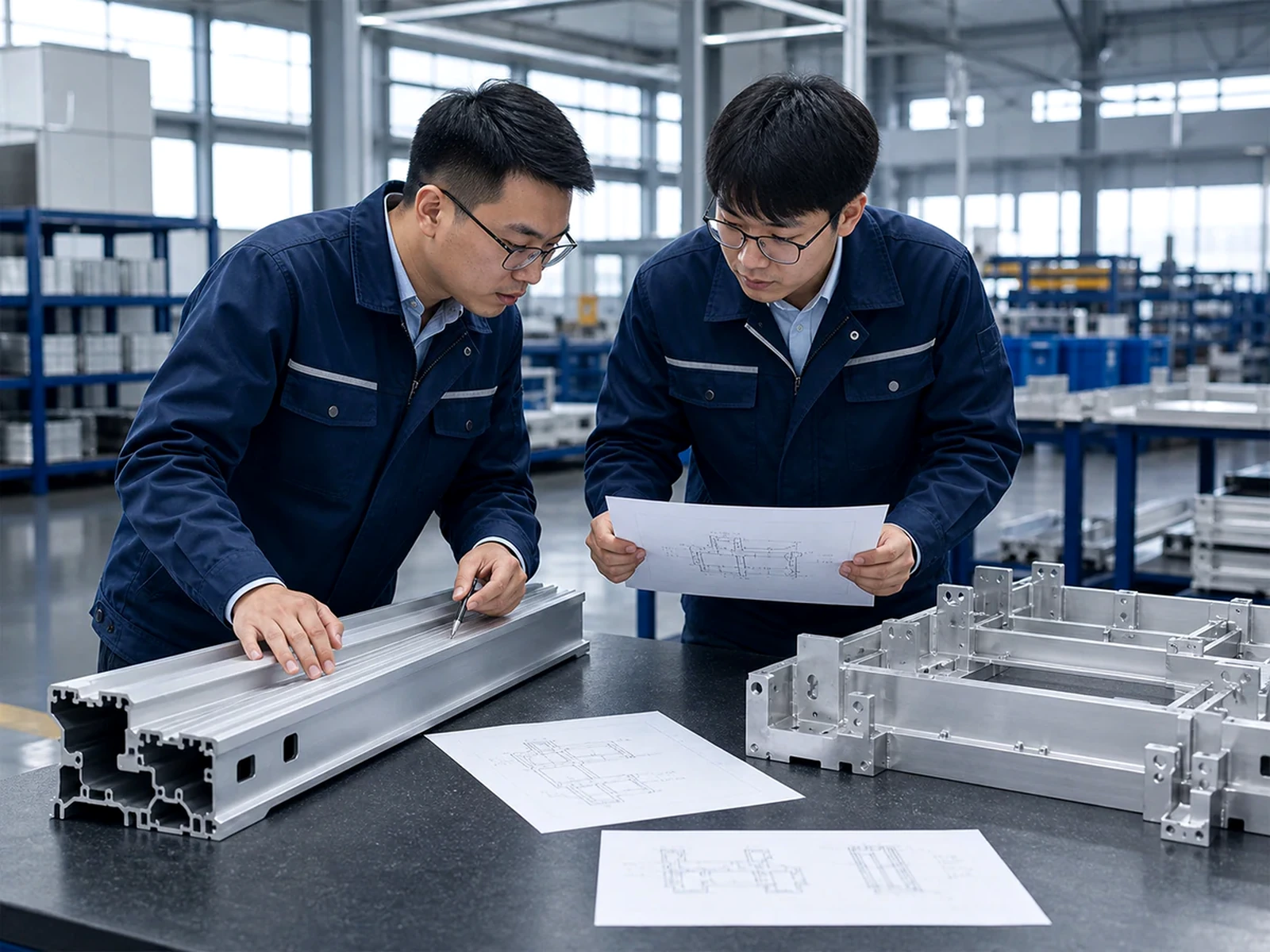
Send the supplier the released member matrix, available profile drawings, actual stock samples or accurate section information, sample-set quantity, accepted inspection method and the stage at which the buyer will receive output. Ask the supplier to identify any part it cannot assess from the available material. Require a quotation that names the machine, included feed and support equipment, fixtures, blade and program scope where relevant, collection and identification boundary, trial conditions and unresolved exclusions.
A practical release sequence has three separate decisions. First, approve the scope and a representative trial plan. Second, review the measured cut blanks and the complete labelled kit at the agreed receiving point. Third, let the responsible downstream team decide whether the parts support its assembly and product qualification work. If drawings or stock change between these decisions, record what evidence remains applicable and what needs a fresh trial. The drawing-revision guide explains that recheck decision in more detail.
To request a machine direction, send JiurunCut the member matrix, drawings, stock condition, output target and the gaps you cannot yet resolve through the engineering inquiry page. Ask for a configuration proposal and sample-cut plan tied to the actual released parts. A supplier answer should identify assumptions and excluded work instead of promising that a generic frame photograph proves the job.
General equipment video
Video: general angle-saw equipment footage from the Jiurun Machinery YouTube channel. It illustrates machine movement only; it does not prove this article’s EV material, model configuration, customer, sample trial, finished kit, cut quality or performance.
Decision rule: buy the saw only against the frame members and receiving stage your factory actually retains, with a representative trial and complete-kit check. Keep the saw result separate from downstream vehicle engineering approval.