
Choosing an enclosed aluminum saw or an open station is a workflow decision, not a choice between “safe” and “unsafe.” Both arrangements need an assessed method of guarding the cutting zone. The useful purchasing question is where people, long stock, short parts, chips and maintenance access must cross the machine boundary. A housing that looks tidy in a catalogue may still create a difficult loading route; an open-looking station may be the better fit for frequent, varied manual handling when its hazards are properly controlled.
This guide compares the two arrangements for an aluminum profile or tube buyer. It does not certify a particular machine or replace a site-specific risk assessment. Ask suppliers to demonstrate the proposed configuration with your material, operators and space before deciding.
Enclosed aluminum saw: start with the work crossing its boundary
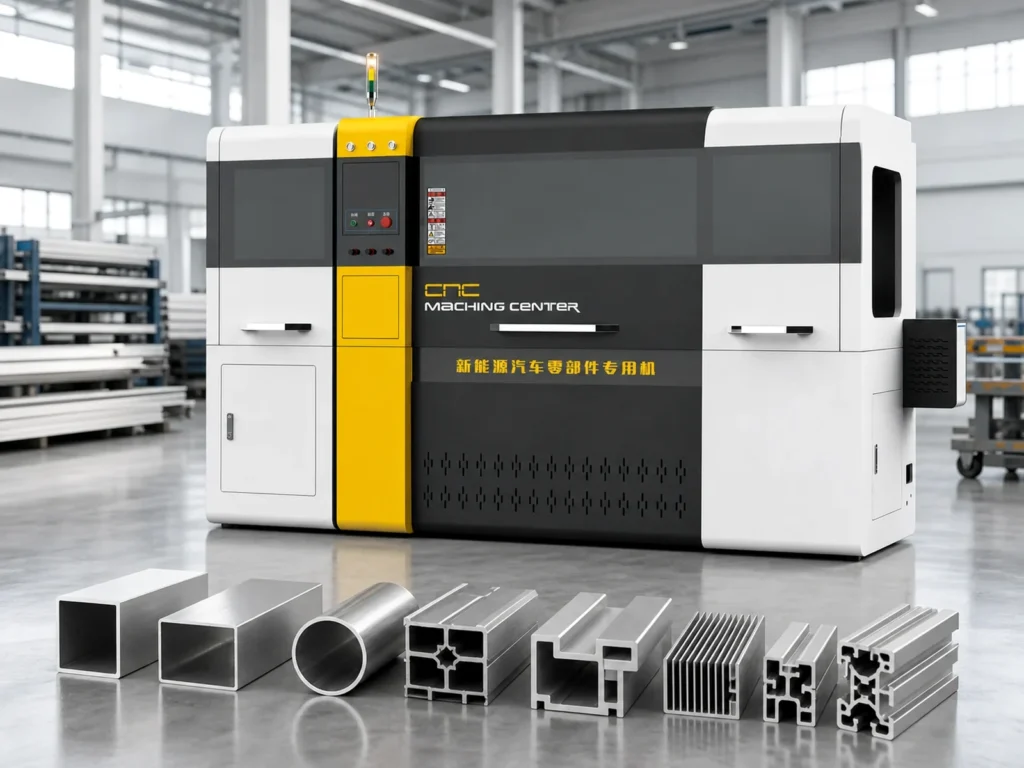
List the stock you will actually cut: section shape, longest bar, shortest accepted part, wall thickness, batch size and frequency of profile changes. Then draw the path from incoming bundle to loading support, clamp, cutting zone, part collection and scrap removal. The enclosure affects more than the blade area. Doors, openings and adjacent fences can change how the operator presents a bar and retrieves a short piece.
For a repeated production family, the cost of opening and closing a guard may be small compared with predictable feeding and part collection. For high-mix work, frequent access for set-up and gauging may dominate the cycle. Neither conclusion follows from the machine photograph alone. The comparison must use the same accepted cut length, operator role, material support and batch definition for both proposals.
Compare access at five moments, not just during the cut
1. Load a full-length bar. Check how the bar reaches the clamp without awkward lifting, twisting or unsupported overhang. Record the usable entry opening and the clearance for the longest stock. A drawing of the main machine footprint omits the infeed table, trolley route and operator stance. See our aluminum saw layout planning guide for the whole workflow.
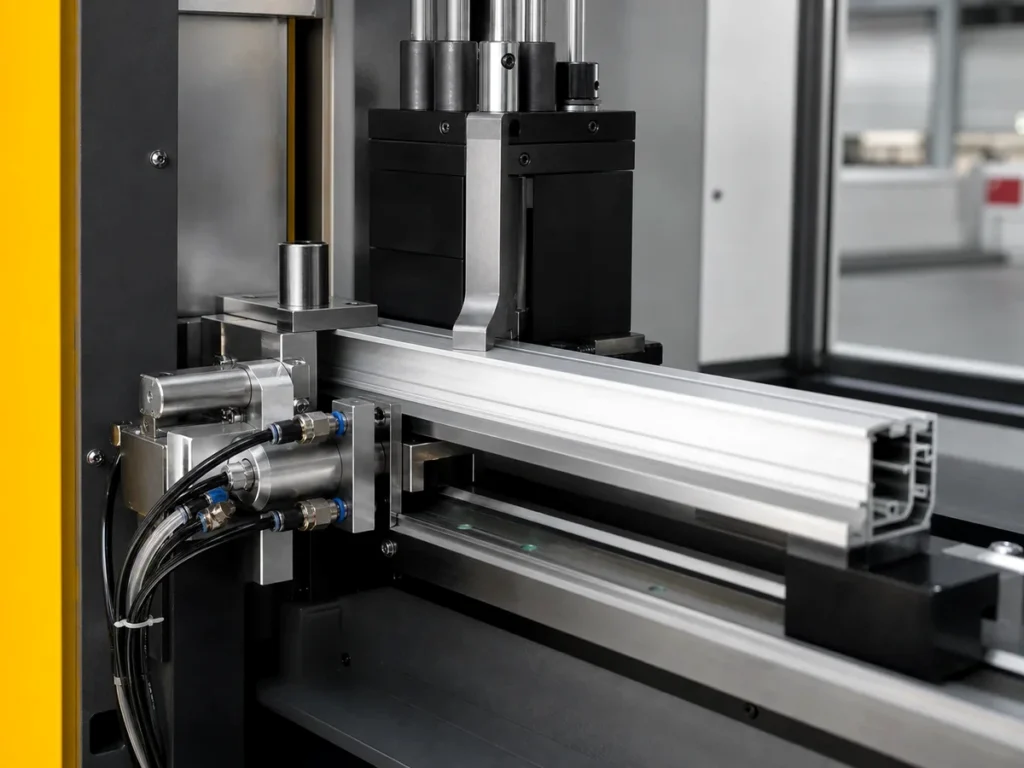
2. Change a profile. Ask the supplier to show the actual sequence for changing the fixture, support or cutting program. Which access panel opens? What can be reached only after isolation? How long does a normal changeover take with the proposed material, rather than with a bare demonstration machine? Separate routine adjustment from maintenance work.
3. Remove the shortest good part. On a long extrusion, the bar can be supported well while the last short piece still tips or falls. Map the route from blade exit to accepted-part bin. Confirm that a person does not need to reach into the cutting hazard to collect it. Our short-piece outfeed checklist gives a useful trial sequence.
4. Clear a jam or unusual offcut. Request a written stop, isolation and access procedure for the proposed layout. A video of a clean cycle cannot prove how a jam is cleared. The supplier should identify which doors, panels, tools and trained roles are involved. Do not count a fast but unsafe shortcut as a productivity benefit.
5. Maintain and clean. Consider blade change, chip removal, lubrication checks and inspection access. Ask which tasks are done from the front, rear or side and how much service clearance is needed. A fully enclosed footprint may demand more free space around it than its outer dimensions suggest.
Define what “enclosed” includes in the quotation
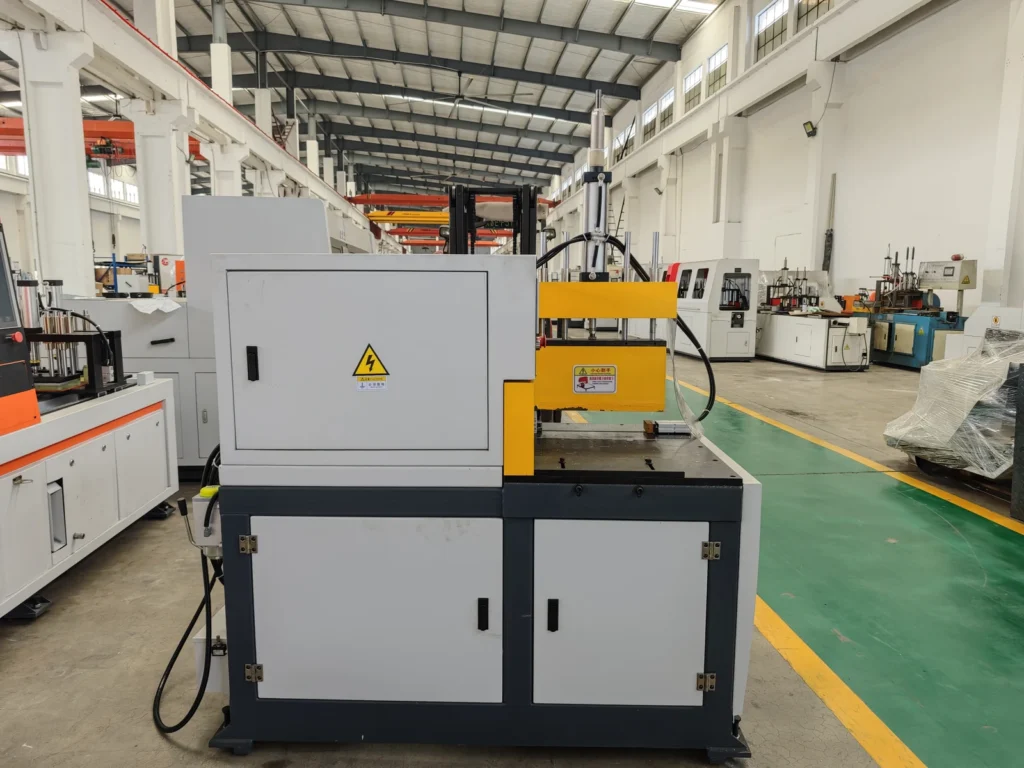
The word enclosed can describe a cutting-head cover, a machine housing, or a larger cell with surrounding material-handling equipment. Require a layout drawing with the boundary marked. Identify every opening used for stock infeed, finished parts, scrap and maintenance. If a conveyor or loader is outside the housing, show who controls it and how people are kept clear at the interface. Ask for the proposed door and interlock arrangements in writing; do not infer them from a promotional image.
A partially enclosed or open arrangement also needs a clear safeguarding plan. In the United States, OSHA 29 CFR 1910.212 describes guarding hazards such as the point of operation, rotating parts and flying chips. ISO 16093:2017 addresses significant hazards for cold-metal sawing machines. These are references for a specification conversation, not evidence that a quoted JiurunCut model meets a standard or that a particular rule applies in every jurisdiction. Your safety team and supplier must assess the installed system under the rules that govern your site.
Our separate emergency-stop and guard-interlock comparison explains why an emergency stop and access control should be evaluated as different functions. Ask for the actual circuit documentation and demonstration of the proposed machine rather than assuming a button or a door label settles the question.
Material flow can reverse the apparent winner
An enclosure may help define where chips and offcuts stay and where extraction or collection connects, but it does not guarantee a clean floor. Check the chip path for the profiles and blade you intend to use. If the short-part chute blocks, the operator may face more interruptions even while the cutting zone is covered. Conversely, an open station may offer easy visual access yet create a difficult boundary around a long moving bar.
Make the supplier draw three paths on one scaled plan: full-length stock in, good parts out and scrap/chips out. Then overlay the operator and maintenance routes. If any path requires someone to cross another machine’s operating area, fix the layout on paper before arguing over a nominal cycle-time figure. Include the shortest good piece and longest stock in this test, since average parts often conceal the handling problem.
Use one comparison sheet for both proposals
| Decision item | What the buyer should record |
|---|---|
| Material envelope | Maximum stock length and section, minimum good-part length, and support at both ends. |
| Routine access | Who loads, changes fixtures, measures and retrieves parts; which opening each task uses. |
| Safeguarding | Hazard assessment, proposed guarding and access-control functions for the complete installed line. |
| Flow and space | Scaled footprint including stock, operators, bins, extraction and service clearance. |
| Exceptions | Procedure and responsible role for jam, offcut, blade change and cleaning. |
| Evidence | Drawing revision, option list, demonstration material and acceptance test record. |
Compare the quotations only after the rows describe the same job. A lower base price can exclude the support, chute or guarding interface that makes the workflow viable. An attractive cycle-time claim can exclude changeovers and retrieval. Request an itemized scope so any assumption is visible before purchase.
Request a demonstration that exposes the trade-offs
Give both suppliers the same sample drawings and stock schedule, including one easy production part, one short accepted part and one profile-change case. Ask them to demonstrate a complete batch: load, set, cut, collect, inspect and change over. Record where the operator stands, every manual touch and each interruption. If remote testing is all that is available, ask for an unedited sequence and a dimensioned layout, then put any remaining uncertainty into the acceptance plan.
The acceptance document should name the offered configuration, its options and the tested material. It should distinguish feed-positioning specifications from the finished-part dimensions you will inspect. State who supplies the blade, fixture, infeed support, outfeed arrangement and extraction connection. Agree on the method of measuring parts and the permitted rework or scrap treatment. No short marketing clip can replace this agreement.
Video note: This clip from Jiurun Machinery’s YouTube channel shows general enclosed saw equipment in operation. It is an equipment-flow example only; it does not demonstrate the material, model configuration, customer installation, trial cut, measured result or safety performance discussed in this guide.
Which arrangement belongs on your shortlist?
Shortlist an enclosed proposal when the documented material route, collection and access plan suit your repeatable work and the supplier can show the safeguards and service tasks for that exact installation. Shortlist an open or partially enclosed station when frequent varied handling makes that arrangement practical and the supplier and your site team can demonstrate a suitable guarding and operating plan. Do not use either label as a proxy for safety, throughput or cut quality.
Send JiurunCut your profile drawings, stock length, shortest accepted part, batch pattern and available floor plan. Ask for a quotation that marks the machine boundary, support and collection equipment, access sequence and acceptance test. That package gives you a decision you can inspect instead of a comparison based on catalogue photographs.