
A curtain wall saw purchase only pays for work your factory actually retains. A stick-built façade, a shop-assembled ladder and a fully unitized panel may share aluminum mullion and transom profiles, yet they arrive at different stages and carry different fabrication responsibilities. Before asking a saw supplier for capacity or price, decide whether your company will receive long stock, cut members, prepared frame kits or glazed panels.
This guide is for façade fabricators and procurement teams comparing an in-house aluminum profile saw with prepared-member or panel supply. It addresses the make-or-buy boundary. For drawing and cut-quality checks on an already selected project, see our curtain-wall profile cutting checklist. No image or video here proves that a particular Jiurun configuration has cut a specified architectural system.
Curtain wall saw purchase: define the system route and handover unit
System suppliers distinguish routes that buyers sometimes group under “curtain wall.” Kawneer describes traditional stick fabrication and unitized options: stick systems are assembled and glazed in the field, while unitized systems are assembled and glazed in a shop environment. Its 1600 SS description also shows a screw-spline route that can be pre-assembled and delivered to site. These examples explain possible supply boundaries, not a specification for another supplier’s system or a Jiurun cutting trial.
Write the actual contract handover for each project family. A pallet of long extrusion needs cutting and almost every later operation. A labeled set of cut mullions and transoms still needs any required end preparation, joints, seals, assembly and checks. A shop-built frame or glazed unit includes far more work. If your purchase comparison prices a saw against complete panels without accounting for the work between the two, it will make internal fabrication look cheaper than accepted project output.
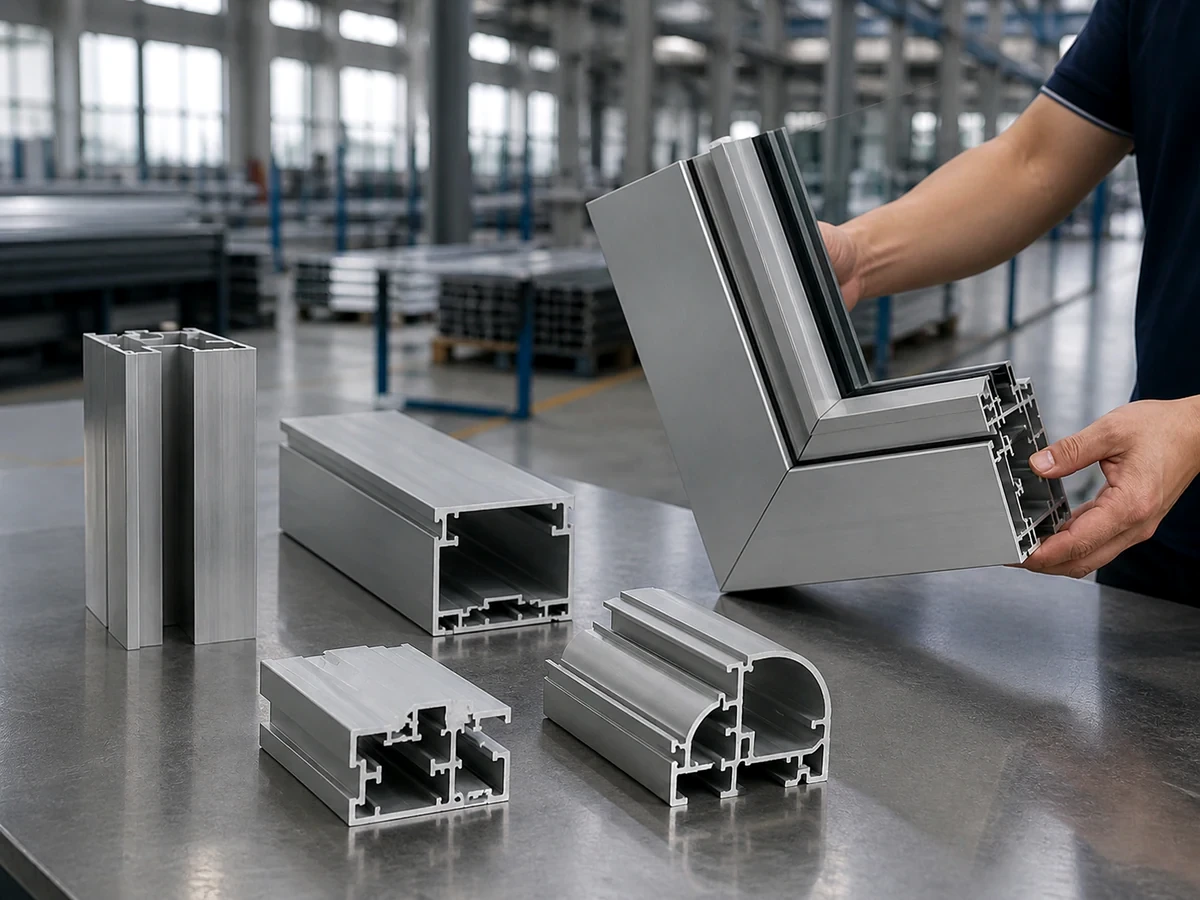
2. Separate the three supply choices before requesting equipment
- Buy completed or substantially completed units: quote the approved system, fabrication and glazing scope, project revision, packaging and incoming checks. A saw has little relevance if your factory does not retain the extrusion cuts.
- Buy prepared members or frame kits: specify which party owns cutting, end machining, drilling, notching, identifiers, protective handling and assembly fit. A partial kit may still leave a small but important cutting workload.
- Buy extrusion stock and cut in-house: include stock procurement, profile identification, cutting, fixturing, inspection, scrap, secondary work, logistics and responsibility for nonconforming members.
Compare these routes at the same accepted stage. For example, if a subcontracted kit arrives labeled by elevation and ready for frame assembly, include sorting, labeling and the rejected-piece replacement route in the internal saw case. If field trimming is unavoidable, state who approves it and whether it is a planned operation or a controlled exception. An in-house saw should be purchased for a stable, defined package of factory cuts, not for undefined site changes.
3. Build a released profile and project matrix
One attractive sample mullion is not a machine specification. For each released system and project, list the exact profile reference and drawing revision, incoming stock length, cross-section, wall features, surface finish, cut orientation, shortest accepted piece, length range, batch quantity, joint type, end preparation and inspection datum. Distinguish mullions from transoms, cover or pressure-plate members, and any other metal parts. Separate glass, seals, anchors and panel assembly from the saw’s scope.
Mark each row as retained in-house, supplier-prepared or excluded. Then group the retained rows by the physical support and clamping problem they present. A thin architectural flange, a deep hollow mullion and a short mitered part need different handling questions. A single nominal maximum width does not establish that every section can be held without distortion or visible marking. Ask the machine supplier to assess the actual drawings and representative stock before selecting a blade, clamp or feed layout.

4. Define the saw trial around downstream assembly
Choose an ordinary high-volume member and a difficult in-scope member from the released matrix. Give the seller the profile drawing, physical stock, finish condition, cut list and agreed inspection method. The proposed trial should say what machine configuration, blade, support and clamping arrangement is used, how pieces are identified, and which surfaces may touch fixtures. If a member will receive a later joint operation, identify the datum the next station actually uses.
Judge more than an isolated length reading. Record length and angle against the released drawing, cut-face and burr condition, profile deformation, visible surface damage, identification and fit at the intended joint. Follow an agreed sample into the next real fabrication step: a cut that passes at the saw but fails a screw-spline connection, end preparation or frame alignment is not accepted output. Agree on sample quantity and who measures before the demonstration. Do not convert a feed-positioning figure into finished-member accuracy.
The embedded clip below is general Jiurun saw equipment footage from the Jiurun Machinery channel. It shows a saw table and clamping equipment. It is not footage of the curtain-wall profiles in this guide, a named system, a promised machine configuration, a customer project, a test cut or any performance result.
5. Compare cost at the same accepted project stage
For a curtain wall saw purchase, set a decision horizon and obtain quotations for equivalent output: approved delivered units, prepared members or internally produced members. The in-house route needs the actual saw quotation, included fixtures and training, stock purchase, expected yield and kerf, operators, blade and service costs, inspection, rejects, finish protection, secondary fabrication, storage and delivery to assembly. The outsourced route needs its own order minimums, project-change charges, lead time, replacement-part route and incoming inspection. Do not invent utilization, scrap rate or cycle time to force a positive payback.
Test at least two demand cases: a stable project with repeated released cuts and a mixed schedule with changing elevations or profile revisions. Ask whether retained cutting has enough volume across compatible systems, whether downstream machining or glazing is the actual bottleneck, and whether purchased kits provide valuable revision control. A faster saw cut does not by itself shorten installation or panel completion. If responsiveness is the main reason to buy, specify the desired time from approved drawing release to accepted member and verify that stock, labor and the downstream station can meet it.

6. Put responsibility and exclusions into the RFQ
The equipment RFQ should contain the in-scope profile matrix, finish and contact-surface restrictions, ordinary and difficult sample jobs, acceptance method, proposed tooling, handling and outfeed arrangements, operator training, spare and service terms, and a clear list of profiles or operations outside the assessed scope. Request a written configuration tied to those samples. Do not assume a catalog photograph represents the quoted machine.
The project-supply RFQ should state who owns drawing release, material traceability, cutting, joint preparation, seals, glazing, frame assembly, labeling, packing, shipping damage and nonconformance resolution. The saw seller can answer for the machine and demonstrated blank condition; the façade system supplier and fabricator remain responsible for their own specified system and assembled performance. Keep those accountabilities visible in the cost table.
When each choice deserves closer review
- Buy prepared or completed units when your retained cuts are few, projects change often, or supplier assembly and system accountability have more value than controlling the first cut.
- Buy member kits when your team assembles frames but specialist preparation or low-volume sections are better sourced outside.
- Evaluate an in-house saw when released systems provide a repeatable retained cutting package, actual stock and fixtures can be assessed, sample members pass the downstream handover, and equivalent accepted-output economics support the investment.
Next step: send Jiurun the released in-scope profile drawings, stock form, cut schedule and acceptance criteria through our contact page. Ask for a written configuration and sample plan. Compare that proposal alongside prepared-member and unitized-panel quotations at the same project handover point.