
A curtain wall mullion saw trial is easier to judge when it ends with a small, identified assembly rather than a stack of attractive cut ends. A mullion can meet its isolated length callout and still leave the transom connector, pressure plate, gasket or drainage route difficult to assemble. The buyer’s question is therefore specific: can the proposed sawing setup produce the released mullion and transom member set, with the correct reference faces and end conditions, for the system you actually intend to fabricate?
This guide is a trial brief for that purchasing decision. It covers saw-cut members and their handover to any separate milling, drilling, notching and glazing operations. It does not suggest that a saw alone makes a finished curtain wall panel. System drawings and project tolerances, not a generic machine claim, must define acceptance.
Start with the system boundary, not the saw model
Ask the facade designer or system supplier for the current profile sections, fabrication drawings, connector details, gasket and pressure-plate arrangement, drainage details and the approved revision. List which operations are assigned to the saw and which belong to later stations. Some systems use mullion and transom arrangements that look similar from the outside but have different joint and water-management details. For example, Kawneer’s 1620UT curtain wall documentation offers system-specific mullion and pressure-plate details; ALUMIL’s SMARTIA M50 information identifies its mullion/transom and concealed-drainage concepts. Those are examples of why the project system document must control the trial, not specifications for a Jiurun machine or for every curtain wall.
Mark every sample with profile code, drawing revision, finish side, member role and cut-list item. Include a vertical mullion, a horizontal transom, any cover or pressure-plate member that is actually cut on the proposed line, and at least one difficult section. If the factory buys prepared kits or unitized panels, first decide whether it really needs to saw all those members. The related curtain wall saw purchase guide compares that supply boundary.
Define the cut reference before asking for a tolerance
A length reading is meaningful only if both parties use the same finished-part datums. For each member, identify the face that bears against the saw fence, the end from which length is measured, and whether the callout is for a square cut, a miter or a prepared end after downstream machining. A drawing dimension to a connector shoulder cannot be accepted by measuring only the overall extrusion length. Record any stock bow or twist that changes contact with supports and clamps; use a representative piece rather than a conveniently straight coupon.
Separate three questions on the trial sheet: did the feeder or stop position consistently, did the saw make a satisfactory end, and does the finished part pass its drawing check after all assigned operations? A quoted feed-position figure is not a guaranteed assembled-member accuracy. Specify measurement instrument, datum, conditioning and decision rule before the demonstration so a supplier and buyer can reproduce the result.

Build a representative curtain wall mullion saw trial set
Do not let one clean cut on one stock length stand for the whole contract. Use the planned stock condition, the longest and shortest production pieces that the quoted setup must handle, the most awkward section for clamping, and any angle family in the purchase scope. Include a changeover from one profile to another if mixed production is important. Agree who supplies the material, how much may be consumed for setup, how blade and clamp choices will be recorded, and who owns the samples after the trial.
At the machine, watch the complete path: support and load the long section; set the datum; clamp without damaging a visible or functional face; cut; release; collect; identify and protect the part. Check whether the stock remains supported when the short remnant is cut. A trial that hides the loading and collection steps cannot answer labor, handling or marking questions. If a fixture or special pad is proposed, ask for its drawing or description in the quote and repeat the trial after a realistic changeover.
Inspect the joint and water path as an assembly
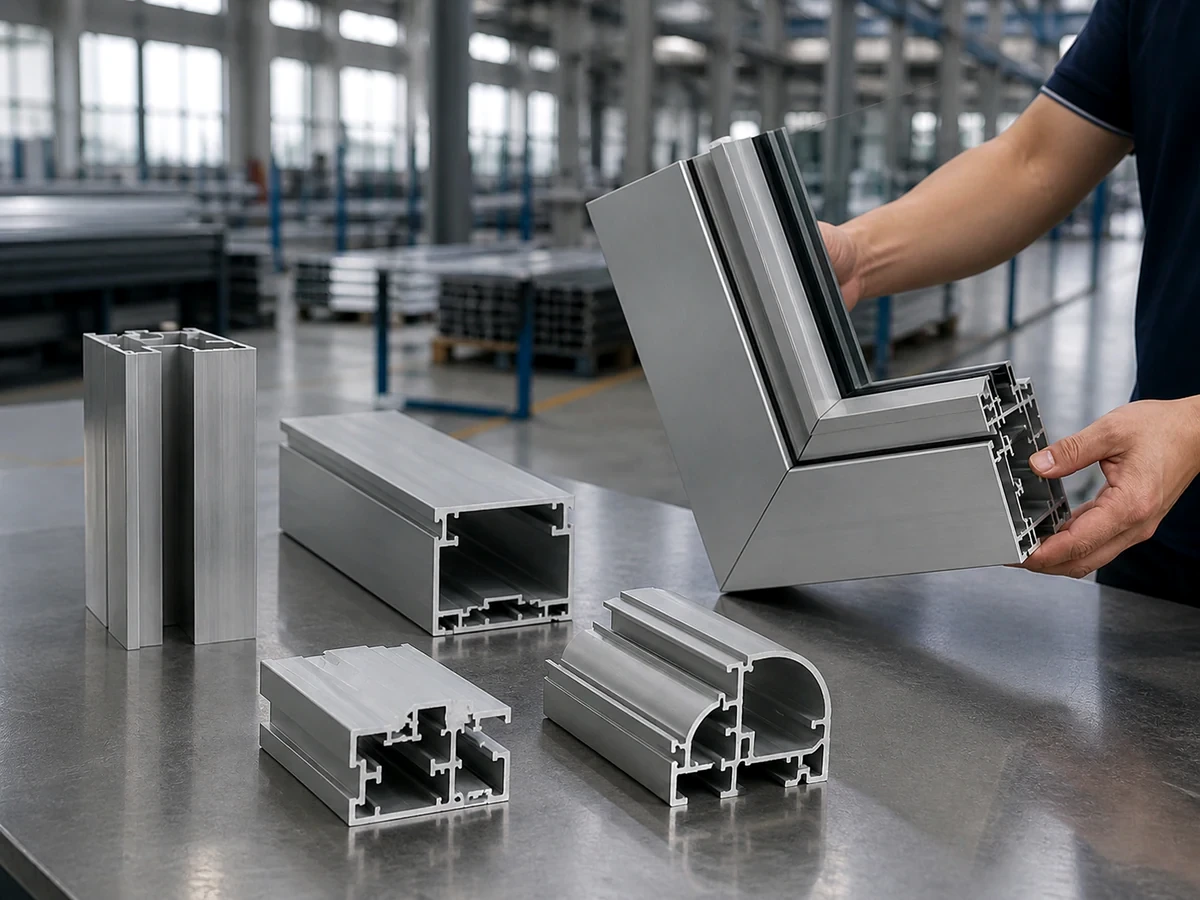
After sawing, complete the downstream operations specified by the facade system. Then dry-fit a mullion-to-transom joint with the actual connector and relevant cover or pressure plate. Check the exposed face alignment, gap, squareness, connector seating and whether a burr, proud cut edge or distorted chamber obstructs the approved joint. For a project that depends on a gasket groove or drainage channel, confirm that the released end preparation and joint detail leave the intended route open. Do not infer watertightness from a photograph, a visual gap check or a saw demonstration; facade performance belongs to the system design and its prescribed tests.
Keep the saw’s responsibility visible in the report. If a notch or weep feature is machined later, a failure there is not automatically a saw failure. Conversely, a saw cut that moves the reference face or damages a channel should not be excused because the later station can compensate once. Mark each nonconformity to its operation and agree the correction and repeat sample.
Set an acceptance record that can settle the purchase
Before the test, make a one-page matrix with the following columns: member and revision; stock and finish; saw setup and reference face; required cut condition; measurement method; post-saw operation; assembly check; result; owner of any corrective action. Add an agreed sample count and decision rule for each critical condition. Keep individual readings and the identified physical pieces, not just a pass/fail photo. If the trial reveals a setup limitation, record the revised clamp, support, blade or workflow and repeat the affected cases before accepting a revised offer.
The strongest purchasing evidence is a signed link from drawing revision to cut list, machine configuration, measured parts and assembled sample. Preserve the setting sheet and a repeat sample for later factory acceptance. The contract should state whether that sample is a reference for appearance or geometry, and how future drawing changes will be approved. A retained piece does not replace the released drawing.

What to put in the RFQ
- Released section and finished-member drawings, revision and member codes.
- Stock lengths, expected bow/twist condition, finish and protected visible faces.
- Cut list by member, quantity, angle and changeover frequency.
- Defined length and angle datums, allowed part variation and measurement method.
- Connector, gasket, pressure-plate and drainage details needed for the assembly check.
- Operations included in the saw quote versus separate drilling, milling, notching and glazing work.
- Sample matrix, acceptance authority, repeat-test rule and evidence to receive.
- Handling, support, collection, marking and protection requirements for long and short pieces.
Related equipment footage
The following video from Jiurun Machinery’s YouTube channel shows general JR-455Q saw equipment footage. It is an equipment/process illustration only. It does not show or prove the curtain wall members, system details, quoted configuration, customer project, sample trial, measured tolerance or performance described here.
Request a drawing-based review
For a curtain wall mullion saw trial, send JiurunCut the released section and finished-part drawings with the cut list, stock lengths, member finish, assembly interfaces and acceptance method. Ask for a written boundary between sawing and downstream fabrication, then request a representative sample trial for the configuration actually quoted. Do not choose a model from a generic video or an illustrative image alone.