
Bimini frame tube cutting is only one step in a fitted assembly, not a way to make interchangeable tube lengths. A saw buyer can make a sound cutting decision only after separating the straight aluminum members from bent bows, connector details, fabric and installation work. That boundary matters most when a frame ships as a knock-down kit: one overall top dimension does not define every blank cut.
This guide is for a Bimini-frame fabricator or parts buyer scoping a repeatable straight-tube cutting step. It is not a design or load approval for a boat top. The finished frame, mounts and canvas must be checked against the kit designer’s drawings and installation requirements.
Start with the kit, not the saw
Catalog examples show why a single “Bimini tube” assumption fails. Taylor Made describes a pontoon kit with a four-bow frame of 1¼-inch square aluminum tube, while another square-tube kit uses 1-inch tube. Its broader Bimini range also distinguishes frame length, height, mounting-point width, bow count and knock-down connections. Those are examples of supplier offerings, not dimensions to copy into another job. The actual drawing and bill of materials control your cut list.
The first purchasing question is therefore: which pieces are delivered as straight stock, cut blanks, bent bows, preassembled sections or bought-in hardware? If the bow arrives already bent, a straight-cutting saw may prepare a short connector or support member but does not create the bow geometry. If the workshop bends its own bows, it must separately define bend allowance, springback, hole position and post-bend end reference. Do not quote that as a saw-only operation.

Record a member-by-member cut map
Ask the frame designer for an assembly drawing, an exploded parts list and one marked sample or approved first article. For each member, record its section (round or square), outside size, wall, alloy/finish if specified, stock state, quantity per kit and whether both ends are saw-cut. Name the mating component at each end: hinge, jaw slide, insert, snap-button connector or another specified part. A hardware name alone is insufficient to determine a cut plane or hole pattern.
Use separate columns for cut length, finished installed dimension and inspection reference. Taylor Made’s fitting guidance measures frame width between the two mounting locations, not simply the hull beam. That is a frame-selection measurement; it is not automatically the length of a straight tube blank. If a drawing says only “96-inch top,” ask which dimension it denotes before releasing a saw program.
For a knock-down frame, map the connector overlap and stop locations on the approved assembly drawing. A short tube section can have a correct total length yet place its end feature on the wrong side. Identify left/right and fore/aft orientation on the traveller so that a correct cut does not become a wrong-hand part downstream.
Define what the saw is expected to make
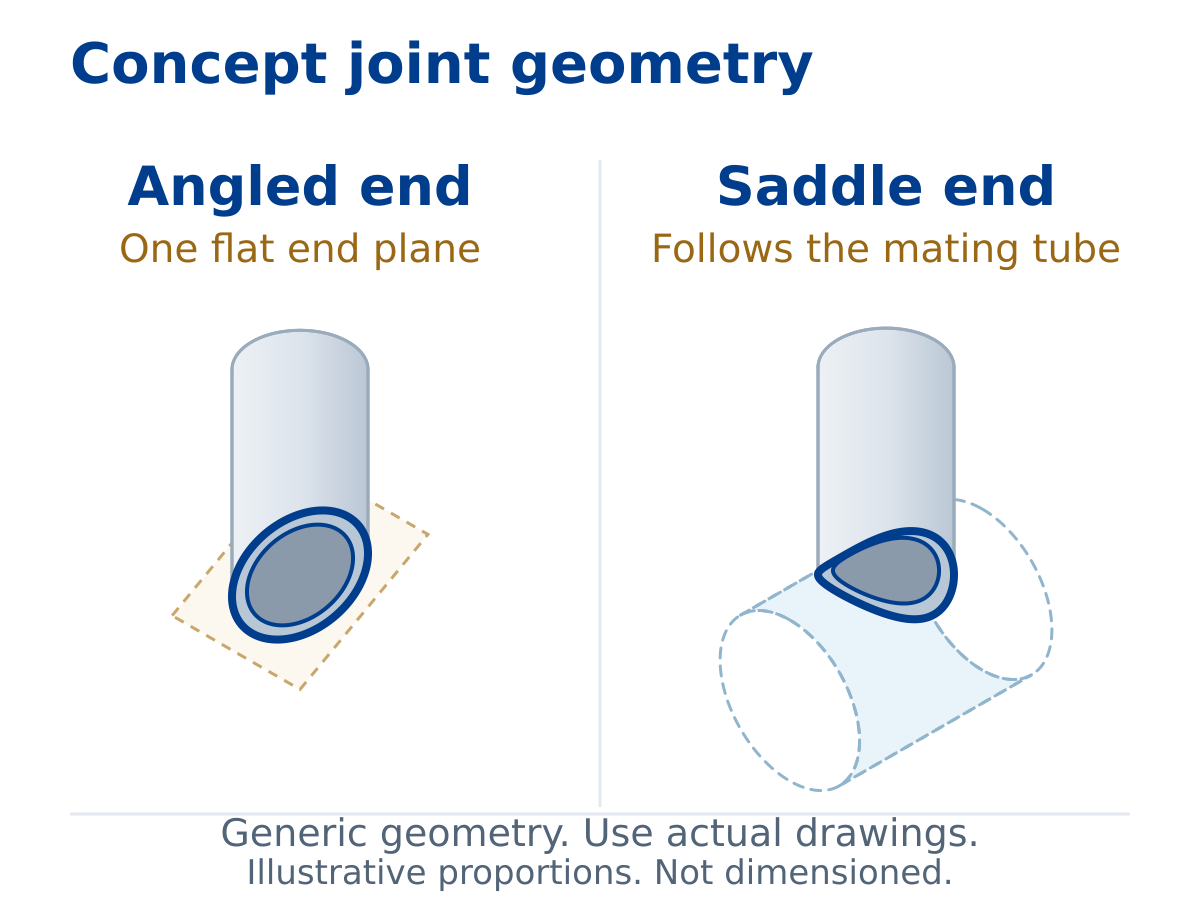
A circular saw can be evaluated for straight cutoff of a defined tube section. A job may also call for a non-square plane, a notch, a saddle, deburring, drilling, forming or bending. These are different capabilities and may require different stations. Request a drawing of each end family and a sample for any shape beyond a simple flat cut; do not infer it from a product photograph.
If a supplier says “angle cut,” specify the reference axis, angle convention, which end is angled and how length is measured. If the joint requires a contoured mating surface, do not accept a planar miter as an equivalent without assembly approval. For bent bows, state whether the saw cuts before or after bending and where the final length datum is taken.
Trial the real stock and its support
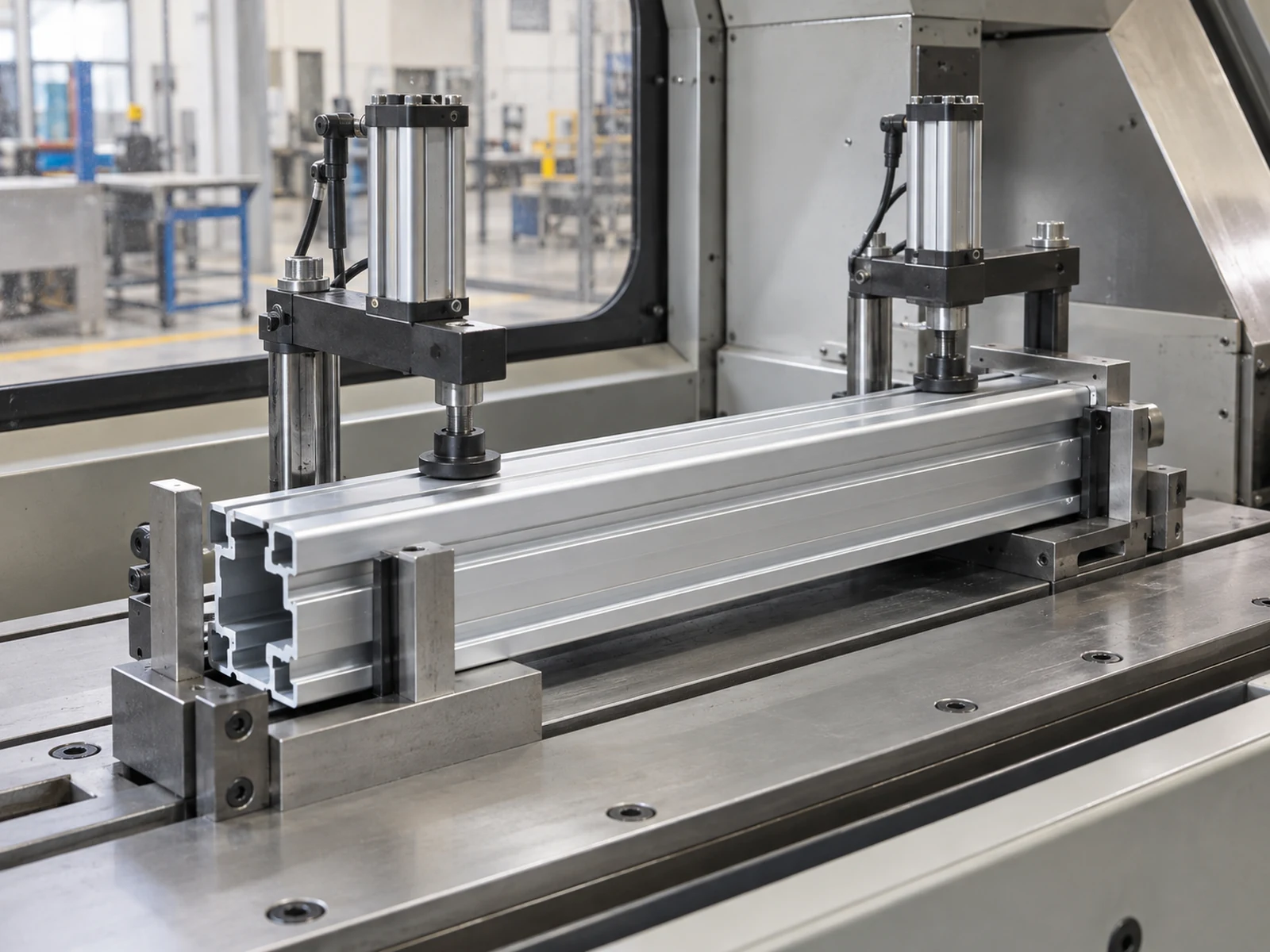
Before buying a machine, send the supplier the actual profile drawing and representative stock. A nominal tube size does not establish how a thin wall behaves under clamping, whether a square face can be referenced consistently or where a finished anodized surface may touch a support. Request a witnessed or documented trial with the intended blade, holding method, length stop and infeed/outfeed arrangement. Record which settings were used; a sample from another section is only a general process demonstration.
Inspect several consecutive pieces, not only the first attractive cut. Check the declared length datum, end squareness or specified angle, burr condition, visible deformation and finish contact. A piece that measures correctly before deburring may fail the assembly length after hand finishing. Agree who removes burrs and how the accepted edge is measured. For a bent or formed part, reserve a separate fit check in the actual assembly.
Keep downstream operations in the quote
A Bimini frame bill of materials can include snap buttons, slides, hinges, fasteners and fabric. The cutting quotation should say whether it includes only raw blanks, deburred blanks, drilled and oriented members, formed bows, assembled subframes or a packed kit. If any bought-in piece has a lead time or a version-specific fit, list it separately. Mixing these scopes is a common source of “the saw is too slow” conclusions when cutting is not the bottleneck.
Plan handling around finish as well as length. Separate stock from accepted blanks, protect exposed surfaces as required by the drawing, label parts by member ID and keep a first-off sample with the batch record. For a knock-down kit, verify the packed member count and connection orientation against the assembly traveller. Packaging and assembly are outside a saw’s cutting performance, but they determine whether the cut parts are usable on the boat.
A practical Bimini frame tube cutting RFQ packet
Send one packet to each saw supplier so their responses can be compared on the same basis:
- Assembly drawing and revision, with straight members and bent bows identified.
- Profile cross-sections, size/wall/finish, stock length and expected cut quantity by member ID.
- End drawings showing cut plane, length datum, orientation and any non-saw features.
- Representative stock and the required first-off and consecutive-piece checks.
- Required infeed, holding, outfeed, deburring and part-marking scope.
- Quoted exclusions for bending, drilling, assembly, hardware, fabric and installation.
Ask the supplier to reply line by line: supported with the quoted setup, supported only with an option or secondary process, or not included. A drawing-backed response is more useful than a generic capacity number. For a broader marine profile procurement framework, see our boat rub rail cutting guide; for another round-tube kit with different joints, see the boarding ladder tube guide. The geometry and acceptance checks must still be set independently for this Bimini job.
Related cutting-equipment video
The following video from Jiurun’s own channel shows a related aluminum cutting-equipment scene. It does not establish that the pictured machine, fixture, material, customer, Bimini frame or cutting result is the one discussed here.
Make the purchase decision at the process boundary
For Bimini frame tube cutting, the useful saw decision is limited and concrete: can the quoted setup repeatedly cut the actual straight members to the approved end and length requirements while protecting the section and finish? A “yes” to that question does not certify a bent bow, hole pattern, hardware fit, assembled top or marine installation. Keep those acceptance steps with the responsible designer and fabricator.
If you want a machine proposal, send Jiurun the marked member drawing, stock section, target quantity and sample-check plan. We can discuss a cutting trial against that defined scope and identify operations that need a separate station or supplier.
Source notes
The kit examples and frame-selection distinctions above come from Taylor Made’s pontoon Bimini kit, square-tube kit and Bimini frame selection guidance. They describe Taylor Made products; they are not Jiurun machine specifications or a substitute for your project’s drawings.