
An automotive side sill extrusion saw trial is a purchase test for a defined cut blank, not a shortcut to approving a vehicle structure. A side sill may start as a long, asymmetric, multi-cavity aluminium extrusion, while its released component can also require machining, joining, inspection and traceability after cutting. A useful saw quotation therefore begins with the exact member family and the receiving operation. If the quotation merely promises to cut “EV profiles,” the buyer cannot tell whether the proposed support, reference face or handoff will work on the approved part.
This guide is for a manufacturer deciding whether to retain the straight-cut blank stage in-house, buy prepared blanks, or ask one supplier for a wider fabricated component. It sets out the saw-stage evidence to request without treating a photo, a generic video or an acceptable end face as proof of crash performance.
First separate the sill blank from the finished component
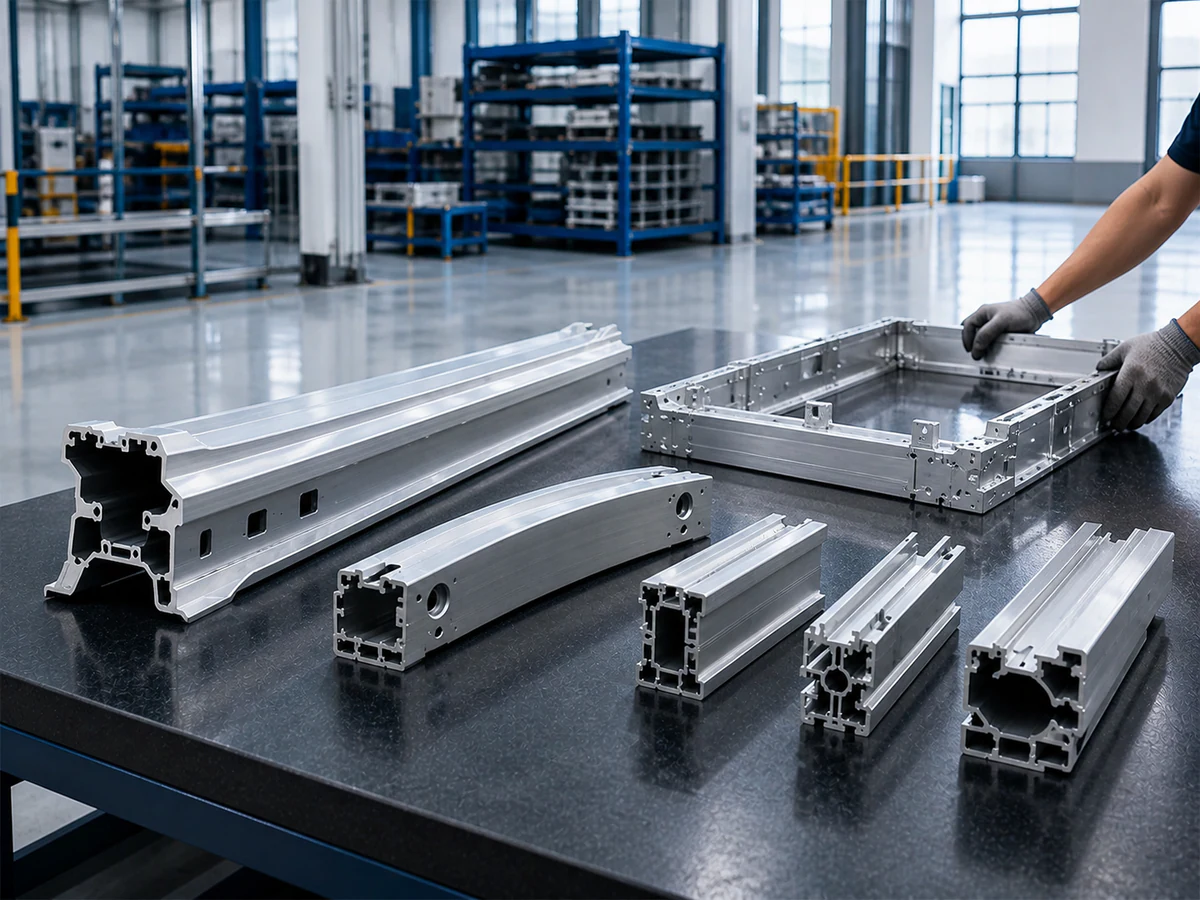
Hydro describes automotive sills as complex extruded profiles and lists cutting alongside CNC machining, punching, welding and assembly as separate value-added operations. Its automotive sills overview is an example of how an extrusion can move through several stages; it is not a specification for a Jiurun machine or for your vehicle program. Hydro also describes the distinction between long profiles and ready-to-fit components in its automotive component production overview.
Ask the buyer, extrusion supplier and receiving team to mark a boundary on the released drawing. Is the saw expected to deliver a straight blank at a defined length and end condition? Does a later fixture establish hole positions or weld references? Are bent members, cast nodes or complete sill assemblies purchased? Put each operation in one supplier’s scope. A saw trial may verify a cut blank against its agreed drawing, but it cannot validate the subsequent body structure, side-impact behavior, joining process or automotive approval.
For the request for quotation (RFQ), identify each proposed input by drawing revision, material and temper as stated by the approved release, extrusion cross-section, stock length, finish, and any pre-existing holes or surface features. Do not assume every member is raw and straight. Label left and right members separately where they are handed. Mark the planned downstream operation and its actual receiver so that a visually similar blank cannot be accepted under the wrong identity.
Choose the datum before judging length
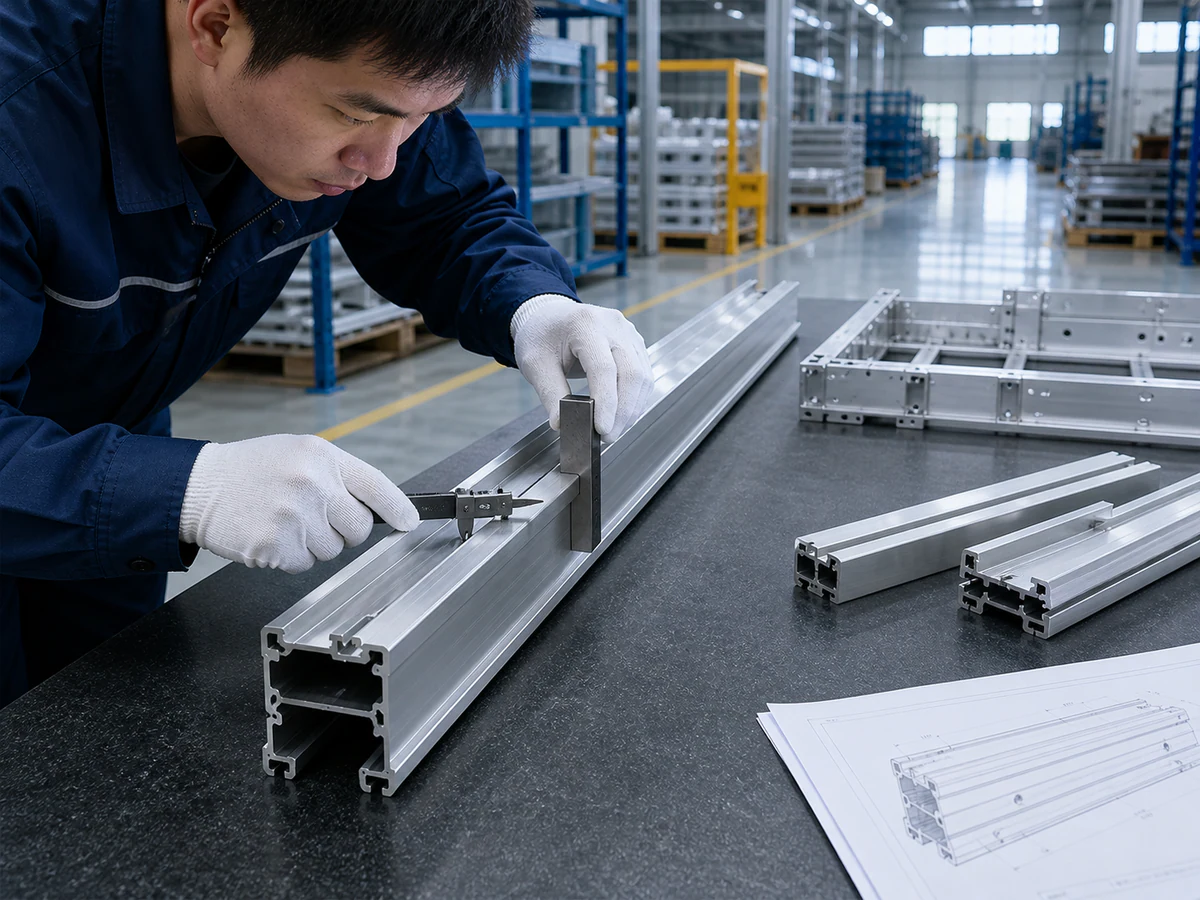
The most consequential ambiguity is often the measurement reference. A long sill section may have several lips, channels and cavities, none of which automatically becomes the datum for the finished cut. The drawing owner should identify the reference face or edge, the measurement points for overall blank length, the permitted end geometry, and the inspection method. If left and right parts use opposite orientations, the hand designation belongs on both the work instruction and sample label.
Do not turn a feed-positioning claim into finished-part accuracy. Feed control describes one part of a machine cycle; the released blank is judged by the relevant drawing and agreed inspection method after cutting. Ask the supplier to show where a stop or gripper contacts the real profile, what happens at the first cut after a changeover, and how a short remainder is handled. Any numeric acceptance limit must come from the customer’s controlled print or a separately agreed trial plan, not from this guide.
A buyer should also specify whether a cut is square to the reference face, mitered, or intentionally offset. Record which end is the datum end and which is the process end. If the profile already carries punched features, the cut-to-feature relationship must be assigned to a controlled inspection step. The saw’s straight cut does not create, position or verify those features by itself.
Trial support and clamping on the actual cross-section
A multi-cavity profile can be stiff in one direction and vulnerable at a thin lip or open channel in another. Before discussing cycle time, have the supplier show the profile seated in the proposed fixture in the orientation required by the drawing. Identify the supported faces, clamp contact areas and free-standing overhang. The goal is to prevent the trial from succeeding only because an operator holds the part by hand or because a substitute solid bar is easier to clamp.
Inspect the first cut blank for local marking or distortion at contact areas, movement during cutting, chatter marks and an end condition that the next process can accept. If protective pads or a dedicated nest are required, record them as quoted tooling, not as an assumed standard feature. Repeat the setup after removing and reinstalling the profile. If changing from a large side sill to a smaller member changes the supports, include that changeover in the trial and quotation.
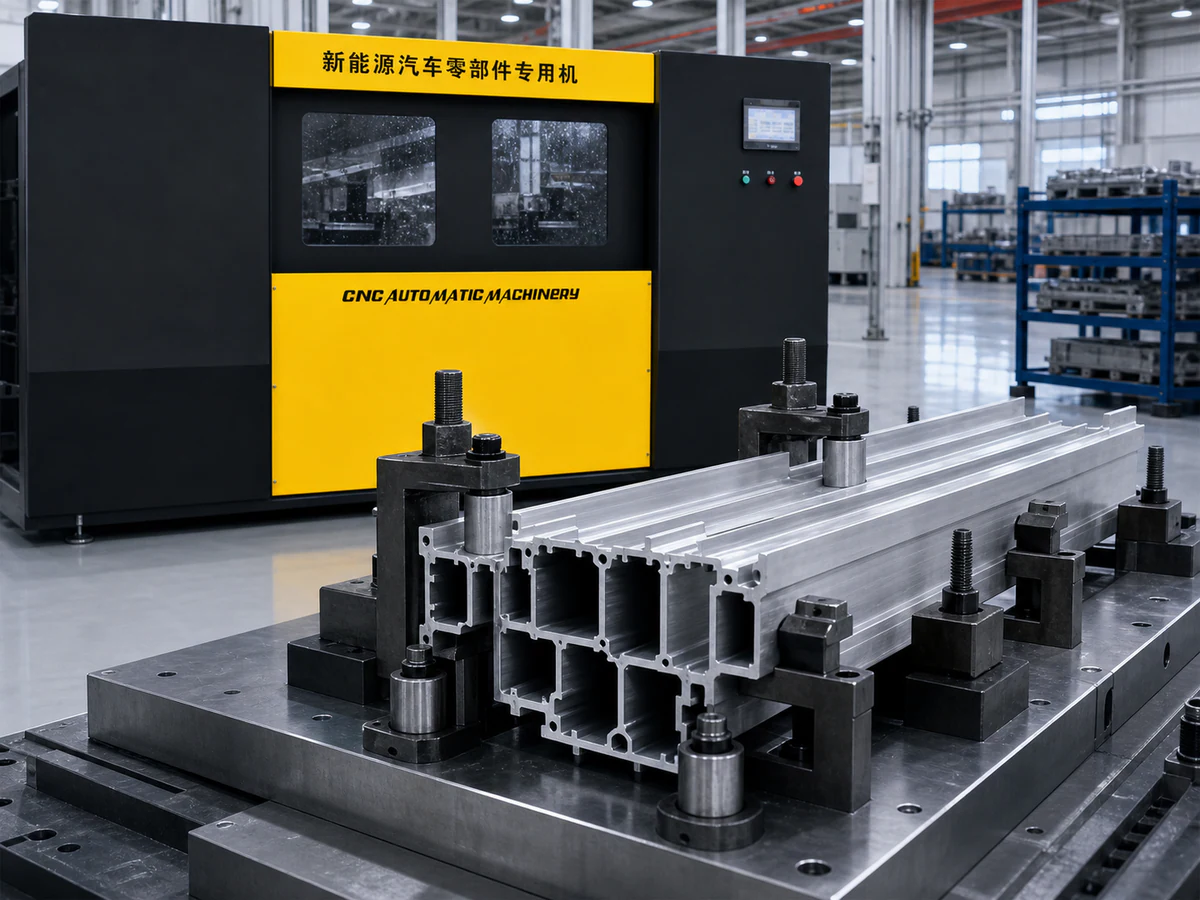
For a long member, check how the inbound stock and outbound blank remain supported throughout the cut. The buyer should ask the supplier to state the required material-handling equipment and floor-space assumptions. A successful short sample on a bench does not demonstrate that a full-length released stock bar can be fed, supported and removed in the intended production route.
Automotive side sill extrusion saw trial: what a sample proves
Plan a small, representative matrix rather than asking for an impressive-looking video. Include the largest and smallest released straight sections if both belong to the purchase, the handed orientation where relevant, and a changeover back to the original member. For each sample, record the source stock, drawing revision, fixture setup, cut sequence and receiver. Preserve one labeled accepted blank for a later repeat-order comparison; it supplements, rather than replaces, the controlled drawing and inspection plan.
| Trial question | Evidence to collect | Decision owner |
|---|---|---|
| Does the actual section seat repeatably? | Fixture contact photos, setup record and reinstallation observation | Manufacturing engineering |
| Is the approved length datum clear? | Drawing reference, measurement method and labeled cut sample | Drawing owner and quality |
| Is the cut end acceptable for its next operation? | End-face and burr review against agreed receiving criteria | Receiving operation |
| Can each released family be changed over? | Tooling list, first-piece inspection and repeated setup record | Production and supplier |
| Are process boundaries explicit? | Separate responsibility for cutting, machining, joining and vehicle validation | Buyer and program owner |
Ask the supplier to identify all included samples and exclusions in the trial report. A trial that only shows a blade passing through an unspecified profile has little purchasing value. Equally, an acceptable straight blank does not prove hole location after machining, welded assembly geometry, sealing, impact response or any vehicle-level qualification. These require their own program evidence and decision owners.
Compare the complete purchase route
Two quotations are comparable only when they deliver the same accepted stage. One supplier may quote a saw and a generic clamp, while another includes a dedicated nest, feed support, sample program, training and spare tooling. A third may sell prepared blanks. Record the stage at which the buyer receives an accepted item and the work still required downstream. Include material loss from the actual released cut schedule, setup effort across the member families and the cost of handling long profiles; do not assume a single nominal cycle time describes the whole program.
If the factory is also choosing equipment for battery tray members, keep that component route distinct. A tray side rail and a body side sill may both be aluminium extrusions, but they can have different drawings, datums, downstream operations and acceptance owners. Shared equipment can be assessed only after the released samples and tooling changes are understood.
The useful RFQ deliverable is a short responsibility and evidence package: approved member list; input and output stage; datum and hand convention; actual stock and sample requirements; proposed supports and consumables; cut-end inspection criteria; downstream handoff; and a clear statement of what the saw trial will not prove. This gives engineering, purchasing and the receiving shop a common basis for an honest quotation.
General equipment footage
The video below is from Jiurun Machinery’s own YouTube channel and shows general aluminum cutting equipment footage. It is an equipment/process illustration only. It does not show or prove the side sill material, this article’s fixture or model configuration, an identified customer, a side sill trial, a dimensional result or vehicle performance.
What to send for a relevant quotation
Send the released side sill extrusion drawings or controlled section data, stock and cut lengths, expected family mix, left/right identification, material and finish requirements, downstream receiving criteria and the trial matrix. Mark confidential or unreleased files through your normal supplier process. Ask for a quote that explicitly names the sample sections, fixture and support arrangement, included operations and acceptance evidence. Contact JiurunCut with that bounded package to discuss a saw-stage trial; any machine suitability remains subject to reviewing the real parts and agreed criteria.