
The aluminum tube end you need depends on where it meets the next member. Two angled ends can meet at a corner. A tube ending against the curved side of another tube may need a saddle contour. Show the joint before asking for a cutting setup.
On this page
Read the aluminum tube end in its joint
A round tube cut on a flat angled plane can have an oval-looking rim. The curved outline comes from that plane passing through the cylindrical tube. The cut surfaces around the wall still lie in one plane.
A saddle end follows the curved side of the mating tube. Its edge wraps around that surface instead of lying entirely on one flat plane. A loose-end photograph can hide this difference, especially when the view is taken at an angle.
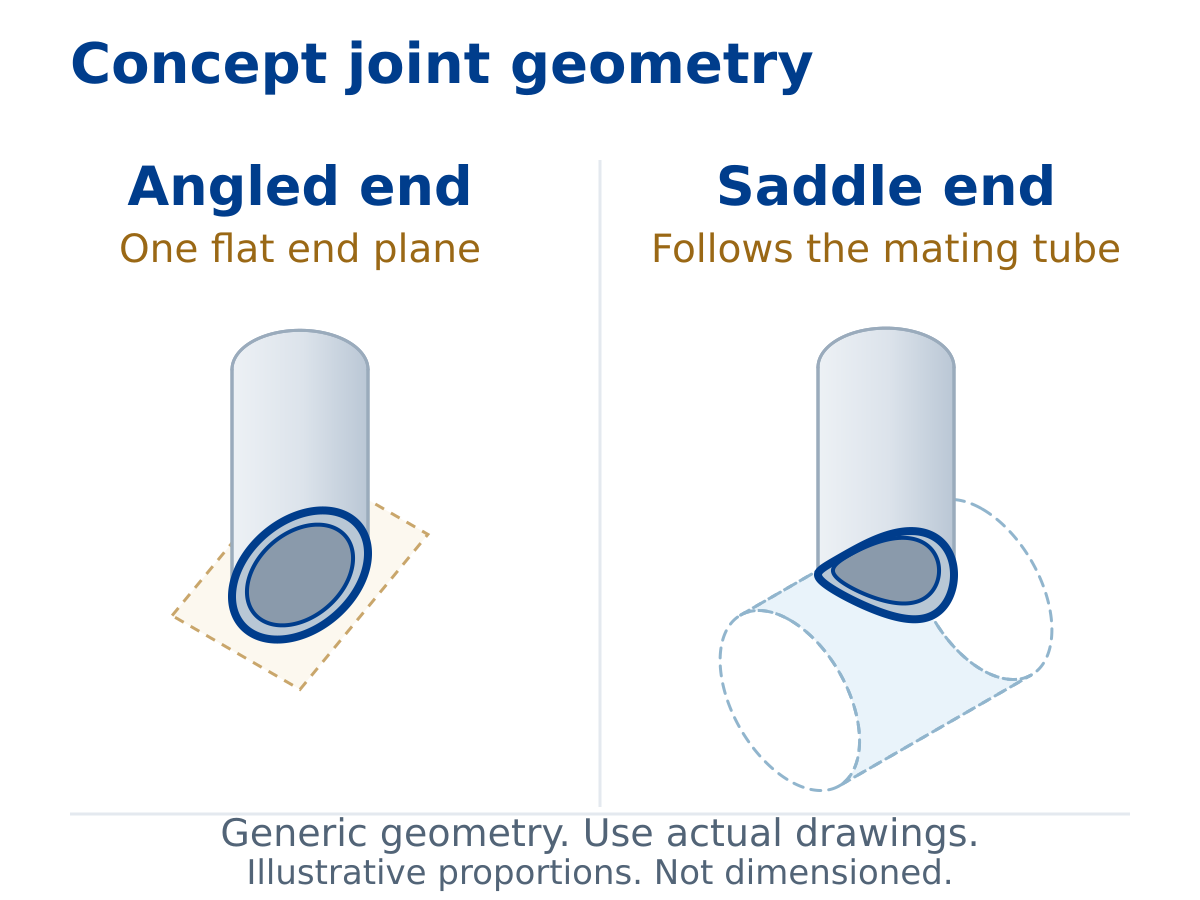
Look at the two meeting parts together. That view explains whether the required end is a planar face or a shaped contour.
Which surface will your tube meet?
Send a sketch of the assembled joint and a photo of both tubes or parts.
When two angled ends meet
In a simple mitered tube corner, the two finished ends meet each other. Each member has its own angled face, and the drawing defines how those faces form the corner.
An aluminum tube end may look right on its own while facing the wrong way relative to the other end of the same member. Keep the complete part view linked to the joint view. Our angled-tube end-orientation guide explains that separate question.
When one end meets a tube side
Imagine a round upright ending against the side of a cross tube. In a saddle-style design, the upright’s end contour follows the cross tube’s outside surface.
The matching shape depends on both tube sizes and their assembled relationship. A centered joint and an offset joint can require different contours. Changing the mating tube can therefore change the end requirement even when the upright uses the same stock.
Show the intended finished contour and fit on the drawing. Have the responsible designer define the connection and its acceptance requirements. The illustration explains the shape; it is not a connector or welding design.
Planning a tube-to-tube connection?
Share both tube sections and the joint view so the finished end can be discussed clearly.
Discuss the cutting stage
Jiurun’s brochure identifies the JR-550CNC-CORNER as an automatic corner-cutting machine. Use your complete tube drawing to discuss the proposed cutting arrangement.
Ask what condition the part will reach when it leaves the saw and which end preparation remains afterward. If the order needs a saddle, identify how that contour will be produced and who will provide it. Keep those operations visible in the quotation.
The cutting-before-welding guide discusses how to separate a cut blank from later joint preparation.

Watch: Jiurun angle-saw demonstration
Use this angle-saw reference when discussing the cutting stage for your actual parts.
Discuss your aluminum tube end with Jiurun
Show what it will meet, the required finished shape and your usual batch quantities. Ask for the cutting scope to be checked against those parts.
Sources and scope
Machine context: Jiurun brochure, physical PDF page 13, through Catalog & Downloads. Ercolina’s end-forming overview describes tube-end notching to fit a mating tube or pipe. This supports the general distinction, not a Jiurun saddle-cutting claim. The diagram is simplified geometry; confirm the complete manufacturing route for your actual joint.