
Aluminum saw relocation is a transfer of an existing cutting system, not simply a delivery of the main machine to another building. Plan it around the equipment that is actually installed, the conditions that will change and the evidence needed before the system returns to use. A machine that previously made acceptable parts has a useful history, but that history does not automatically approve a different installation or production task.
Start by identifying what moves, what stays behind and who will review the receiving factory. Keep transport completion, installation inspection, production verification and the factory’s release decision separate. This purchasing guide helps define the information and service scope; the responsible specialists must determine and carry out the actual preparation, disconnection, movement and installation work.
Establish the system record for aluminum saw relocation
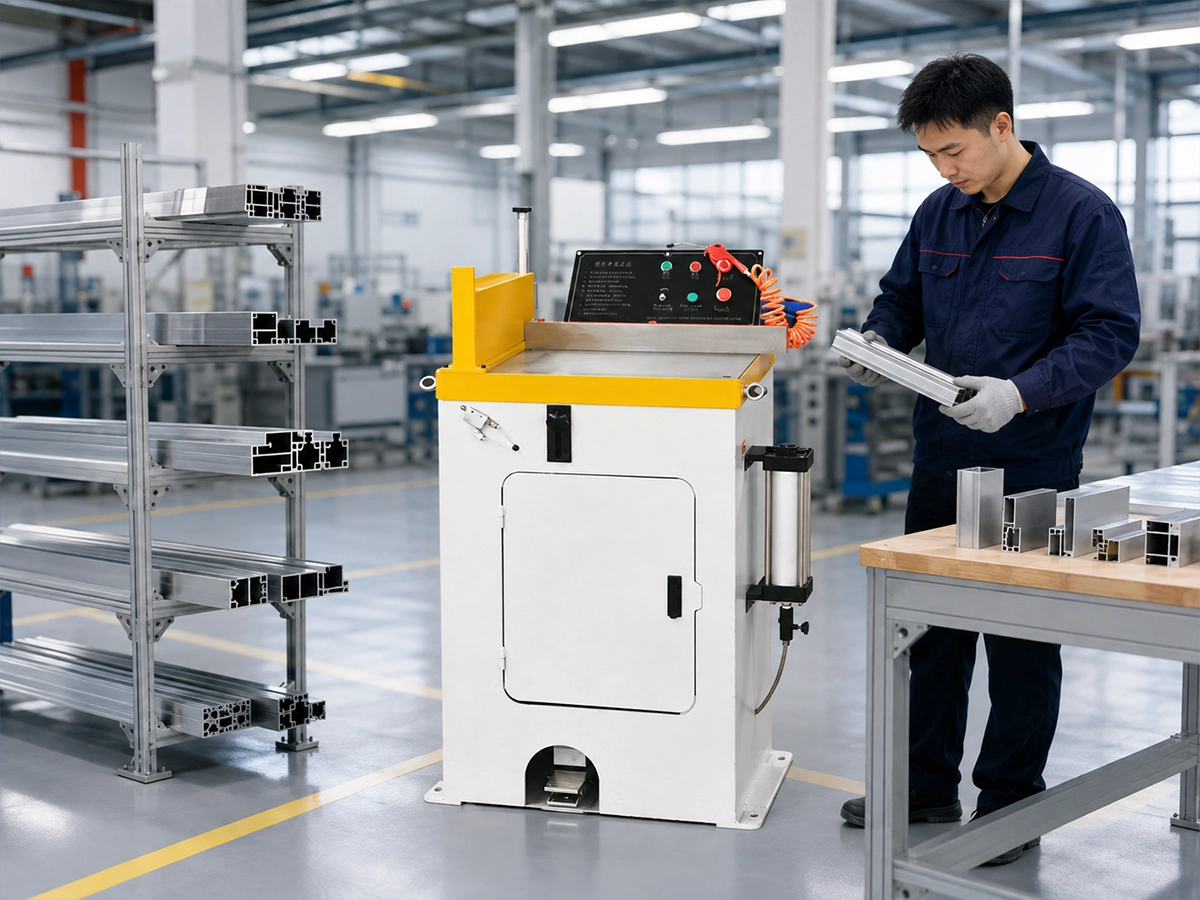
Use the equipment identity as the anchor: manufacturer, model, serial number where available, and the known configuration. Identify the saw, feeder, stock supports, outfeed equipment, collection equipment and other connected items that belong to the system. Distinguish manufacturer-supplied equipment from additions installed by the previous owner or another provider. A model name by itself may not identify all of those arrangements.
Collect the applicable manuals, drawings and recorded changes. Check that they refer to the equipment as currently installed. If a document describes the original supply but a later addition is not recorded, label the gap and identify who can clarify it. Do not turn an old drawing into an as-installed drawing simply by changing its filename or date. The electrical-drawing guide discusses one part of this documentation question.
Preserve relevant condition, service and inspection information with the equipment identity. Record known unresolved issues rather than asking the move to erase them. A relocation contractor’s offer to transport a saw does not necessarily include diagnosing an existing intermittent fault or restoring a worn component. Those are separate items of work that need an agreed scope and responsible provider.
Also preserve the production context behind earlier results: profile drawing revision, alloy and temper information, stock condition, cut lengths, angle requirements, inspection method and the part destinations. Keep the difference between an observed production result and a guaranteed capability visible. This history helps the receiving team ask focused questions, but it is not a substitute for deciding what needs verification after the move.
Compare the old and new operating conditions
Create a change register before requesting the transfer service. Describe each relevant old condition, the proposed new condition and who has reviewed the difference. The goal is not to declare the site suitable from a checklist. It is to identify which existing assumptions need a responsible technical review and which missing facts prevent the relocation plan from being complete.
| Review area | Old-to-new information | Question for the responsible team |
|---|---|---|
| System boundary | Connected items moving, retained or replaced | Will the complete intended system still be available? |
| Factory services | Applicable supply specifications and proposed connections | What compatibility evidence is required for this unit? |
| Physical arrangement | Stock entry, part exit, supports and surrounding access | Which interfaces or tasks change at the receiving site? |
| Environment | Stated location conditions and relevant manufacturer limits | Does the existing configuration remain applicable? |
| Cutting work | Actual old task and proposed part families | Which earlier results are relevant to the new work? |
| People and support | New users, supervisors and maintenance arrangements | What information and task-specific preparation are missing? |
For factory services, obtain the actual machine requirements and the new site’s confirmed information. Do not use a familiar plug, motor power figure or national supply assumption as a complete compatibility decision. The power-supply purchasing guide covers the information request; connection decisions belong to the responsible qualified people.
A changed arrangement can also alter the handling job even when the cutting task is unchanged. Stock may enter from another location, supports may be supplied by someone else, or completed parts may go to a different downstream station. Review those interfaces as part of the existing-system transfer. Refer to the actual equipment instructions and responsible providers rather than assuming a rearrangement is equivalent because all items fit on the floor.
Agree the scope of the relocation service
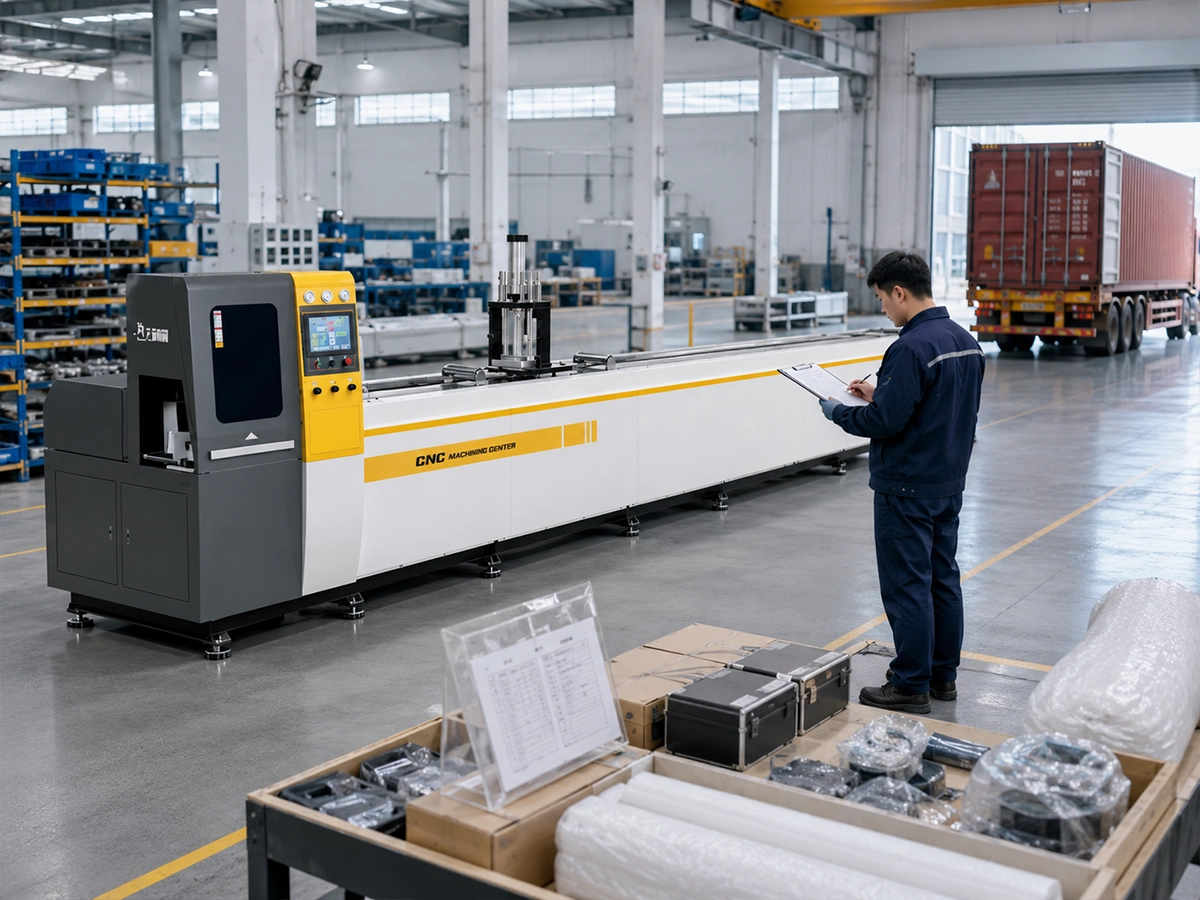
Ask for a service proposal that names the equipment and the start and end of the provider’s responsibility. Identify whether it covers a pre-move review, preparation, transport, receiving, reinstallation, applicable inspection or agreed production verification. An offer described only as machine relocation can leave the buyer with a different expectation of completion from the contractor.
Separate included activities from work performed by other parties. The manufacturer may provide configuration information, a specialist may manage the physical movement, and the factory may supply site services and authorize production. These roles are examples, not a mandatory provider arrangement. Name the actual parties and obtain their acceptance of the interfaces instead of assuming that one provider will complete everything.
Request the information needed to define the work without inventing movement instructions. Applicable equipment records, access information and the receiving location should go to the responsible planner. If further site assessment or manufacturer instructions are needed before a firm proposal is possible, record that condition. A procurement worksheet cannot establish lifting points, isolation arrangements, transport restraints or installation settings.
Where service or maintenance work forms part of the project, the UK HSE’s maintenance guidance emphasizes planning, suitable information and competent people. Treat that as UK-context guidance, not a worldwide relocation procedure. Agree the actual work arrangements with the responsible specialists; do not substitute this article for their machine-specific instructions.
Compare proposals using the same completion definition. If one ends at equipment delivery and another includes defined new-site checks, their prices cover different work. Ask for any exclusions, required factory inputs and conditions that can change the scope. Avoid assigning a cost of zero to missing inspection, unresolved repairs or site work simply because no amount appears in the transport offer.
Worked example: a transfer offer leaves the receiving review unassigned
Consider an invented comparison. Provider A offers to transfer the identified saw and connected items, with completion at delivery to the receiving factory. Provider B offers a transfer plus a specified reinstallation service. Both offers describe the machine as relocated, but neither identifies who will determine the applicable new-site inspection or authorize the intended production task. Choosing B does not close those gaps just because its description contains more activities.
Put each proposed result beside an actual responsible party. Ask A to confirm its delivery boundary and B to define the result of its reinstallation service. Ask the receiving factory who will arrange the installation-related review and the agreed production verification. Where a separate specialist is needed, obtain that scope as a separate item and reconcile the information the specialist requires from A or B. A list of provider names is insufficient if each believes the next party owns the same unresolved question.
The purchasing decision can then compare complete arrangements. An apparently lower transfer price may leave the buyer to procure another service; the higher offer may still depend on documents or factory inputs that are unavailable. Record the unresolved scope and obtain its price or pricing basis before calling either offer a complete project cost. This comparison concerns who delivers which result. It does not establish a safe method of moving, connecting or operating the machine.
Use a short handover entry for each interface: the result required, the named provider, the information to be supplied, the person receiving that information, and the next decision it supports. If the manufacturer supplies a configuration clarification, identify who must review it for the receiving arrangement. If a contractor reports its contracted work complete, retain that report without relabeling it as the factory’s production release.
Keep new-site checks separate from old production evidence
In the UK, HSE’s work-equipment inspection guidance identifies new-site reassembly as an inspection circumstance where safety depends on installation conditions. It also explains that inspection scope follows risk assessment, relevant manufacturer recommendations and the necessary competence. This is a jurisdiction-specific reference. The applicable requirements for the receiving location must be established by the responsible team.
Keep that installation-related decision separate from whether the relocated saw meets the required cutting task. A transport receipt does not demonstrate either. Similarly, a satisfactory cut-length measurement is not a complete assessment of the installation. Record what each check covers, who determines the method and who makes the resulting decision; do not describe a single successful sample as approval of every aspect of the move.
Consider an invented planning example. An existing system previously cut profile family A, with one stock support arrangement and a documented part destination. The new factory proposes family B and a different support arrangement. The old family-A records remain useful evidence of the earlier job. They do not answer the applicability questions for family B or the changed arrangement. The change register should identify both differences rather than marking the whole system previously proven.
If the same family A is retained at the new factory, the previous results still need their conditions attached. Ask which relocation-related checks and production verification the responsible team requires. That is a narrower question than treating the equipment as completely untested, but it also avoids assuming that previous results prove the current installation. Agree representative parts and decision criteria before arranging any authorized verification work.
Plan the interruption and handover around real dependencies
Identify the last required production work at the old location and the activities needed before the receiving factory can use the system. Keep dates for stopping production, transfer, installation-related review and production release visible. Do not call the transport arrival date the restart date unless all necessary dependencies have actually been satisfied.
As another invented example, assume transport delivery on day ten, the necessary installation decision on day fourteen, and completion of the agreed production verification on day seventeen. Under those assumptions, an intended day-eleven production restart is not supported. The dates are planning illustrations only; they do not represent Jiurun service times or predict the duration of a real move.
Ask how production requirements will be covered during the interruption. Compare supported options using the actual customer demand and available capacity. Extra finished stock, another qualified resource or a revised order schedule may each need their own approval. Avoid treating a backup machine, spare shift or external supplier as available without confirmation, or promising output from a machine that has not been released for the intended task.
Prepare a handover record connecting the pre-move identity and condition to the received system, the applicable documents, changed conditions, completed checks and remaining actions. Name the person responsible for each unresolved item. If a fault is discovered, preserve the observations and their timing without assigning a cause merely because the finding occurred after transport. A useful handover allows the next reviewer to see what has changed and what remains unknown.
Worked example: the records omit a later addition
Suppose an invented system has an original supply drawing and a support assembly added by the old factory several years later. The receiving team plans to move both. A photograph shows the addition, but the original drawing does not identify it. Copying the original documentation to the new factory therefore preserves useful supply information while leaving the actual system boundary unresolved.
Record the distinction directly: original manufacturer-supplied arrangement, observed later addition, and applicability still to be reviewed. Ask the appropriate parties for the addition’s identification and relevant records. Keep the photograph linked to when and where it was taken; its visible arrangement is an observation, not proof of design suitability or approval. Do not attribute the addition to the saw manufacturer without matching evidence.
If clarification changes the proposed transfer scope, retain the earlier scope and issue a dated revision describing the affected items and decisions. Reconcile that change with transport, receiving review and production planning. A revised drawing supplied after booking does not mean every provider has incorporated it. Confirm that the parties whose work depends on the revision have received the applicable information and identified any effect on their scope.
This resolves a practical purchasing question: whether the available records define the system being bought as a transfer service. It avoids both discarding all earlier evidence and treating incomplete historical records as a current technical decision. Any actual alteration or return-to-use assessment remains work for the responsible competent team.
Request the transfer review before booking the work
For an existing saw, assemble its identification, configuration records, relevant condition history, old cutting task and proposed new task. Add the receiving factory information and identify connected items that will be retained, replaced or supplied separately. Mark missing information explicitly and ask the responsible providers what additional review is needed to define the transfer.
Ask each service provider to describe its work boundary, required inputs, completion evidence and arrangements for changes. Reconcile those responses into one project scope. The buyer should be able to distinguish physical delivery, completed contracted work, applicable installation decisions and authorization for the required production task without relying on an informal statement that the machine is back in place.
If you are reviewing the equipment requirements for a Jiurun saw at another location, send the model and equipment identity, current configuration records, profile drawings, cut lengths and tolerances, and the proposed factory conditions. Request confirmation of the applicable equipment information and any offered support scope. Relocation services, inspection, modifications and performance at the new site require specific confirmation; an inquiry does not establish that they are included or guaranteed.
Use a cutting video for equipment context
This Jiurun equipment video illustrates a cutting job. It does not demonstrate a relocated installation, confirm transfer-service scope or approve a return-to-use decision.