
An aluminum saw for roof rack manufacturing should be specified around the aluminum members your factory will actually cut—not around a finished rack’s outside dimensions or a catalog photograph. A business may buy complete crossbars and platforms, buy prepared member kits, or retain long extrusion stock and make cut parts in house. Those three routes put very different work on a saw. Define the retained route first, then test the difficult members, handoffs and changeovers before comparing machine quotations.
This guide concerns production planning for cut aluminum members. It does not establish vehicle fit, load capacity, attachment safety, aerodynamic behavior or compliance of a finished roof-rack system. Those decisions belong to the product owner and its approved design and validation process.
Start with the roof-rack product family, not a single “rack size”
Crossbar systems and platform systems can contain different extrusion sections and different kinds of joints. For context, Yakima describes JetStream as an aluminum crossbar, while Rhino-Rack describes a modular aluminum Pioneer platform. These are examples of product categories, not evidence that their parts are made on any Jiurun machine or that one saw is suitable for either manufacturer.
For each family that you make, build a released member list. Separate crossbars from platform perimeter members, slats, supports and any other aluminum parts that your drawings identify. Record the extrusion section, alloy or temper if specified, finish state, stock length, cut length, end condition, quantity per saleable unit and revision. Record bought components separately. A finished rack, a pair of crossbars and one loose cut member are different counting units; do not use them interchangeably when quoting capacity or scrap.
The first purchase decision is therefore a make-or-buy boundary. If a supplier already sends ready-to-assemble bars, your proposed saw may only support exceptions and rework. If your factory retains full-length stock for several models, the saw may become a central preparation station. If one family is bought complete while another is cut in house, specify both routes explicitly rather than averaging them into an imaginary “typical rack.”
What an aluminum saw for roof rack manufacturing must actually cut
- Complete bought product: identify whether any aluminum cutting is actually required. Inspection, kitting and assembly alone do not justify a production saw.
- Prepared member kit: identify the few late changes or replacement lengths that remain in house; quantify their frequency and the accepted drawing revisions.
- Long extrusion stock: list each section and cut length, minimum practical part, longest supported stock, expected batch size and sequencing rule.
- Mixed route: separate standard purchased members from specials, prototypes and service parts, so the quote is sized for the work you retain rather than the volume you buy.
Keep the source of each length unambiguous. The cut length on a member drawing is not automatically the outside dimension of an assembled platform. Connectors, end caps, joint geometry and later operations can change that relationship. Ask the product engineer for the released cut-part drawing and its measurement datum.
Follow one member from incoming stock to the next operation
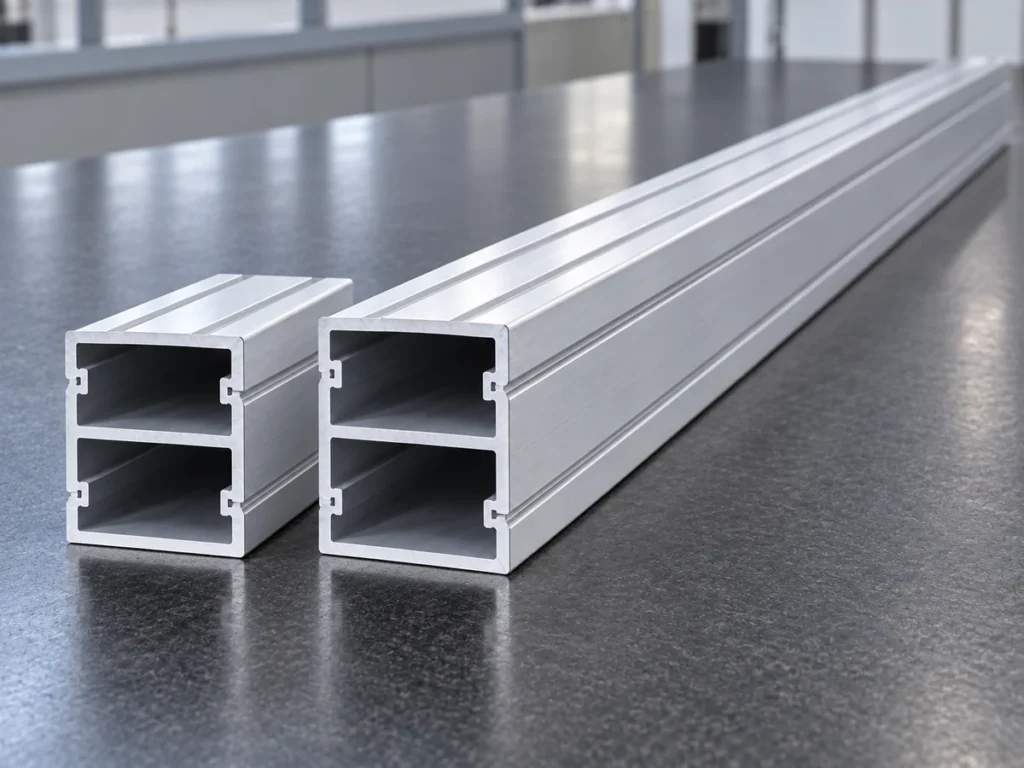
Before selecting a saw, map the route for one long crossbar section and one different platform section. At receiving, the operator needs an unmistakable stock identifier and revision. At infeed, the profile must be supported without twisting or scratching the surfaces that matter. At clamping, contact should hold the actual cross-section without crushing a thin wall or bearing only on a fragile lip. At the cut, the acceptance rule should name length datum, angle where relevant, burr and visible-face condition. At outfeed, the part needs a positive identity before it joins a kit.
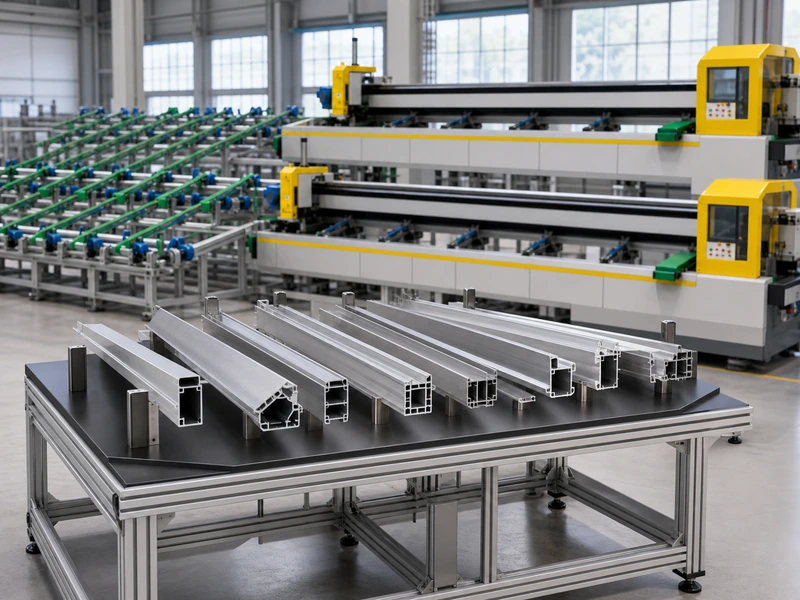
Then record what happens after sawing. Drilling, milling, deburring, finishing, assembly and final fit checks may be performed elsewhere. A saw purchase does not automatically include those operations. If a finished or anodized extrusion will be cut, define how the factory will protect that surface and assess a cut edge; if cutting occurs before finishing, define the transfer point and responsibility. Neither route should be assumed from a product photograph.
Plan the physical handoff too. Long profiles can look alike while carrying different revisions or destination models. A label or traveler should connect each cut batch to the correct section, drawing, length, finish state and downstream order. For general cut-part staging principles, see our long aluminum cut-part staging guide. It is a separate handling topic; this article uses it only to frame the roof-rack member handoff.
Build a trial set that can reveal the wrong machine choice
A useful supplier trial uses the actual retained sections, not just one easy straight sample. Send approved drawings and physical profile samples or an accurate section specification. Include a long member that challenges support, a short member that challenges clamping and an end or wall geometry that is sensitive to marking or burrs. If the factory needs angle cuts, identify the drawing and acceptance method; do not assume a nominal machine angle proves the assembled joint.
Ask the supplier to show the setup and record what was demonstrated: stock presentation, contact points, measured cut parts, cut-face condition, changeover steps, piece identification and any downstream work that was outside the demonstration. Agree who measures, with which datum and instrument, and where the measurements are recorded. A video of a general saw running is useful to understand the station, but it cannot substitute for this part-specific evidence.
Video illustration: footage from the Jiurun Machinery YouTube channel shows a general aluminum cutting machine. It does not demonstrate these roof-rack materials, the configuration quoted for your factory, a customer trial, cut-part acceptance or performance.
Keep a trial matrix by section and cut condition. If a candidate machine cannot accommodate a retained section, revise the scope or the process route before ordering. If only a special fixture or optional feed arrangement makes the trial possible, put that exact configuration in the quotation and acceptance record. Avoid turning a demonstration of feeding repeatability into a claim about finished-part accuracy or complete roof-rack fit.
Compare quotations on the same production boundary
Request separate line items for the saw and blade arrangement, section-specific clamping or support, stock infeed, outfeed, measuring method, cut-part collection, controls, installation scope, operator training and trial acceptance. Ask which accessories and fixtures are included, which are options, and which must be provided by your factory. Describe the site’s space and power requirements, but have the supplier confirm them for the quoted configuration rather than assuming a specification from another model.
For each offer, compare the same mix of sections and release patterns. A low machine price can be offset by frequent manual changeovers, extra fixtures, damaged finished surfaces, ambiguous part identification or downstream recutting. Conversely, a high-throughput configuration may be unnecessary if almost all production is bought as prepared kits. Evaluate the route cost with your own measured volumes, setup time and rejection data; do not accept generic yield or labor-saving percentages as proof.
When the decision includes shipping or assembly away from the saw, specify whether the quotation ends at a loose cut part, a labeled member kit or a completed assembly. That boundary determines what the saw supplier must demonstrate and what the product manufacturer must still validate. For a related receiving problem, our cut-part transit damage evidence guide explains why part identity and condition records matter after dispatch.
Questions to send with the RFQ
- Which crossbar or platform families are retained for in-house cutting, and which are bought complete or prepared?
- What are the released section drawings, cut-part lengths, tolerances, visible-face rules and revision identifiers?
- What are the longest stock pieces, shortest accepted parts, typical batch sizes and number of section changeovers?
- Which cuts occur before or after finishing, and what downstream operations are excluded from the saw scope?
- How will parts be supported, clamped, labeled, measured and handed to assembly or packing?
- Which real sections and cut conditions will be used for a witnessed trial, and what recorded result will count as acceptance?
Next step: send JiurunCut the released cut-part drawings, representative extrusion sections, stock and part lengths, batch mix and the intended handoff point. We can discuss a saw-station scope and a trial plan against those inputs. Product fit, load ratings and vehicle safety remain for your product engineering and validation team.