
A request for an aluminum saw for flagpole manufacturing can describe two very different jobs. One buyer purchases finished, formed shafts and only cuts brackets, sleeves or other straight components. Another starts with straight aluminum tube and retains a cut-to-length operation before forming, joining or finishing. A circular saw quotation makes sense only after the buyer identifies which operation remains in-house. This guide turns that distinction into a cut-list and trial plan, without assuming that a saw can manufacture a tapered or finished pole.
First decide what the supplier delivers
Write down the incoming condition for every pole family: a finished shaft, a formed but unfinished section, or straight tube stock. Then mark where the next irreversible operation occurs. If the shaft already arrives at its required length and form, a new shaft-cutting saw may add no value. The cutting request may instead concern accessory tubes, mounting parts or repair stock. If straight stock arrives longer than the needed precursor, cutting could be a separate station, but forming, joining, finishing and structural approval remain outside a circular saw’s scope.
Do not use “pole height” as the saw’s cut length. A flagpole manufacturer’s residential specification table lists exposed height, overall length and shipping sections as distinct fields. That is a useful example of why the buyer must name the dimension on the actual stock drawing. It does not provide a Jiurun machine specification or approve any particular pole design.
Build a route sheet before comparing machines
Make one route sheet per product family, beginning with the exact form received from the upstream supplier. Record the stock outside diameter and wall where applicable, cross-section and straightness condition, supplied length, required cut length, acceptable end condition, and which downstream process uses the cut end. Record whether the cut is on a straight precursor, a formed section, or a short accessory. Mark any taper, seam, internal reinforcement, surface treatment or attached hardware; these details change whether a conventional clamp and blade even have a valid contact area.
A route sheet should also identify the owner of each acceptance decision. The pole designer or finished-product supplier is responsible for structural and installation requirements. The saw supplier can discuss only the proposed cutting operation after receiving real stock samples and drawings. Where either party has not confirmed the interface, leave it open in the request for quotation rather than turning an assumption into a purchase criterion.
- Finished-shaft route: confirm whether any shaft cut is allowed at all; list only the separate components that still need cutting.
- Straight-stock route: identify the precursor length and the next forming or joining step; specify the end condition needed by that step.
- Sectioned route: separate cuts on raw sections from cuts on already formed or finished pieces, and obtain the section supplier’s instructions before altering them.
Translate the route into a real cutting envelope
The saw envelope is not a single maximum diameter. Send the shortest and longest required pieces, the range of incoming stock lengths, the outside diameter and wall of each round tube, and any flat, angle or other accessory profiles that are genuinely in the same order. Indicate which faces can be clamped without marking a visible finish. Identify whether long stock can be supported through the full feed path and whether a short offcut can be released safely. A proposed machine must be checked against the actual blade path, clamp contact, feed travel and downstream collection arrangement for that part mix.
For thin-wall or finished stock, the buyer should define what is unacceptable: ovalizing at the clamp, a burr that interferes with joining, a scratched visible face, or a distorted end that cannot enter the next operation. These are inspection questions, not promises that every tube can be cut cleanly. For a tapered, curved or assembled section, request an explicit feasibility review rather than assuming a straight-tube setup applies.

Check support, handling and the next station
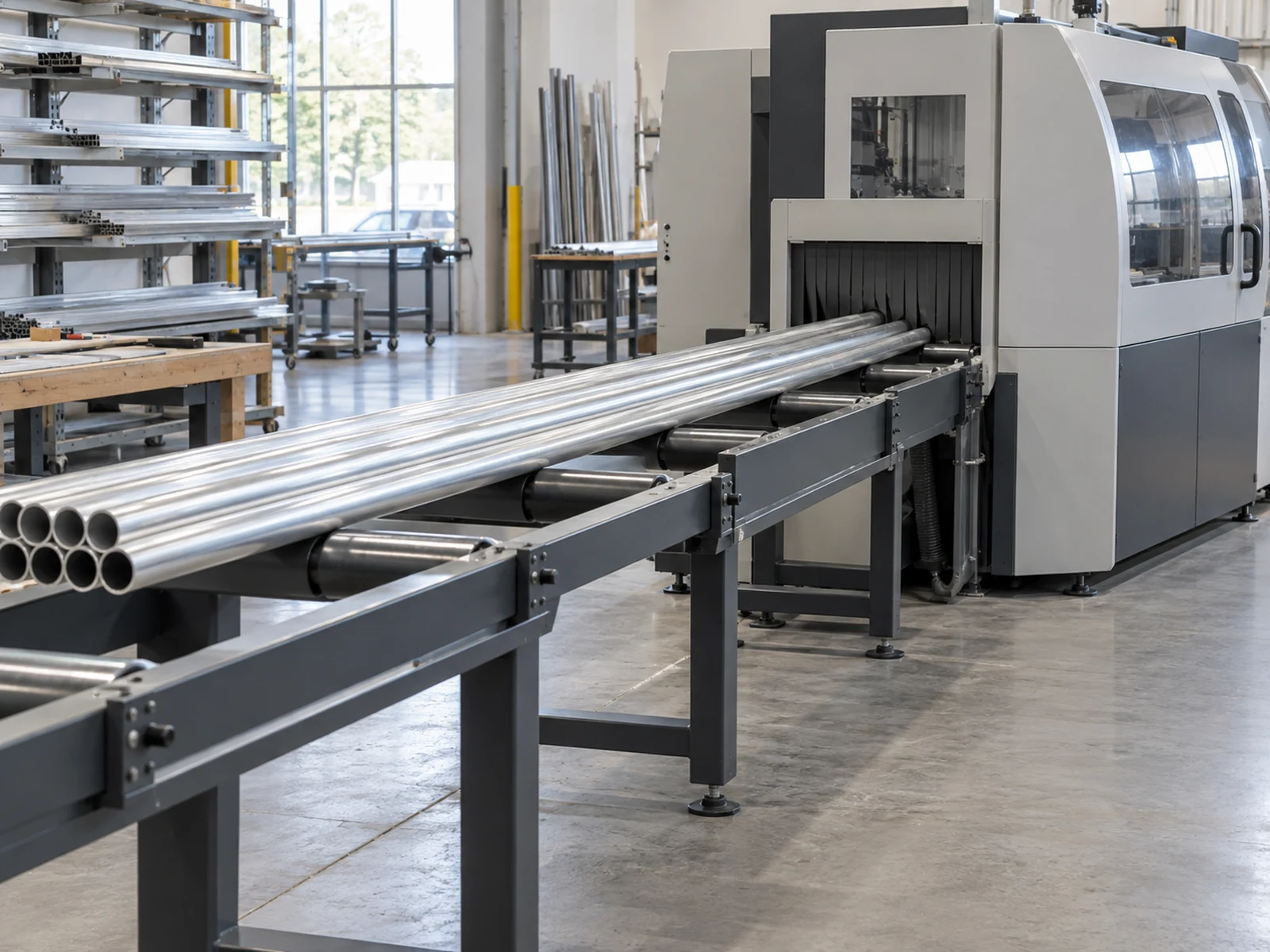
A long, light tube can still be awkward to align and protect. On a floor sketch, show where stock is staged, how it is lifted to the infeed, where it is supported before and after the blade, and how cut pieces are identified for the next station. Ask who will remove chips, protect finished surfaces, and separate accepted pieces from trial pieces. The sketch should include operator access and maintenance space, not merely the machine footprint. Our remote site-survey checklist gives a more detailed way to document those interfaces before a quote.
The image below illustrates a round-tube feed and support concept. It is not a confirmed configuration for the reader’s shaft length, tube wall, finish or plant. A purchase decision needs a drawing and a witnessed handling test with the buyer’s actual stock.
Define a trial around the next process, not a generic sample
If the route includes straight-stock cutting, ask for a trial plan before treating a machine shortlist as settled. Provide actual production stock for the smallest and largest relevant cross-sections, surface states, and cut lengths. Mark the datum used to measure the cut; explain whether the next step is forming, joining, machining or finishing. Inspect the cut end with the downstream team, because a dimension that looks acceptable at the saw may still fail at the next station.
Record blade identity and condition, clamp contact, support position, stock orientation, feed setting, measured cut length, visible burr, end deformation, surface marking and any rework. Repeat the measurement across a representative sequence, including the changeover between unlike parts if that is a real production requirement. If a substitute tube must be used, document exactly which properties differ and what conclusion the substitute cannot support. Our substitute-stock trial guide explains how to limit that claim.
Do not promote a feeding-position figure into a finished-part accuracy claim. Measuring a complete cut piece and verifying fit at the next operation are separate checks. A supplier should state which measurement was observed, on which stock, with which setup, and under what acceptance rule. Any unsupported precision, throughput, scrap or labor-saving target belongs in the buyer’s requirement sheet as a goal to test, not as an established machine result.
Separate the saw quote from finished-pole responsibility
The purchase file should have two sign-offs. The first is a manufacturing-route decision: which stock is cut, where, and why. The second is the equipment decision: whether a specific saw setup passes the agreed cutting trial and can fit the site. A saw supplier’s test cannot certify pole wind loading, installation, taper geometry, finish durability or compliance of the finished structure. Those decisions belong with the pole designer, manufacturer and relevant project specifications.
When requesting prices, send the route sheet, representative drawings, stock photos, cut list, finishing state, site sketch and acceptance plan to every supplier. Ask each one to mark included supports, clamping, chip handling, blade scope, training and trial conditions as included, optional or excluded. That makes unlike quotes comparable without inventing a universal flagpole machine.
Watch the equipment example with its limits in mind
The Jiurun channel video below shows a general aluminum-profile saw and its clamp/feed sequence. The visible material is a straight aluminum profile, not a flagpole shaft. It is an equipment-flow example only. It does not prove a specific round-tube material, flagpole model, customer setup, trial result or machine performance for this article. Use it to frame questions about stock support and operator access, then require a separate trial for the intended stock.
Aluminum saw for flagpole manufacturing: what to send
Start with one page that states whether you buy complete shafts or cut straight precursors. An aluminum saw for flagpole manufacturing should enter the discussion only after that boundary is explicit. Attach a drawing for every part to be cut, the actual incoming form, longest stock and finished-piece range, wall and diameter for tube parts, finish restrictions, and the operation that follows cutting. Add a plant sketch and a few real samples for a conditional trial. Jiurun can then discuss an industrial aluminum circular-saw cutting operation against that evidence. If the shaft arrives finished, ask about the genuine accessory-cutting task instead of ordering equipment against the word “flagpole” alone.
Next step: send your shaft-stage route sheet and representative cut list to Jiurun. State which decisions remain with your pole supplier or designer, and ask for a cutting feasibility review before requesting a model-specific quote.