
An aluminum saw for exhibition stand manufacturing should be bought for the new and approved replacement members your workshop must produce, rather than for the total size of the stands it installs. A modular stand business may own finished members, receive reusable components after a show, buy additional system parts and fabricate new lengths. Only part of that workload belongs at a new extrusion saw.
The purchase decision starts with a released fabrication schedule. Connect it to the chosen exhibition system, accepted available inventory, actual incoming profiles and the show kits your workshop must hand over. This guide explains how to establish that schedule and compare an industrial cutting proposal. It does not design an exhibition structure, approve suspended loads or prescribe how to modify a proprietary system.
1. Separate stand assembly from member manufacturing
A company building large stands is not necessarily cutting large quantities of new extrusion. It may assemble purchased finished components or combine existing members in a new layout. Before comparing saws, identify which tasks the business retains: cutting new stock, preparing approved replacement members, performing later connection operations, assembling frames, packing kits or installing at the venue.
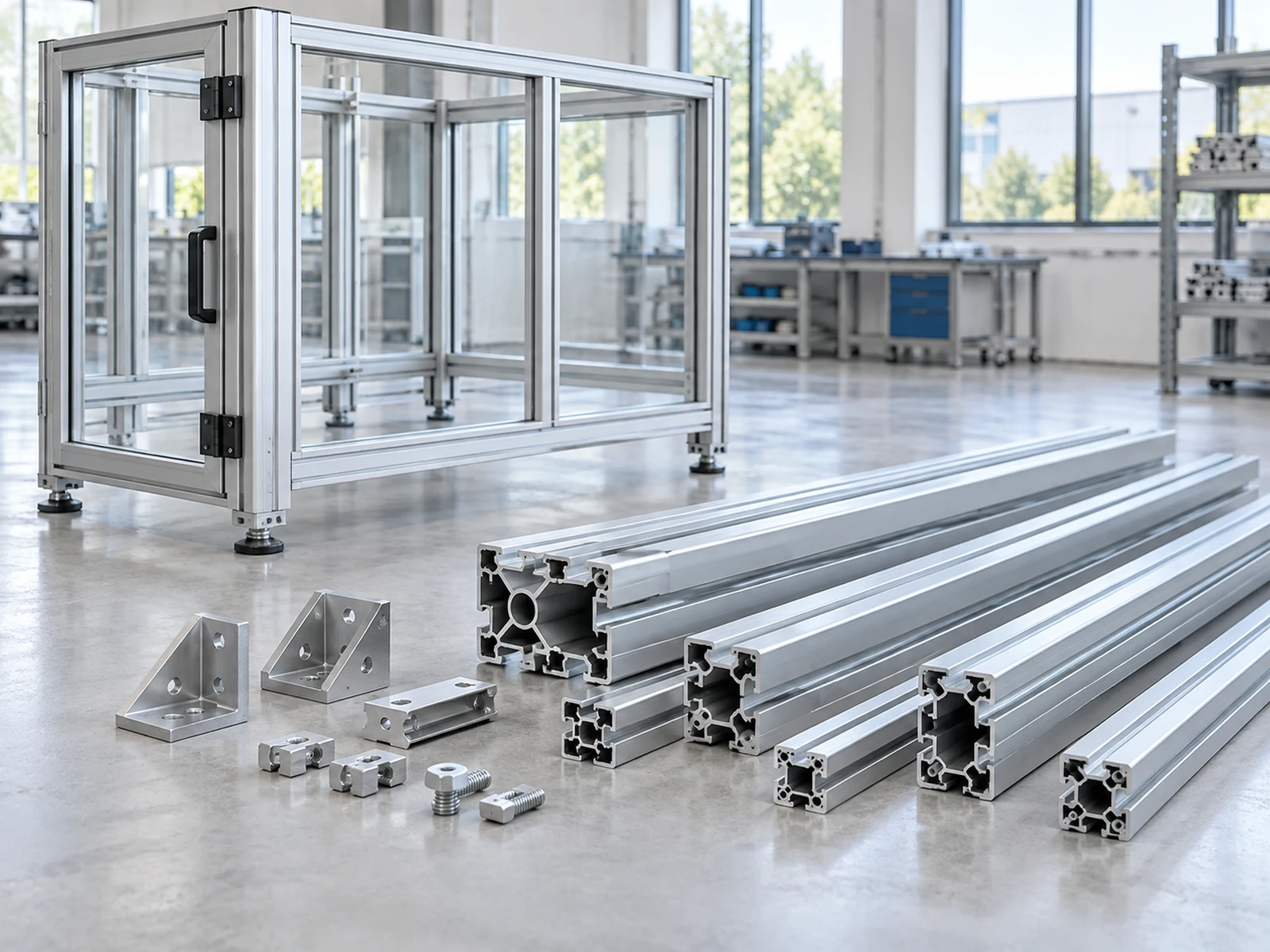
OCTANORM’s octaclassic system description provides a useful example of this distinction. It describes reusable aluminum extrusions and components, uprights and beams joined through system-specific connection features, and several infill options. Those are attributes of that named supplier’s system. They are not Jiurun machine specifications or confirmation that every exhibition frame uses the same construction.
If your business buys finished system members, identify the actual new cutting work before investing in equipment. An increase in installed booth area might require more assembly labor or purchased components without increasing retained cutoff work proportionally. Use your own released orders and workshop records to establish the difference; do not substitute a general exhibition market estimate for production demand.
If you buy long profile stock, define what the proposed cutting station receives and what it must release. A useful boundary is identified, approved extrusion stock entering the station and checked cut-stage members leaving for a named next operation. Connection machining, assembly and kit packing remain separate unless specifically included in the assessed equipment offer.
2. Let the approved system define each member
Start with the system family and released fabrication records. A booth plan can show overall width, graphic area, an opening or a counter location without giving the actual manufacturing length of an individual member. Obtain the part schedule and drawings from the responsible system or design owner. The saw supplier should assess those records rather than infer member dimensions from a rendering.
Record the actual extrusion designation, section drawing and supplied condition. Identify the relevant upright, beam, frame edge, door member or accessory family. Similar-looking grooves do not establish connector compatibility. Do not use one outside bounding dimension to represent a group of different sections or assume that all members in a modular booth can share a holding arrangement.
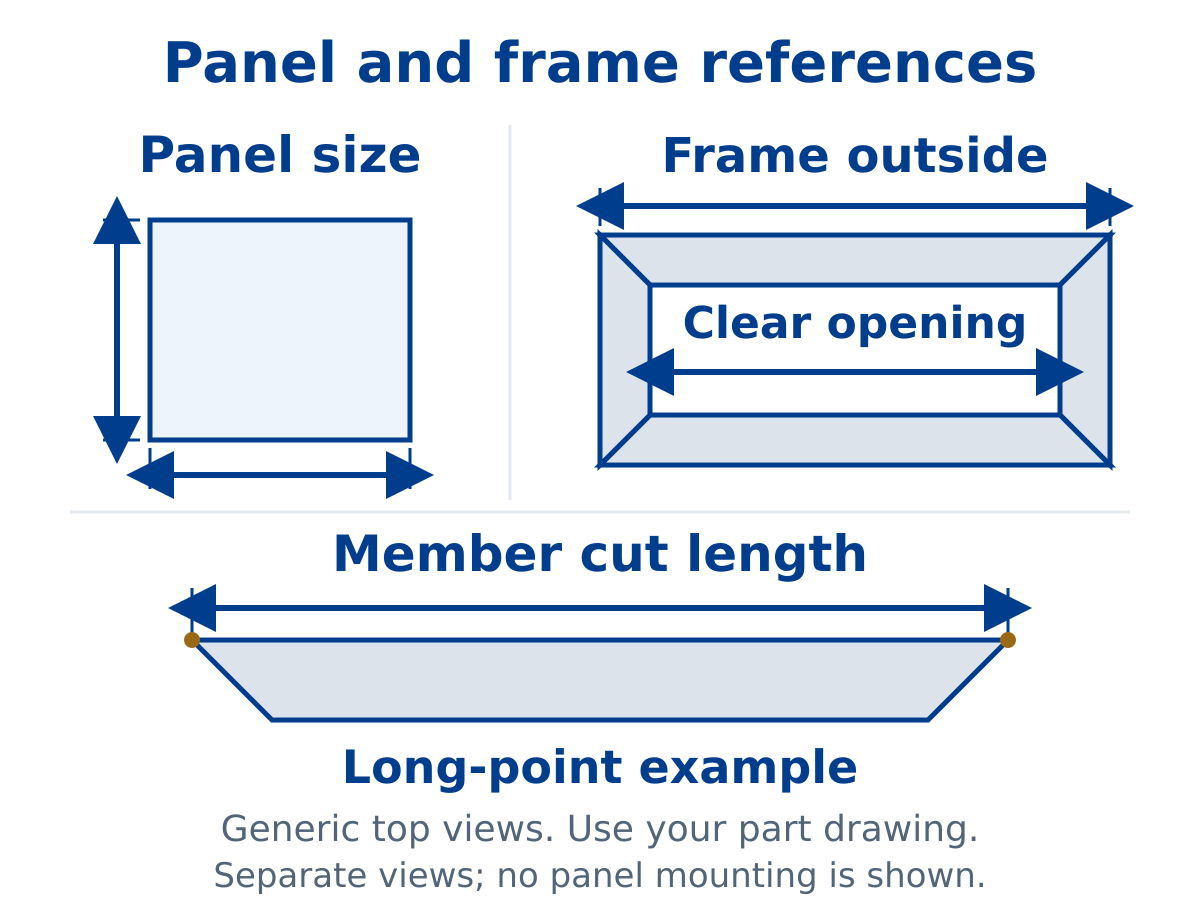
For every cut-stage member, show the required ends and measuring reference. Identify square, angled or handed variants in the actual drawing. A graphic panel dimension, clear opening and finished frame outside dimension are different references. The relationship to a member’s cut length depends on the released construction; there is no universal subtraction suitable for every exhibition system.
Ask the responsible designer to release any change affecting the connection or infill. Do not shorten a member, reposition a feature or change an end merely because the result would fit a convenient saw arrangement. A machine supplier can assess the proposed cutting task. It cannot turn an unapproved system modification into an accepted exhibition component.
Where lighting, cables, panels or other items arrive already associated with the profile, describe that supplied condition explicitly. Do not treat an assembly containing different materials as bare aluminum stock. Keep electrical work, panel processing and installation requirements with the parties responsible for those tasks.
3. Establish net fabrication demand after inventory allocation
Reusable inventory changes the purchasing question. Count accepted members of the correct identity and required condition before translating an upcoming stand order into new cutting demand. Keep available stock, items allocated to another event, returned items awaiting review and confirmed new fabrication requirements as separate quantities.
The review of a returned member belongs to your released inspection and disposition process. Appearance alone does not confirm that it is reusable, and an unreviewed piece should not be counted as accepted inventory. This article supplies no service-life limit or repair instruction. If an item requires an approved change, establish that authorization and the resulting fabrication requirement before assigning it to the saw.
A simple inventory-to-job record makes the distinction visible. Keep the member designation and revision associated with each quantity. A long beam cannot automatically substitute for a short beam; a surplus of one family cannot cover a shortage of another. Physical stock exists, but the released kit requirement determines whether it is usable for the particular order.
| Quantity category | Evidence to retain | Effect on the saw inquiry |
|---|---|---|
| Accepted available member | Correct identity, condition and allocation | May satisfy the released order without new cutting |
| Allocated elsewhere | Named order or event commitment | Do not count it again as available |
| Returned item awaiting review | Pending condition or identity decision | Keep its contribution unresolved |
| Approved new member | Released profile and cut-stage requirement | Include it in the assessed fabrication schedule |
| Proposed modification | Responsible system owner’s disposition | Include only the authorized retained task |
Invented inventory example: an upcoming order requires 60 members of family A and 24 of family B. The workshop has 50 accepted A members, but 12 are already committed to another event. It has 30 accepted B members, with 8 committed elsewhere. Available inventory is therefore 38 A and 22 B. The current new-member requirement is 22 A and 2 B, or 24 members, rather than the order’s total of 84.
Suppose a further 10 A members have returned and await review. Their existence does not reduce the confirmed new requirement yet. If the responsible review releases all 10 for this order, the new A requirement falls to 12 and the total falls to 14. If none are released, it remains 24. Record the actual decision; do not select either outcome merely to support a preferred machine purchase.
One event is still insufficient to establish an annual cutting workload. Apply the same allocation method to your own relevant planning period, including new system purchases and approved replacements. Preserve deadline concentrations and changes in the mix. A yearly total can conceal a short fabrication campaign that must complete before several kits leave together.
4. Compare the retained fabrication route
Consider three real procurement routes: buy finished members, outsource specified new-member work, or retain assessed cutting in your own workshop. Each route has a different boundary. Compare the same accepted output, with your own quotations and records, rather than assuming that an owned saw is automatically cheaper or that outsourced work includes every later feature.
For an in-house proposal, identify the cutting machine, tooling, stock support and collection arrangement. State the incoming stock lengths and the short and long outputs in the released schedule. Ask which families are confirmed, which require representative evidence and which are excluded. A demonstration of an easily handled beam does not settle a short accessory member or a different section.
Jiurun manufactures industrial circular-saw equipment for aluminum and nonferrous materials. Request a model- and configuration-specific assessment for your released exhibition members. A general product description does not confirm every system section or angled job. Feeding repeatability must not be presented as a guarantee of finished member or assembled frame accuracy.
Use the offered functions as stated. If a quotation includes a job recipe, programmed length change, marking function or collection device, identify its scope for the assessed work. A CNC label does not confirm automatic inventory allocation, connector machining, kit identification or event-order management. Buyer-provided processes can be included in the route honestly without inventing machine features.
Compare the whole retained route economically. Include separately quoted connection operations, handling, inspection and packing where required. Use confirmed purchase prices and your observed work records. Avoid fictional tool life, labor savings or utilization percentages. An unresolved family remains a conditional cost and workload item until the supplier and responsible production team answer it.
5. Keep connectors and later operations visible
An accepted cut member may still require work before assembly. Identify the connection details shown on its released record and distinguish features supplied with the incoming profile from features produced later. The presence of a lock, bracket or fixing in an assembled frame does not prove that a saw makes the corresponding preparation.
Have the responsible process owner define the receiving condition for later connection work. Record relevant end references, orientation and any required identification. If a face will be used as a later setup reference, obtain its released cut-stage requirement rather than guessing a universal tolerance. Keep the agreed observation method with that requirement.
Retain the relationship between the profile and its connector family. A correct length reading is only one piece of evidence; it does not establish that a different connector will fit or that a groove has the correct system identity. The separate aluminum frame bracket order guide addresses the bracket purchase question. Here, the machine comparison must account for the fabrication steps your workshop actually retains.
Confirm how a member remains identified between cutting, later preparation and kit assembly. If the proposed machine supplies marking, obtain its actual limits. Otherwise name the separate workshop process. Avoid mixing visually similar members from different revisions simply because they were produced during the same shift.
System approval and structural suitability remain separate from cutting evidence. A successful saw observation does not certify an exhibition stand, approve an overhead element or establish a venue’s permitted construction. Use the responsible design, system and event requirements for those decisions.
6. Assess an aluminum saw for exhibition stand manufacturing over a campaign
A representative observation should cover the released fabrication campaign, not only repeated cuts from one convenient profile. Include the families and transitions that could change the buying decision: another extrusion section, a different required end, a short output, a protected finish or a change in the receiving operation.
Agree the observation’s entry and exit. If one supplier reports only consecutive cutting motions and another includes stock retrieval, setup, changes and checked collection, their figures describe different work. Request the missing boundary information before comparing them. Keep estimates distinct from measured observations.
Record the actual stock identity, part revision, supplied configuration, tooling and conditions with the result. Identify who measures the relevant dimensions or observes the end condition. If the next operation is included in the evidence plan, record its receiving decision separately from the saw’s output count.
Use the production calendar as a requirement, without converting a trial into a guarantee. State the fabrication release date, the required kit handover and the work that must occur in between. If staffing, replenishment or handling in the intended workshop differs from the demonstration, ask the supplier to address that difference explicitly.
A change between events may involve stock allocation rather than machine settings. Do not ask the saw to solve missing inventory or an unreleased drawing by increasing its advertised output. First resolve the fabrication requirement. Then assess whether the quoted arrangement can complete that defined stage under the agreed conditions.
7. Count accepted show kits and preserve component identity
The commercial handover may be a labeled kit for an event or stand area. Define it in the released packing record. An excess of one member type cannot compensate for a missing different member, connector or retained operation. Keep cut-stage quantities and complete-kit quantities distinct.
Invented kit example: each of six released kits needs two new members of family C and one new member of family D. The fabrication schedule therefore needs 12 accepted C members and six accepted D members. Suppose the workshop releases all 12 C members but only five D members; another D item is held for review. Only five complete kits can be allocated, leaving two C members without the sixth required D member.
Do not call the held D item accepted merely because its saw cut looked satisfactory. Preserve its actual disposition and the receiving requirement that remains unresolved. If a replacement is produced, retain the association with the original requirement so both are not counted as successful output for the same kit.
Then connect the kit label to the released member and event records. Show which items are newly fabricated, which come from accepted reusable inventory and which are purchased finished. This gives the packing team a complete handover without attributing all components to the cutting machine.
Return handling should preserve that distinction for the next event. Agree how kit identity, condition review and available inventory will be recorded in your own process. The objective is a reliable next fabrication schedule, not a claim that the saw automatically tracks a rental or exhibition fleet.
8. Send a complete inquiry and compare unresolved answers
Send the approved system identifier, actual section drawings, incoming stock condition, cut-stage member records and net new-member schedule. Include the relevant job changes and required handover. Make pending reuse decisions visible, but distinguish them from released cutting work. A supplier can assess a defined family more usefully than a total booth area.
Request a quotation identifying the model, configuration, confirmed families, tooling, support, collection, buyer-provided work and later operations. Ask for the evidence needed to close conditional rows. Compare alternatives against the same net fabrication requirement and accepted output, including the retained route beyond the saw.
The decisive follow-up should answer a real gap: handling of a particular section, coverage of an end variant, acceptance by the next process, or completion of the changed-family campaign. Another clip repeating the easiest cut adds little if that gap remains. Keep the outstanding question and its effect on the purchase visible.
Contact Jiurun with your released exhibition member fabrication schedule to request an aluminum circular-saw assessment. State which members will be newly cut, which are supplied finished and what the cutting station must hand over. Confirm the actual application and supplied configuration before selecting equipment; system design, component reuse approval and venue requirements need their own responsible decisions.
See the cutting stage in context
This Jiurun video illustrates a general aluminum cutting-stage context. It is not an exhibition-system trial, proof of the invented inventory or kit examples, or evidence of automatic reuse allocation. Assess the actual member schedule and supplied equipment separately.