
An aluminum saw fixture rebuild or replacement decision starts with the cutting job, not with a photograph of a worn clamp. A buyer needs to know which profile family the fixture must locate, which surfaces establish the cutting datum, which elements are damaged or hard to adjust, and who will accept the repaired setup. Otherwise a low repair quote and a complete replacement quote may describe different deliverables.
This guide treats the fixture as a separate workholding system. It does not assume that an entire saw needs replacing, that a new fixture fits an existing machine, or that Jiurun supplies a particular repair service. Use it to prepare a comparable request for quotation and an acceptance plan with the machine owner, fixture designer and responsible supplier.
Define the recovery job before asking for a price
Write down the production problem in observable terms. Is a contact face worn, a stop difficult to repeat, a support missing for a new profile, a clamp no longer serviceable, or the whole fixture body incompatible with the next product family? Record the affected part numbers and drawing revisions, the existing machine and fixture identifiers, the required cut orientation, and the profile samples that can be supplied for review. A statement such as “fixture is inaccurate” is too broad to quote because it does not identify the datum, the measurement method or the point where the deviation appears.
Separate the existing accepted job from a requested process change. If the buyer wants the original cut restored, the supplier needs the earlier drawings, setup records and accepted sample criteria. If the buyer also wants to process another extrusion, different wall section or reversed end, that is a new scope requiring its own interface and trial. Do not quietly treat the new family as covered by an old acceptance.
| RFQ field | Evidence to provide | Decision it supports |
|---|---|---|
| Current cut package | Part drawings, revisions, cut list and orientation marks | What must be recovered |
| Fixture and saw interface | Fixture ID, mounting drawing, envelope and access photographs | What can be reused |
| Observed problem | Tagged contact/stop/support locations and inspection record | Replace a component, rebuild a body or investigate further |
| Next product family | Representative profiles and changeover sequence | Whether the recovery scope also needs redesign |
| Acceptance owner | Named person, sample plan and release criteria | Who can sign off the result |
Aluminum saw fixture rebuild: map the parts before pricing
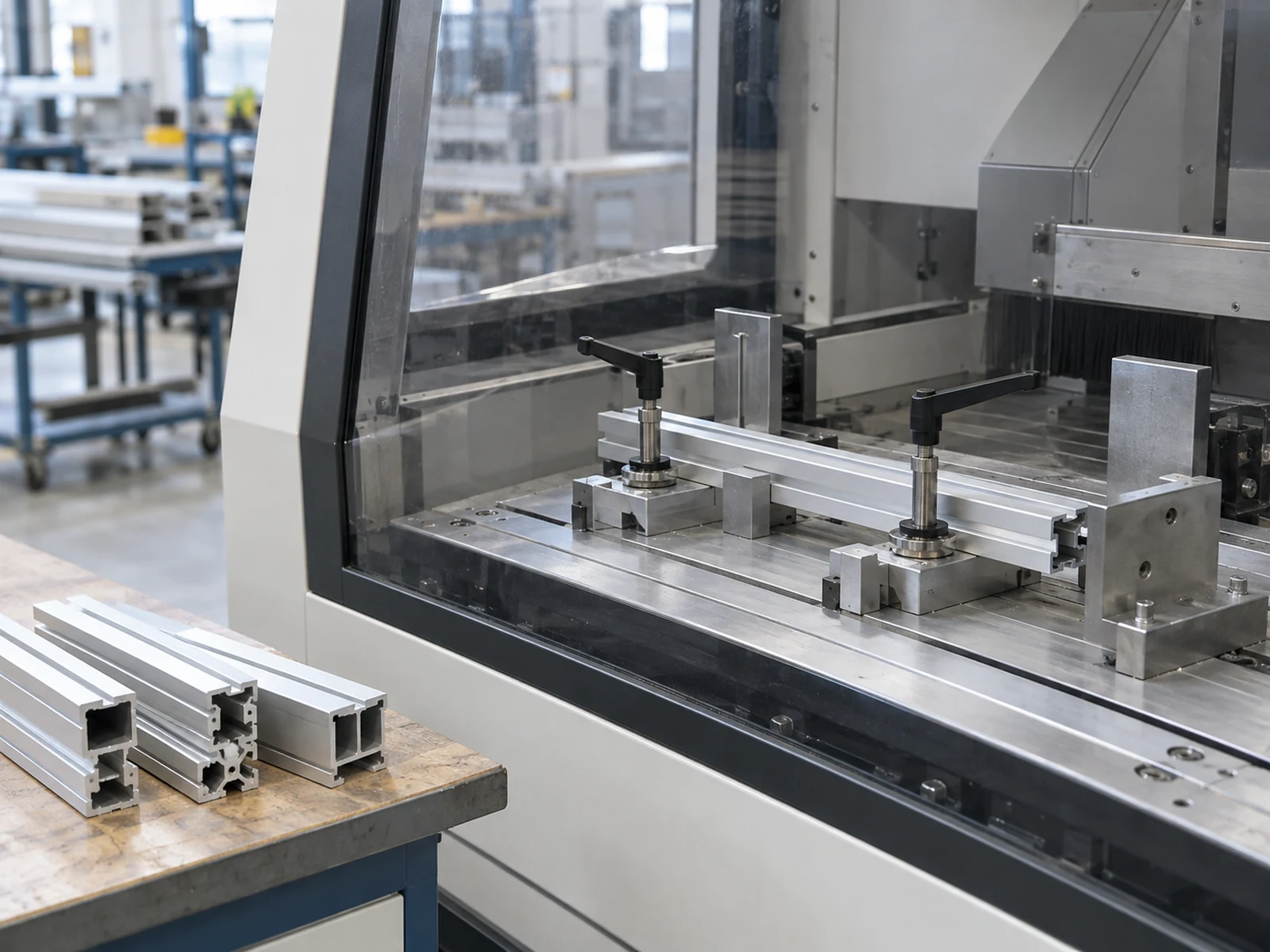
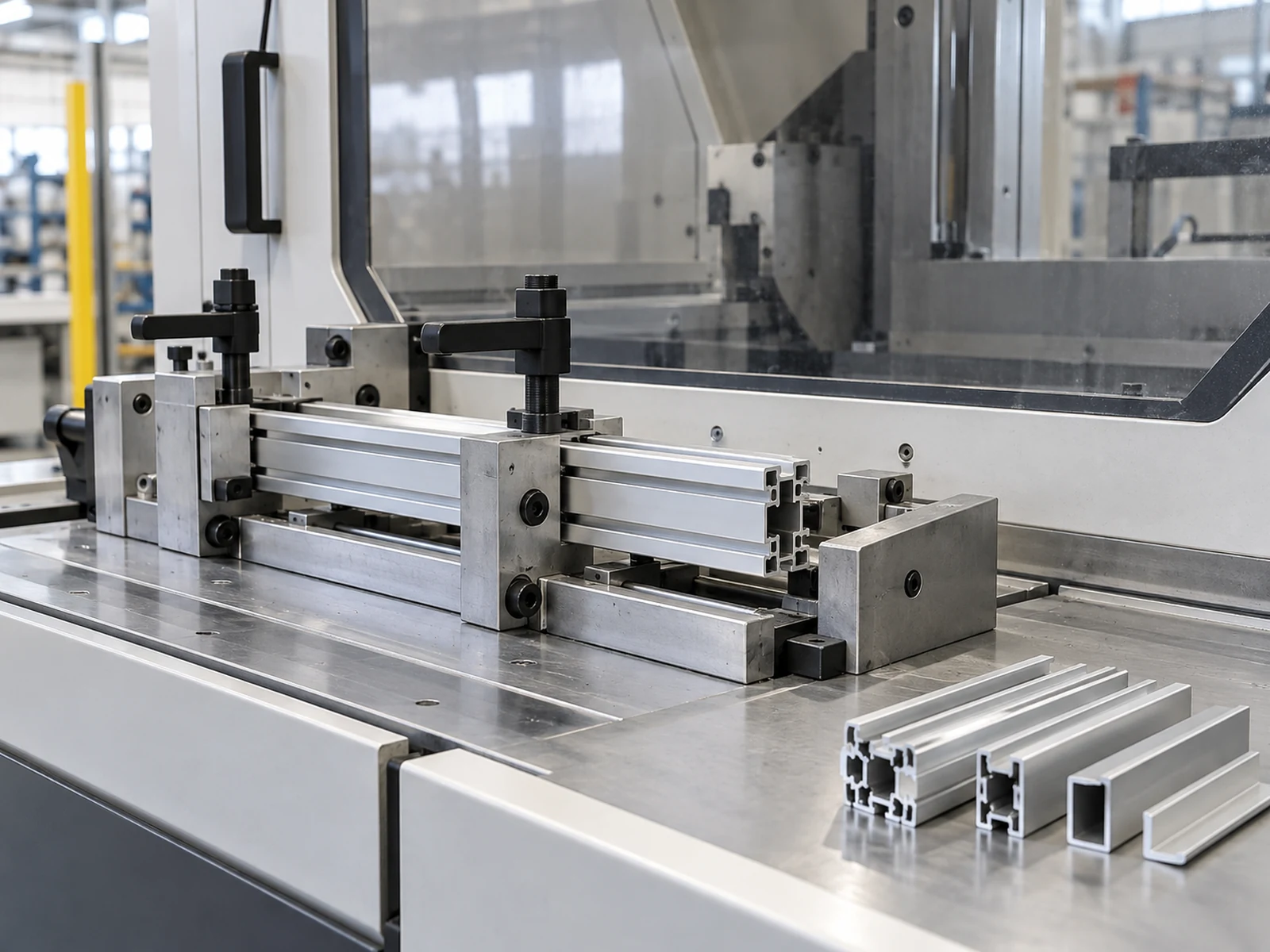
A workholding system has a body or base, supports, locators or stops, and clamps. Those elements may be replaceable components or features machined into a larger body. Carr Lane’s fixture construction guide explains those roles; its work-support guide distinguishes replaceable rest buttons and plates from support faces made directly in the fixture body. These are general design references, not evidence about the construction of a particular Jiurun fixture.
Ask the supplier to mark each proposed change on a current drawing: retained base, new contact, reworked stop, added support, replaced fastener, altered mounting point and any required guard or sensor interface. A quote for three contact pads is not equivalent to a quote for a complete fixture body. Nor does a newly made body automatically include the locating, clamping and machine-interface components needed for a usable assembly. Request one bill of materials and one responsibility matrix for the whole delivered setup.
Choose the recovery route by the part that actually failed
Replace serviceable contacts or stops when the body and machine interface remain accepted and the problem is confined to identified removable elements. Confirm the replacement’s drawing revision, attachment method, location and inspection responsibility. A simple component order still needs a post-installation cut check because a contact can be the part that establishes the workpiece position. Our clamp-pad replacement guide covers that narrower spare-parts case.
Rebuild or rework the fixture body when its locating or support features must change but the retained body and mounting relationship are suitable for the agreed job. Request a marked-up drawing that separates surfaces to be retained, restored, newly machined or fitted with replaceable elements. The quotation should identify who checks the body before work begins and what happens if inspection reveals damage beyond the priced scope. Avoid making a dimensional promise until the responsible engineer has defined the datum and measurement method.
Replace the full fixture when damage, missing documentation, repeated rework or a new product family makes a controlled rebuild uneconomic or impossible to specify. A replacement quote should list the complete assembly, not merely the base plate: supports, locators, clamps, fasteners, interfaces, change parts, documentation and trial support as applicable. Compare it against the rebuild on the same part family, machine interface and acceptance evidence. Replacing the fixture is a different decision from retrofitting or replacing the whole saw.
| Route | Typical scope boundary | Proof to request |
|---|---|---|
| Component replacement | Named removable wear/contact items, existing body retained | Component identity, installation record and cut requalification |
| Body rebuild | Defined surfaces or features restored or modified | As-built drawing, interface check and agreed sample trial |
| New fixture | Complete assembly with specified retained machine interface | Assembly bill, setup instructions and full acceptance trial |

Keep the saw interface and the profile datum explicit
A fixture proposal can look complete on the bench yet fail at the saw. Record the machine model and actual mounting arrangement, accessible working envelope, feed and blade path, guard travel, chip and offcut clearance, and any approved control or sensor interface that a change would affect. A supplier should confirm these against the specific installed machine; a photograph or model name alone is insufficient. Do not infer that a fixture from a different machine will fit.
For each extrusion family, name the reference faces and the end that the cut length is measured from. Include asymmetrical sections, hollow cavities and left/right orientation where those details matter. Carr Lane’s locating and clamping principles offer general background, while our multi-cavity fixture RFQ guide addresses family-specific contact planning. Neither reference proves that one set of pads or stops will locate every profile in the buyer’s mix.
Where personnel must inspect or install a fixture, use the site’s approved isolation and maintenance procedure. In the United States, OSHA describes the scope of hazardous-energy control for servicing and maintenance in its lockout/tagout guidance. The purchasing specification should assign responsibility for access and restart checks; it should not substitute a blog procedure for the plant’s safety assessment.
Specify the acceptance trial before selecting a quote
Agree on the test before any rework or new fixture is purchased. The acceptance plan should name the machine, fixture revision, profile samples, cut list, orientation, changeover steps, measuring equipment, inspection locations and decision owner. Include a first-piece check and a representative sequence that exposes the problem the recovery is meant to solve. If the quote promises a new profile family, test that family rather than accepting only the old one. If the fixture must be changed between jobs, include the changeover and return-to-datum check.
Do not reduce acceptance to a single attractive cut photograph. Ask for the measurement record, rejected as well as accepted samples when relevant, visible contact marks, operator observations and a signed disposition of any deviations. Separate the fixture’s locating repeatability from finished-part accuracy; the latter also depends on the saw, blade, stock, feed, measuring method and process conditions. A vendor’s claimed feeding precision is not a finished-part tolerance.
For an illustrative example, suppose two hollow extrusion variants share a general outer width but differ in internal cavity position and the face used as the assembly datum. A supplier offers to replace one side stop. The buyer should supply both drawings and samples, ask whether the revised stop truly locates both variants without shifting the reference, and require sample cuts and recorded checks on each variant. The example does not describe a Jiurun customer, a proven configuration or an achieved tolerance.
Make the commercial comparison complete
Request separate priced lines for inspection, design or drawing recovery, components, body work, new assembly, installation, samples, trials, documentation and follow-up corrections. Mark what the buyer provides: existing fixture, saw access, approved samples, drawings, measurement resources and production downtime. Ask how the supplier handles an unexpected condition found after disassembly. Without these boundaries, the cheapest quoted number may simply omit the work needed to reach release.
Compare options against the same operating period and product mix. A contact replacement may be economical if the base and datum are sound. A body rebuild may be attractive when the accepted machine interface and most components remain usable. A complete new fixture may be preferable when rework creates too many unresolved interfaces or when the next profile family requires a new locating concept. The decision is case-specific; there is no universal threshold based on fixture age or repair price alone.
At handover, retain the final drawing and revision, component list, setup and inspection instructions, accepted sample record, changeover notes and the owner of future replacement parts. Keep the original fixture clearly identified if it is returned as a spare or template. Do not put an unqualified fixture back into production merely because it mounts to the saw.
Video: general machine context
The following Jiurun Machinery channel video shows general JR-510CNC equipment footage, including an enclosure, feed/clamp area and aluminum profiles. It is not evidence of this article’s fixture condition, repair or replacement scope, exact machine configuration, customer, trial, cut quality or performance.
Send a comparable fixture recovery RFQ
Give each supplier the same current fixture identification, machine interface, profile drawings and revisions, failure evidence, retained-versus-new boundary and proposed acceptance plan. Ask them to state exclusions and alternate routes explicitly. Then compare the complete delivered and accepted job, not an isolated component price.
If the recovery changes the interface with a Jiurun aluminum saw, contact Jiurun with the machine details and cut package so the applicable equipment information can be checked. Fixture design, repair, installation and trial services must be confirmed for the specific request rather than assumed from this article.