
If the first finished piece after a change in feed approach falls outside the agreed length while later pieces are steady, a buyer needs more than a claim of “backlash.” An aluminum saw feed reversal trial should separate what the control commanded, what the stock actually did, and what the cut part measures. Those three observations can disagree for different reasons. Replacing a drive before identifying the disagreement may leave the production problem untouched.
This is a method for agreeing a witnessed acceptance test with the machine supplier. It is not a diagnosis of an unseen saw, a service instruction, or a promise that a particular Jiurun model uses a ball screw, encoder or any named feed layout. The supplied machine documentation and the qualified operator determine which movements and measurements are safe and available.
First define which motion reverses
“Reverse feed” can describe the carriage travelling back to collect more stock, a positioning axis approaching a target from the opposite side, or the stock itself being pulled in the opposite direction. It can also be confused with a saw-head return stroke that has no effect on the material feed datum. Put the actual machine sequence on one line: stock support, gripping point, feed motion, clamp transfer, saw cut and return. Ask the supplier to mark where the programmed length is established and which device, if any, reports position.
The distinction matters because a controller can report a repeatable axis position while a profile slips at its grip, and a profile can arrive at the expected stop while a later cut or measurement datum changes the finished length. Do not infer the internal drive from a brochure photograph. The quoted machine configuration, motion diagram and supplier demonstration should identify it.
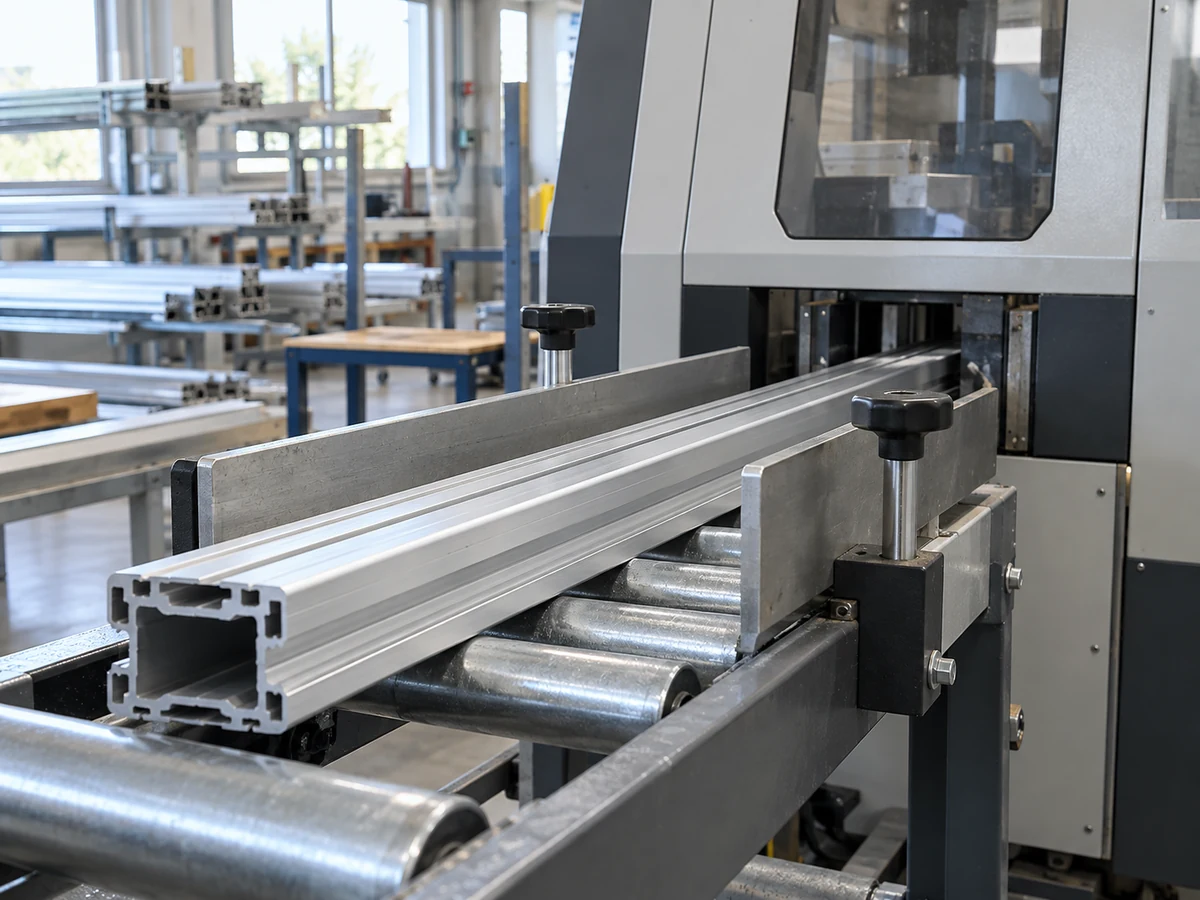
Aluminum saw feed reversal: make the first cut observable
Before comparing pieces, agree on one released drawing and one representative profile lot. Write down the alloy and section, stock orientation, finished-length datum, cut-end definition, clamping method, saw blade and the acceptance rule. Use the same inspection tool and method for both approach conditions. The supplier should set the safe program and any permitted approach sequence; the buyer should not defeat interlocks or improvise an axis reversal to generate a dramatic result.
Mark or otherwise identify the stock at a fixed reference that can be observed without entering a hazard area. Record a baseline approach, then the supplier-approved alternative approach or restart condition. For each condition, keep the commanded target, displayed or logged axis position if the machine exposes one, independently observed stock displacement if practical, and the measured finished part. Label the first part after the change separately from later parts. A pile of mixed pieces cannot reveal whether the error belongs to the first transition or to the steady sequence.
| Trial record | What to retain | Why it matters |
|---|---|---|
| Approach and reference | Direction, start/reference state and first-versus-later piece ID | Shows exactly which transition is being compared |
| Machine indication | Command and available position/status log, with time | Shows what the control believes happened |
| Stock movement | Independent mark, stop or measurement chosen in the safe trial plan | Tests whether the profile followed the feed |
| Finished part | Drawing datum, end condition, measured length and instrument | Tests the acceptance requirement the buyer actually pays for |
These columns are deliberately separate. If the machine cannot expose a trustworthy position log or a safe independent stock check, write “not observed” rather than filling the gap with an assumed encoder value. A record that reveals a missing measurement is more useful than a neat but unsupported diagnosis.
Read the pattern without naming the cause too early
If indicated travel repeats but the stock mark does not, inspect the transfer between feed mechanism and profile: gripping contact, clamp timing, roller traction, profile support and a possible offcut obstruction. The actual design may not use all of these elements. A qualified supplier should decide which applies and examine the evidence under the machine’s service procedure. An axis display alone cannot certify the stock position.
If stock movement repeats but finished length does not, look downstream of the feed reference. Confirm which cut face is measured, whether the piece rotated or shifted at clamping, and whether the blade, cut plane, burr or inspection method changed the apparent length. A saw can meet an axis-position repeatability target and still fail a finished-part requirement. The buyer’s acceptance sheet should keep those requirements separate.
If the difference occurs specifically when the approach direction changes, lost motion is one candidate, but it is not a verdict. THK’s ball-screw positioning guidance explains that axial clearance can create backlash when feed direction or axial load reverses in a ball-screw system. It also identifies lead accuracy, rigidity, thermal displacement and guide orientation as other contributors to positioning error. That guidance is conditional: it does not establish that the quoted saw has a ball screw, that clearance is excessive, or that a screw replacement will correct cut length.
Likewise, the Renishaw encoder glossary distinguishes accuracy from repeatability and describes reversal error for enclosed encoders. Those terms help frame a question to the supplier; they are not evidence that this saw contains a Renishaw encoder. Ask where feedback is taken and whether it measures motor rotation, carriage travel or stock position. Then compare that answer with the physical trial, instead of treating a displayed number as the cut-part result.
Use the machine video for layout, not performance proof
The Jiurun channel clip below shows an automatic aluminum cutter with a long roller-fed stock path and a saw infeed. It can help a buyer point to the feed and support area when asking where a direction change is measured. The clip does not show the proposed reversal test, a cut-length result, backlash, or the exact configuration being quoted. The supplier must demonstrate those points on the relevant machine and stock.
Specify the decision the witnessed run must support
A useful quotation or corrective-action reply should state the approved feed architecture, where the length reference is taken, the operating sequence used for the trial, and how the first piece after each change is identified. It should attach the raw observation sheet, not merely a statement that the axis is “precise.” Include the stock and blade identities, the finished-part readings against the drawing, any excluded pieces, and the person who accepted the method. If the supplier changes grip pressure, program compensation, mechanical components or inspection method, the record should show the before-and-after condition.
Agree the acceptance rule before the trial: which part and end are measured, the drawing revision, the relevant length tolerance, the number and order of pieces, the temperature or conditioning assumptions if they matter, and who owns a failed first-piece result. Do not borrow a universal backlash allowance or cut-length tolerance from an unrelated machine. A repair should be approved only after the evidence shows which stage is failing and a repeat trial meets the same released requirement. A new drive, screw or encoder is a purchase decision, not a substitute for that comparison.
If the issue is simply whether the controller’s movement corresponds to stock travel, the related feed measurement guide helps frame that earlier question. If the error appears after power loss or a reference reset, check the separate feed-carriage homing discussion. For an aluminum saw feed reversal quotation, send JiurunCut the profile drawing, accepted length datum, machine configuration and a short account of which approach produced which part reading. Ask for a witnessed method and a written acceptance record before agreeing a component change.