
Aluminum saw feed-carriage homing deserves a place in the purchase specification whenever a powered feeder must recover its position after a stop or power interruption. A buyer needs to know what the machine calls “home,” when that reference is valid, and what an operator will see before another automatic feed is allowed. These are questions for the quoted control configuration and its approved commissioning procedure. They cannot be answered from a generic machine photograph or an encoder name alone.
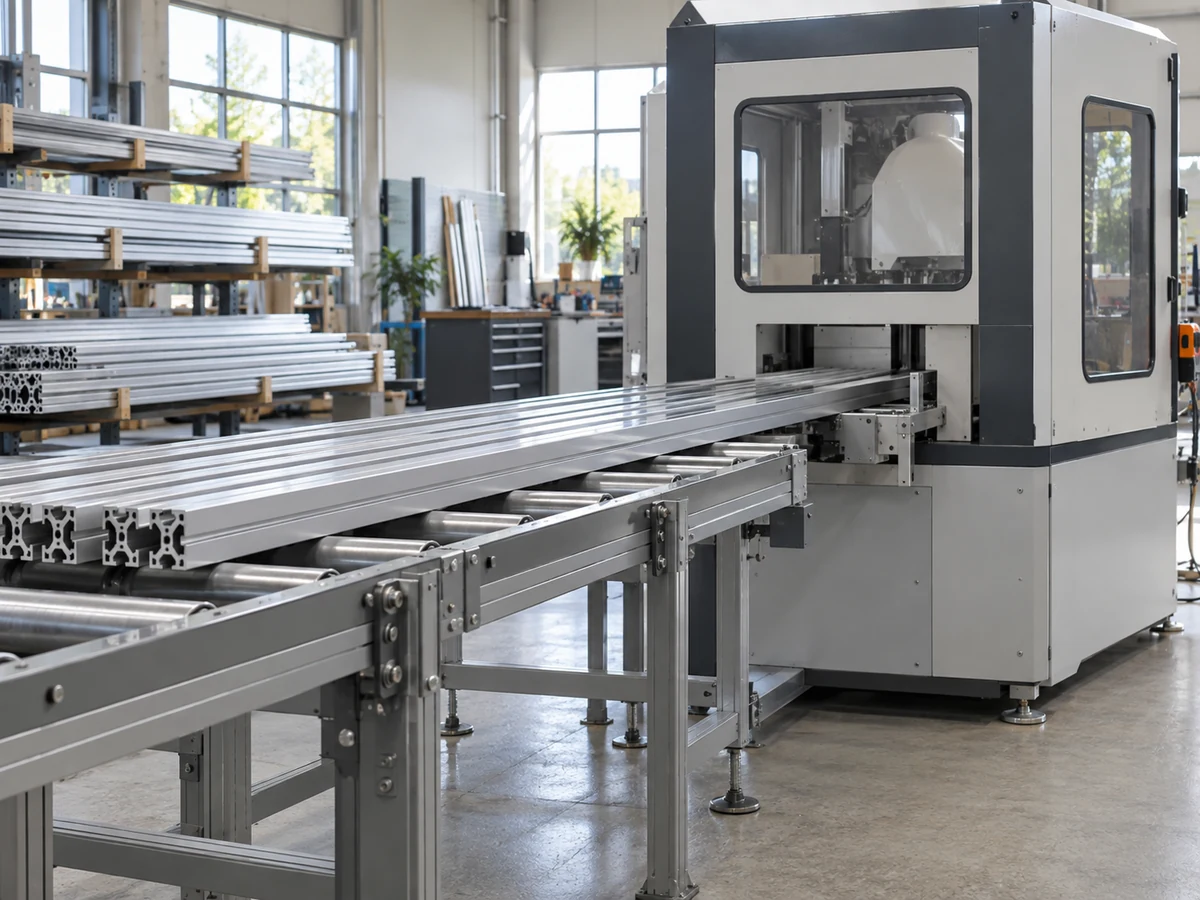
The featured photograph shows a related saw feed bed. It is equipment context only; it does not document the homing sequence, installed feedback, or performance of the machine being quoted.
Aluminum Saw Feed-Carriage Homing: Define the Reference
Homing establishes a known axis reference. In an automatic saw, the feed carriage may have a mechanical travel end, a reference event, a controller position and a stock-contact point. Those are not automatically the same physical location. Ask the supplier to identify the axis being referenced and to show its home position on a dimensioned layout. Include the motion envelope, the location of any home device used in the quoted build, and the reference from which a feed command is calculated. If the machine has more than one moving feed or transfer axis, request a separate answer for each.
Controller suppliers describe multiple ways to establish an axis reference. For example, Rockwell Automation’s motion homing attributes distinguish active and passive sequences and describe switch, marker and other possible events. That is useful vocabulary for an RFQ, not evidence that a particular Jiurun saw uses any of those components or that one sequence is universally appropriate.
A valid home indication is also different from a verified finished length. The controller may know where an axis is while the stock slips, a clamp seats differently or the cut face shifts the measured result. Keep the feed measurement versus stock-travel question and the first-off cut inspection separate from the homing acceptance. This avoids treating a successful reference command as proof of cut accuracy.
Decide What Happens After Power Loss
Ask for an explicit state table for a normal power-up, a controlled stop, an emergency stop, and a loss of power during feeder travel. The supplier should state whether the controller retains a valid position, requires a new reference operation, or requires operator review before any automatic cycle. The answer depends on the actual feedback device, controller configuration and machine design. Do not infer it from “servo feed,” “absolute encoder,” or “battery backup” on a quote line.
Some systems can retain position information across a shutdown; others establish it again after startup. Rockwell’s axis homing configuration guide explains one controller family’s home definition and status. The exact behavior of a Jiurun quotation must be documented by Jiurun for that configuration. If battery-backed feedback is proposed, ask what the battery supports and what fault or replacement changes the reference state; the encoder battery backup discussion addresses that distinct purchasing question.
In the handover test, use only the supplier-approved, guarded and supervised procedure. The buyer’s role is to agree the observations and pass criteria, not to improvise a live power interruption or bypass a protective device. Record whether stock is present, which axis was moving, the displayed state after restoration, and who authorizes recovery. A machine that resumes unexpectedly, reports a plausible number with an invalid reference, or requires an undocumented manual workaround should not be signed off without a resolved explanation.
Six Procurement Checks for a Feed-Carriage Reference
1. Name the referenced axis and its physical boundary
Request a drawing that identifies the feeder carriage, any clamp or pusher that moves with it, the allowed travel, and where a stock bar may protrude. Mark the normal operating range and service access. The drawing should identify the physical reference location without exposing an operator to the moving path. A quote that says only “automatic feeding” leaves too much room for a different interpretation of what gets homed.
2. Describe the homing method for the quoted build
Ask whether the reference is established on startup, on command, after a fault or only after a particular state change. Request the relevant sensor or feedback description, control sequence, and operator-visible completion signal. The same controller family can support different sequences; an encoder marker explanation is background terminology rather than a substitute for the saw builder’s actual configuration. Do not specify an input, speed or offset copied from another machine.
3. Explain permissives and warnings
Before an automatic feed is enabled, what tells the operator that the reference is valid? What message appears if the home event cannot be completed, a sensor is inconsistent, or an axis position is lost? Ask for a screenshot or approved HMI description and the fault identifier that will appear in the handover documentation. The quote should also say who may clear a fault and which checks are required first. These are observable acceptance points, not a request to override interlocks.
4. Account for material and tooling in the recovery state
A carriage returning toward a reference can encounter a stock bar, short remnant, clamp, fixture, outfeed device or operator-supplied accessory. Ask the builder which combinations must be cleared or secured before its approved recovery sequence. Document the stock length and fixture envelope used in the demonstration. The buyer should not assume that a reference move performed on an empty machine proves clearance for the production setup.
5. Separate reference recovery from cut-result confirmation
After homing, request a defined first-off check using a representative profile and the agreed drawing revision. Record the commanded feed, independent finished-part measurement method and any correction rule supplied by the builder. A repeatable home event is one condition for controlled positioning, but it does not guarantee finished length, angle, surface finish or throughput. Keep the machine acceptance criteria tied to parts rather than to a controller status flag alone.
6. Specify a recoverable record
Ask for the as-built axis description, reference procedure, HMI fault list, maintenance responsibility and a record of the commissioning test. The handover should show the configuration version, the observed state before and after the agreed interruption scenario, the actual stock and tooling setup, and any exception with its owner. If software, feedback or sensor hardware is changed later, define who decides whether the reference test must be repeated.
Agree an Acceptance Record Before the Machine Ships
Build a short acceptance sheet with four rows: normal start with a clear machine; authorized restart after a controlled stop; an approved power-loss or interrupted-motion scenario; and a deliberately simulated or observed reference fault under the builder’s safe test plan. For each row, record the precondition, displayed axis/reference state, whether automatic feeding is permitted, the authorized recovery action, and the first-off part check. The supplier should choose and approve the safe method of creating each test condition. Do not ask an operator to create a dangerous fault just to complete a checklist.
Record the result as pass, exception or not tested. “Not tested” is useful when a scenario cannot safely be reproduced at the factory; it then becomes a site acceptance item with an assigned owner. A pass should identify the actual controller/HMI version and the stock setup, rather than just a photo of a green status lamp. If an issue changes the feed reference or the restart sequence, test again and keep both records. This lets procurement compare the quoted scope with the delivered machine without implying that every controller has the same homing behavior.
What to Send in the RFQ
Send the supplier a stock and part list, the longest and shortest intended feed conditions, a plan view showing the infeed and outfeed space, and any fixtures or transfer equipment that share the feed path. State whether your buyer acceptance requires a supervised demonstration after a stop or power interruption. Ask for the axis reference description, its validity conditions, the HMI states, safe recovery procedure and a first-off check proposal for the actual quoted configuration.
If two machines are being compared, put these answers in the same table. Do not compare only a brochure’s feed stroke or encoder label. One quote may include the documented recovery test, operator instructions and site acceptance support; another may leave them as buyer tasks. Record those scope differences before approving the price. The exact controller and motion design belong in the supplier’s approved documentation, not in a generic article.
Related Equipment Video
The following video is from Jiurun Machinery’s own YouTube channel and shows a saw in an operating and feeding context. It does not show or verify feed-carriage homing, a power-loss recovery, the specific controller, any customer installation or the performance discussed in this article.
Ask Jiurun for the Feed-Reference Handover Plan
Share your profile drawing, stock lengths, preferred loading arrangement and the restart scenarios you want the builder to document. Ask Jiurun Machinery to identify the feed reference and propose safe acceptance observations for the machine actually quoted. Contact Jiurun Machinery with that information before freezing the purchase specification. The final operating and commissioning procedure must come from the approved machine documents and qualified site personnel.