
An aluminum saw feed gripper may be listed with “lateral travel” without saying what it does once it has seized a long extrusion. That distinction matters when the stock arrives with an approved amount of bow or does not sit on the feed line in exactly the same place every time. A buyer needs to know whether an axis positions the gripper before pickup, whether a mechanism can follow sideways movement during travel, and which stock conditions the machine will reject. Those are separate questions; a travel number alone does not answer all three.
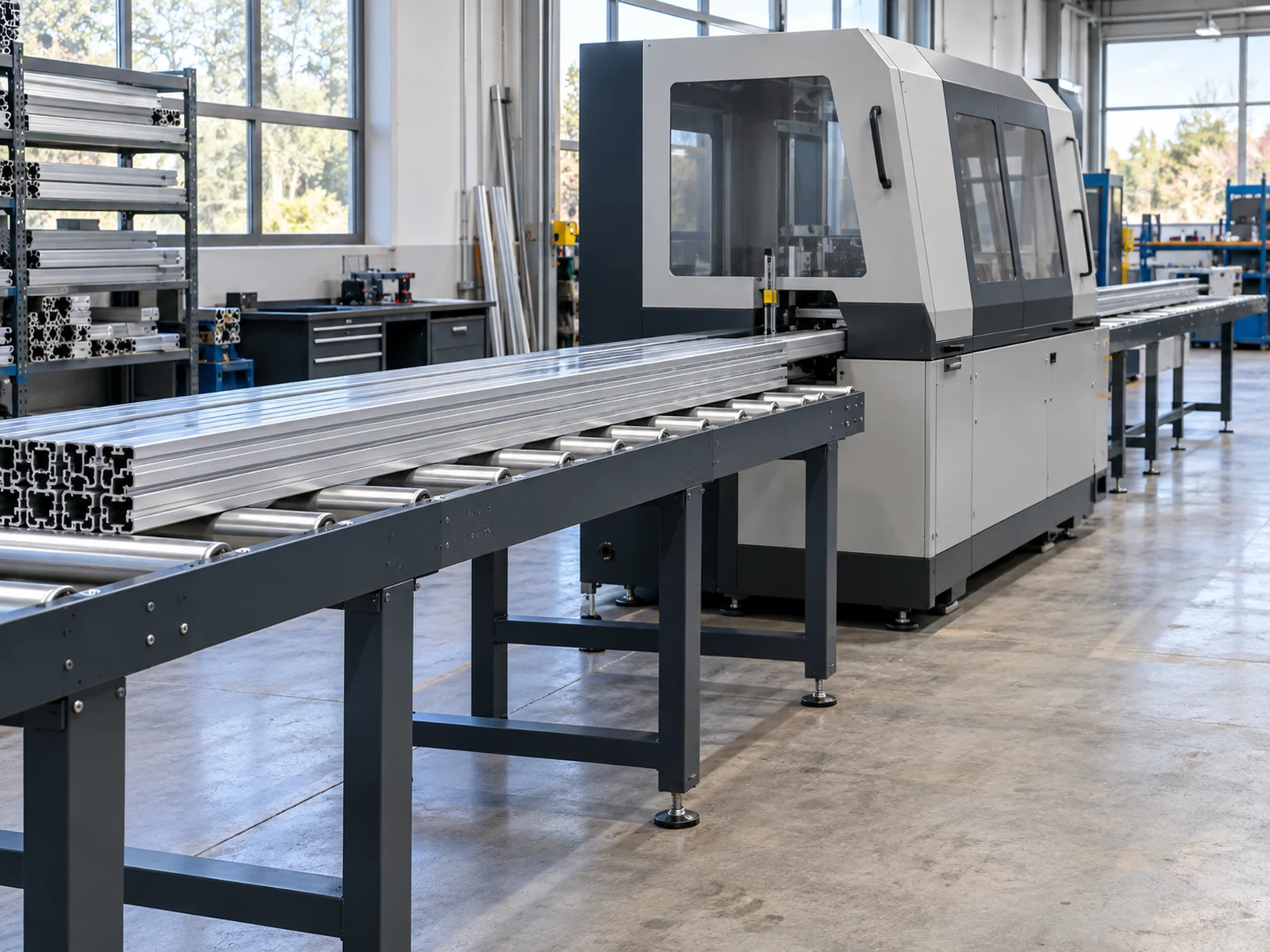
Featured image: a related enclosed Jiurun saw and feed table. It illustrates the machine area to inspect; it does not document the gripper motion or option discussed here.
What the aluminum saw feed gripper actually moves
One published technical catalog lists lateral and vertical gripper-axis travel. Another manufacturer explicitly describes floating Y-axis compensation in a gripper. These are examples of different wording in other manufacturers’ documents. Neither statement establishes a feature on a Jiurun model or proves that the two mechanisms behave alike.
Lateral position adjustment usually answers where a gripper is placed to reach a profile. Floating compensation asks whether it can accommodate a permitted change in the stock’s sideways position while the grip and feed cycle continue. Ask the supplier to identify the actual motion, its control mode, its available range, and the stock conditions under which it is enabled. An adjustable starting position may be useful even if it never floats during a stroke.
Follow one profile through the feed sequence
Begin with a drawing and an actual extrusion from the accepted supply range. Mark the intended gripping face and the datum used by the cut station. A profile can be within its section dimensions yet present a different sideways position along its length. The question is what happens at three points: initial pickup, movement past the supports, and presentation to the saw clamp.
At pickup: where is the gripping face?
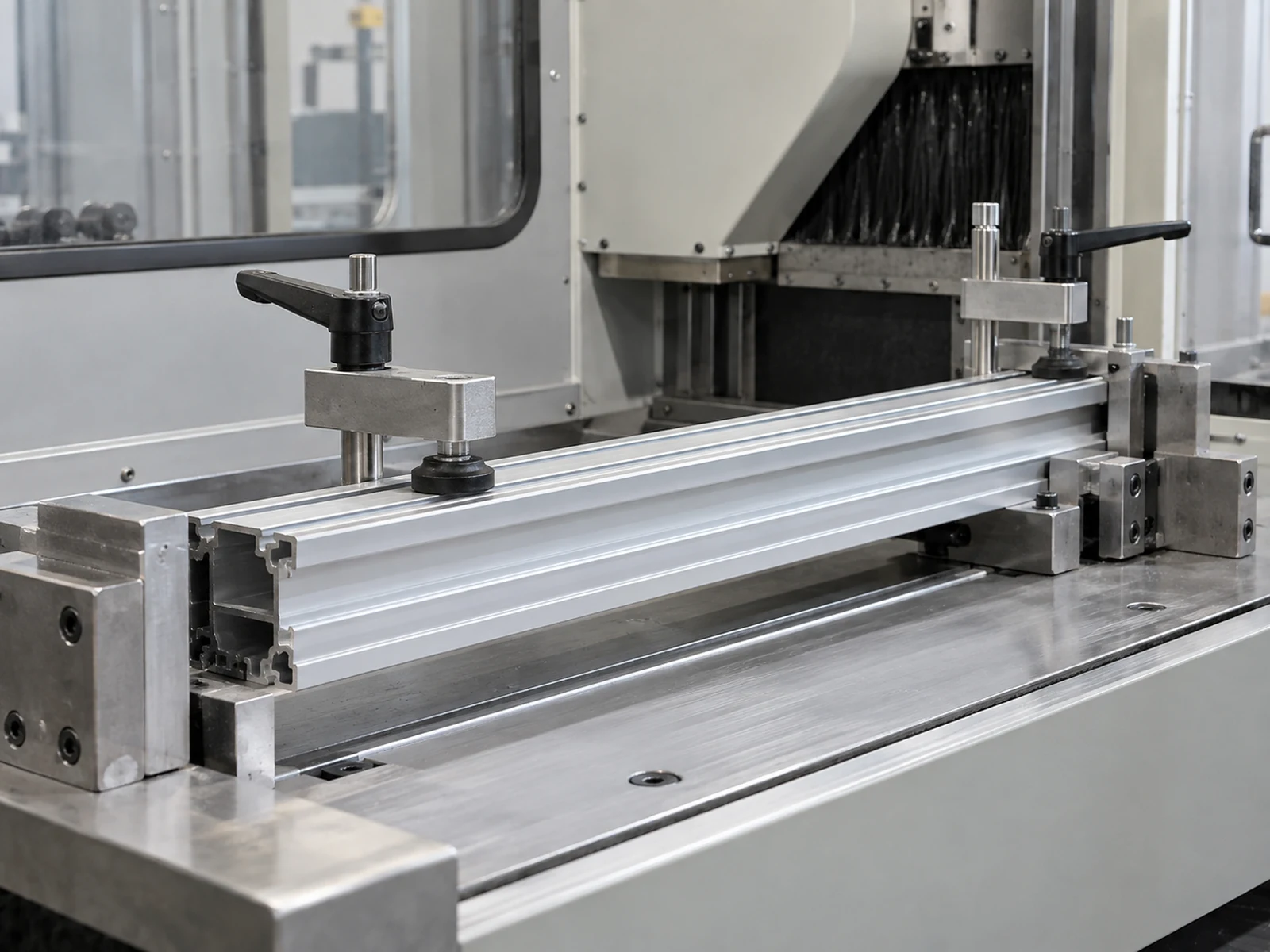
Request a view of the jaw approaching both the smallest and largest approved sections. Check that the jaw reaches a suitable face without bearing on a fragile lip or an open cavity. If an axis is reset for each profile family, record the setup position. Do not assume that the same setting covers every section merely because the quoted travel is large enough. Our separate clamp-jaw travel guide addresses section coverage at the cutting station; the feed gripper must be assessed on its own.
During travel: does the stock steer the gripper, or does the gripper steer the stock?
Ask the supplier to demonstrate the full feed stroke with a representative long profile from the accepted stock range. Observe the lateral relationship between profile, jaw, rollers and side guides. Look for a point where the profile is forced hard against a guide, lifts off support, twists in the jaw, or loses stable contact. A smooth-looking empty-machine stroke cannot settle this question. The supplier should state whether any sideways following is passive, servo controlled, limited to a particular interval, or unavailable on the proposed configuration.
The demonstration should be performed within a documented stock-acceptance limit. “Can handle bowed material” is too broad unless the allowable bow is defined by span, measurement method and profile orientation. Stock outside the agreed limit should be rejected or straightened under the buyer’s process, rather than treated as a machine capability that has not been demonstrated. For the separate decision about accepting bowed stock before a saw trial, see our bowed-extrusion feeding article.
At the cut station: did the datum survive the feed?
After the profile reaches the cutting station, confirm which surface locates the part and whether the cut clamp closes without shifting it. Check several positions along the accepted stock, including the region with the greatest permitted bow. Record any witness marks and compare the part’s cut length and end condition with the agreed inspection method. Feeding stability should be established before a dimensional result is interpreted; a single good cut does not prove that every length, section and stock lot will feed the same way.
Make the quotation answer a testable question
Send the supplier the profile drawings, actual sample pieces, length range, intended gripping faces and a measurable stock-straightness acceptance limit. Ask for a motion diagram or short video identifying the gripper’s lateral setup travel, any in-cycle sideways compensation, travel limits, and what happens when a limit is reached. Request the proposed support and side-guide arrangement as well as the operating mode used during the demonstration. Keep these items attached to the quoted configuration rather than assuming an optional mechanism is standard.
The Jiurun automatic aluminum saw video shows a related machine and long-stock feeding arrangement. It is useful for discussing where to observe the feed path. The footage does not establish floating Y compensation, the exact gripper configuration, an approved bow limit or cutting performance for the buyer’s profile. Those points require a model-specific answer and representative trial.
The decision to take into a supplier discussion
If the proposed aluminum saw feed gripper offers only adjustable lateral pickup, decide whether that is sufficient for the accepted stock and changeover pattern. If in-cycle compensation is needed, ask for the exact option and a witnessed trial using the limiting profile. If neither case can be demonstrated within the buyer’s stock limit, revise the stock specification or the feed concept before approving the purchase. The useful result is a recorded relationship between the actual profile, the feed motion and the cut-station datum—not a feature name alone.
Send Jiurun your profile drawing and representative extrusion with the intended gripping face, accepted bow method and length range. Ask the team to identify the proposed feed path and what can be demonstrated on the quoted machine. Treat any model capability as pending until its configuration and trial evidence are confirmed.