
Two blade quotations arrive for the same aluminum profile. One blade has a lower purchase price; the other supplier expects fewer interruptions between service visits. The buyer asks which costs less per cut. That question leaves out the parts rejected after cutting and the service work needed before a blade is usable again. Aluminum saw blade cost per accepted part is a better comparison, provided both blades are approved for the same machine, stock and quality requirement.
This is a purchasing method, not a claim about Jiurun blade life or a guaranteed cost. It also is not a reason to extend a damaged blade in service. Follow the machine and blade makers’ approved selection and inspection instructions; qualified personnel decide when a tool must be withdrawn. An aluminum saw blade cost estimate starts only after a blade option is technically eligible.
Aluminum saw blade cost starts with an approved tool
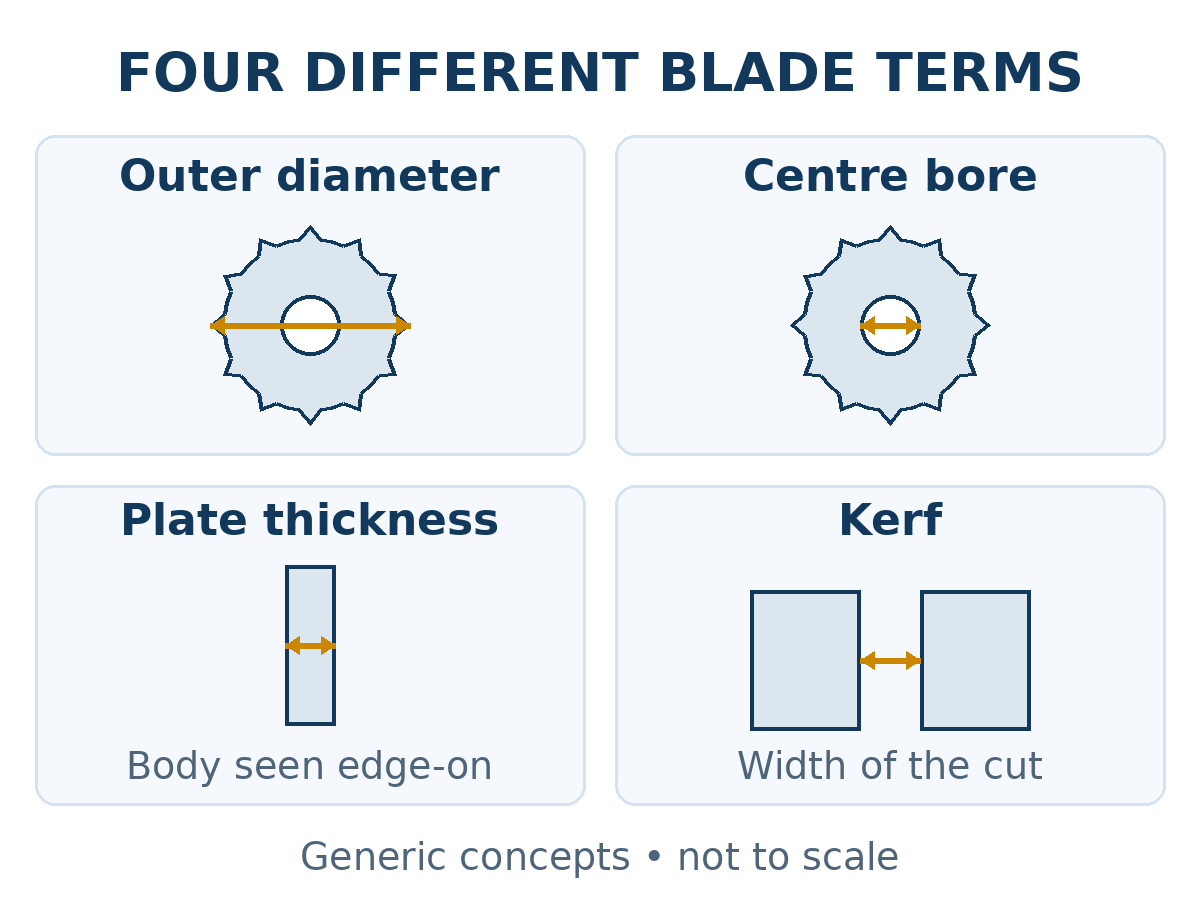
Record the saw model and delivered configuration, blade specification, material and temper, profile section, wall range, cut angle and required output. Confirm mounting dimensions and the blade maker’s application approval. A blade that cannot be approved for the machine or part is not an economic alternative, however attractive its price. The blade-dimension guide separates outer diameter, bore, plate thickness and kerf; use the actual approved values from your machine and tool suppliers, not the generic illustration below.
Keep the acceptance definition beside the tool identity. Length, angle, burr, end-face appearance and downstream fit may each matter, but only the buyer’s approved drawing and inspection plan can set the limits. Comparing a blade that makes a roughing blank with one expected to deliver a finished cut would create a false cost advantage. If two options need different follow-on deburring or inspection, include that difference in the broader process decision rather than hiding it inside a blade price.
Decide what one accepted part means
A saw stroke, a cut face, a finished piece and a released order line are different counting units. One length may require two end cuts; some cuts produce a crop or a test piece rather than a deliverable. Choose one denominator for the comparison: parts from the defined job that pass the agreed cut-stage checks. Count the observed output, including rejected pieces, in a separate column so the acceptance rate remains visible.
Record why a piece was held or rejected. A wrong drawing revision, unsuitable incoming extrusion or handling damage should not automatically be charged to blade wear. A poor end face may also arise from clamping, feed, lubrication or a later handling step. Keep the cause open until a competent review has evidence. A fair blade comparison uses the same acceptance method and does not silently credit every good piece to the tool or blame every bad one on it.
Follow the identified blade through a completed service cycle
A purchase invoice records the entry cost, not the cost of all usable output. Give each blade a traceable ID and record issue, installation, withdrawal, inspection, service, return and final retirement. Tie each period on the saw to its part family and accepted-piece count. If one blade moves among several jobs, allocate its cost by a disclosed method; do not assign the whole blade cost to every job or treat a borrowed spare as free.
- Tool spend: the actual purchase price and approved service charges for that identified blade. Add transport, inspection or repair charges when the buyer truly pays them and the comparison includes them.
- Usable output: accepted pieces from the agreed part family and cut stage during the recorded blade periods. Keep total attempts and holds alongside this number.
- Remaining value: if the blade is still serviceable at the end of the study, document its condition and a consistent allocation basis. Do not call an unfinished trial a full blade lifetime.
- Other production cost: machine time, material scrap, downtime and operator work may affect the overall decision. Show them separately so a blade-only figure does not pretend to be total part cost.
Leitz describes inspection before professional sharpening and explains that the service method can affect the cutting edge and subsequent life. Its sharpening guidance concerns Leitz tools and services, not the number of regrinds available for a Jiurun installation. The buyer should ask the actual blade supplier which service route is approved and what evidence accompanies a returned blade. Our blade-rotation guide treats ready spares and service turnaround; this article treats the expense assigned to accepted output.
A small example shows why the denominator matters
Consider two fictional, technically eligible blade records from one defined part family after each blade has reached its documented retirement decision. Blade A has $240 in purchase cost and $60 in approved service charges. It produces 600 pieces, of which 570 pass the agreed cut-stage check. Its recorded blade spend is $300 / 570, or about $0.53 per accepted piece. Blade B has $300 in purchase cost and $90 in service charges. It produces 900 pieces, of which 810 pass. Its recorded blade spend is $390 / 810, or about $0.48 per accepted piece.
Those numbers are invented arithmetic, not a Jiurun or blade-maker trial. They do not establish that B is the better purchase. The runs may differ in machine time, material loss, mix, service delay or why pieces were rejected. If the blades were not tested on comparable approved stock and settings, stop at the underlying records. If one blade has not reached a comparable service or retirement point, state that the unit-cost estimate remains provisional instead of projecting a lifetime from a short demonstration.
Ask for evidence that can change the order
A supplier may offer a lower quoted blade price or claim a longer interval between sharpenings. Ask what tool code, material, section, cut length, saw, service condition and acceptance rule support that claim. Request the expected supply and service charges separately. If a trial is proposed, agree who supplies the blade, who records its identity, what stock is used, how output and held pieces are counted, and who decides whether the tool can be returned to use. The trial-blade supply guide helps assign custody and record responsibility.
Sandvik Coromant discusses cost per component and tool consumption in a general machining-cost discussion. That accounting idea is useful here, but its commercial program and performance statements are not saw-blade evidence. Use your own accepted-part count and actual charges. Do not apply a catalog lifetime, a percentage saving or a universal cutting cost to the job without a matching record.
Use the machine video for context, then make the request specific
This video from the Jiurun channel shows related aluminum-saw equipment in operation. It does not identify the blade or stock in the proposed comparison, count accepted pieces, show a service cycle or establish blade cost. Use the visible feed and cut sequence to ask which actual machine functions, part families and acceptance checks belong in your trial record.
Send JiurunCut the saw configuration, profile drawing, material condition, cut-stage acceptance criteria, expected mix and the two blade references under consideration. Ask which blades are approved for the quoted arrangement and what a representative, witnessed cut trial can show. Ask the blade and service suppliers for their own approved tool and regrind information. Keep the cost calculation attached to observed accepted output; let missing evidence remain a question on the purchase order.