
An automatic saw can count a cut list precisely and still mishandle the final length of a bar if the controller has an unreliable answer to a simpler question: is usable stock still at the feed boundary? An aluminum saw bar-end sensor may supply a stock-present or stock-end signal, but its usefulness depends on the profile, mounting position, contamination, and the control action tied to that signal. Buyers should qualify the entire decision sequence with their own stock, not assume that a sensor listed on a quote guarantees a clean last cut.
This guide gives a practical acceptance test for a proposed bar-end detection function. It does not describe a confirmed standard feature on every Jiurun machine. Ask the supplier which detection method, logic, and residual-length rule apply to the configuration being quoted.
First define what the signal is meant to decide
“Bar end” can mean several different events. A sensor may report only that material is present at one location. The controller may instead use a measured stock length, a feed-position value, an operator-entered length, or a combination of signals to decide whether another part can be made. Those are different decisions. A presence signal alone does not measure the remaining usable length or prove that the next cut will meet tolerance.
Write the desired action before choosing hardware: should the saw finish the current cut, reject the next cycle, stop before a clamp closes on empty space, flag a short remnant, or request a new bar? Identify the point in the sequence where the answer must be valid. If the requirement is an accurate starting length rather than presence at a point, compare the separate measured versus entered stock-length workflow.
Aluminum saw bar-end sensor: test the real target
Aluminum profiles do not present one uniform target. A wide flat extrusion face, an open slot, a bright round tube, a dark anodized surface, and a short irregular remnant can return different sensing results. For a photoelectric approach, detection mode, target reflectance, background, operating distance, and mounting geometry matter. Keyence’s photoelectric sensor overview distinguishes through-beam and reflective arrangements; SICK’s sensor instructions show why sensing distance and target/background conditions must be checked during commissioning. These are general sensor references, not evidence that a particular sensor is installed on a Jiurun saw.
Bring the thinnest wall, smallest contact face, largest open cavity, most reflective finish, and shortest acceptable remnant in the purchasing specification. Run them at the proposed feed speed and orientation. The test must include the transition from “bar still present” to “bar no longer usable,” including the final two or three planned cuts. Record the controller state at each transition, not just whether an indicator lamp changes.

Separate detection from residual-length logic
Even a repeatable end signal cannot create material that is too short. Calculate the planned part length, saw kerf, required grip or clamp length, and any process-specific trim allowance before declaring another cut feasible. Ask which value the controller uses for each allowance and whether an operator can change it by recipe. A conservative stop may protect a cut list but leave more scrap; an aggressive stop can produce an ungrippable or out-of-tolerance last piece.
For each profile family, agree on a measurable acceptance rule for the aluminum saw bar-end sensor: the last permitted part meets the drawing and inspection plan, while the first prohibited cycle stops before an unsafe or invalid feed/cut command. If the machine uses a tail-handling option, describe it separately; tail pulling is a distinct quotation and test question.
Make the failure response visible to the operator
Ask what happens if the sensor is blocked by chips, misses a shiny target, sees a background surface through a hollow profile, or changes state while the feed carriage moves. A useful specification names the fault state, the displayed message, what motion is inhibited, and how the operator recovers. A detection function should not be described as a safety device without a separately verified safety design and rating; the SICK instructions above explicitly distinguish ordinary photoelectric sensing from safety components.
The acceptance trial should include a clean normal run, a deliberate end-of-stock event, and a controlled fault simulation under the supplier’s safe test procedure. Observe whether the machine pauses in a known state and whether a restart requires a deliberate operator action. Do not reach into guarded or moving equipment to force a test condition.
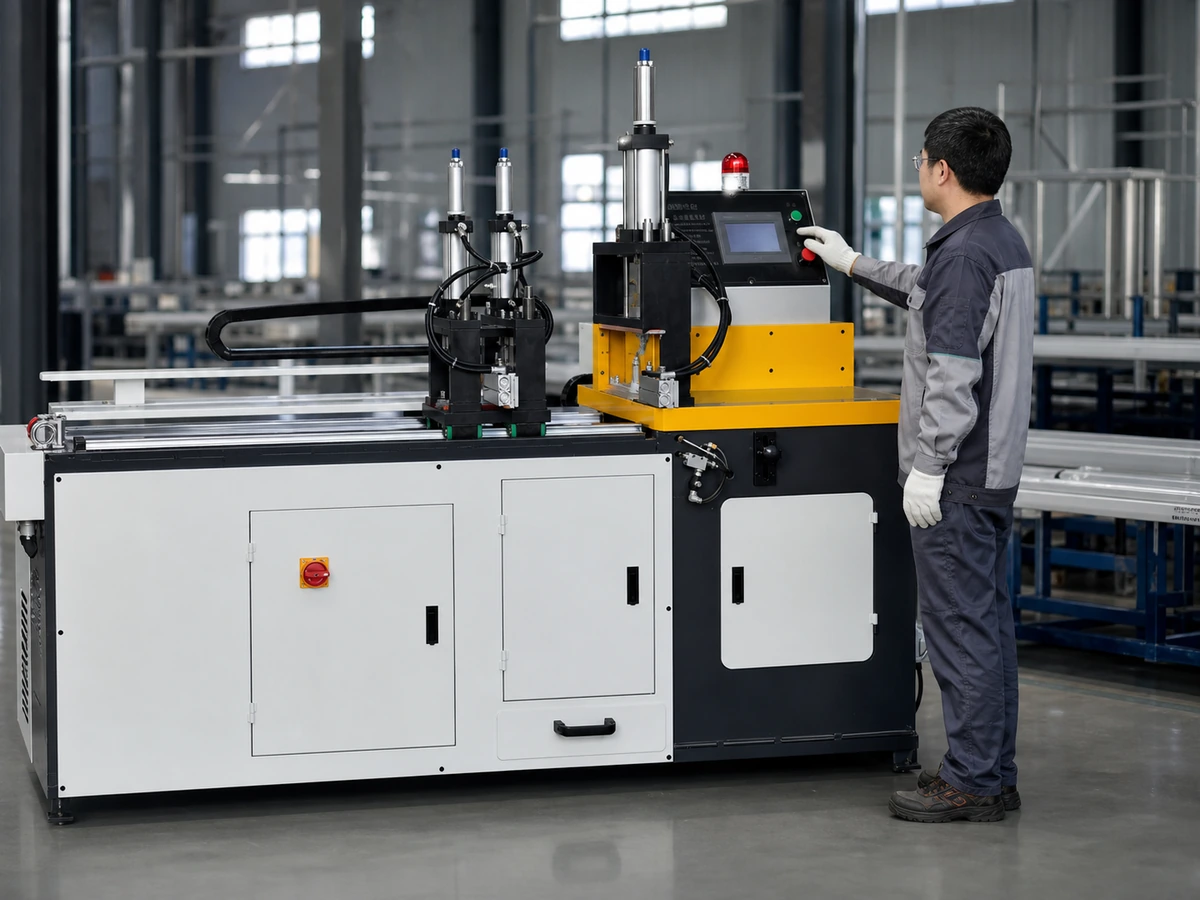
A short witness-test checklist for the RFQ
- Target: list every profile cross-section, finish, orientation, and bar-length range to be accepted.
- Trigger: specify the physical detection point and the controller state that represents “stock end” or “insufficient remainder.”
- Decision: identify the exact cycle step that is allowed, rejected, or paused after the signal changes.
- Last-piece result: inspect the final accepted part against the drawing; record the leftover length and the first rejected cycle.
- Fault and recovery: check dirty optics or an interrupted signal under a safe procedure, then document the alarm and restart steps.
- Evidence: request a video of the agreed test, controller-state notes, sample measurements, and the configuration revision quoted.
Repeat the witness test after a meaningful change in profile geometry, surface finish, sensor position, controller program, or feed hardware. Keep the acceptance evidence tied to the actual configuration. A successful aluminum saw bar-end sensor demonstration on one extrusion does not automatically qualify every other profile.
Equipment context on video
The Jiurun Machinery video below is a related view of a saw and feeding area. It illustrates the kind of equipment interface discussed here. It does not show or prove a bar-end sensor, the exact quoted machine configuration, a customer’s material, this witness test, or cutting performance.
What to send before requesting a quote
Send profile drawings or cross-section photos, finish details, stock and finished lengths, cut-list examples, required last-piece tolerance, and the minimum acceptable remnant. State whether the expected function is presence detection, measured remaining length, controlled tail handling, or all three. Ask for a written explanation of the signal-to-stop sequence and a witness test on representative material. Contact JiurunCut with your profile and cut-list requirements to discuss a configuration that can be evaluated against those conditions.