
Aluminum profile rotation during saw regrip can defeat a cutting plan that looked sound at the first clamp. The stock enters in the approved attitude, the feed clamp releases for another stroke, and a section with an uneven support face settles at a different angle. The next cut may still meet a length check while the visible face, slot or handed end is wrong. A buyer needs the quoted line to hold the required orientation throughout the entire feed sequence, not merely in a posed first-off photograph.
This is a purchasing and trial plan for profiles that could change attitude as contact transfers between infeed supports, feed clamps and the cutting fixture. It does not prescribe clamp pressure, a universal anti-roll device or a machine capability. The supplier must confirm the proposed configuration against the actual released stock.
Aluminum profile rotation: define the failure condition
Start with the drawing and the receiving operation. Identify the face that must point up or toward the fence, the end that will be handed to the next process, and any slot, rib or cosmetic surface that makes a rotated part unacceptable. Give the supplier a marked cross-section and a physical sample if available. A nominal envelope alone cannot say which face is the datum.
For aluminum profile rotation, separate three observations in the trial record: initial loading orientation, attitude after each clamp release and regrip, and orientation at the cut. A mark that is aligned at loading proves only the first state. Also record whether the stock itself turns, whether a support roller changes contact, or whether a clamp shifts the section while closing. These observations lead to different quotation changes.
Follow the stock across the handoff
Ask the supplier to draw or show every support and locating contact from the loading point to the blade. The critical moment may be a short interval when one clamp has let go and the next has not yet established the same reference. On a long or asymmetric extrusion, an upstream overhang or a roller contact can change the section’s attitude without obvious motion at the cutting station.
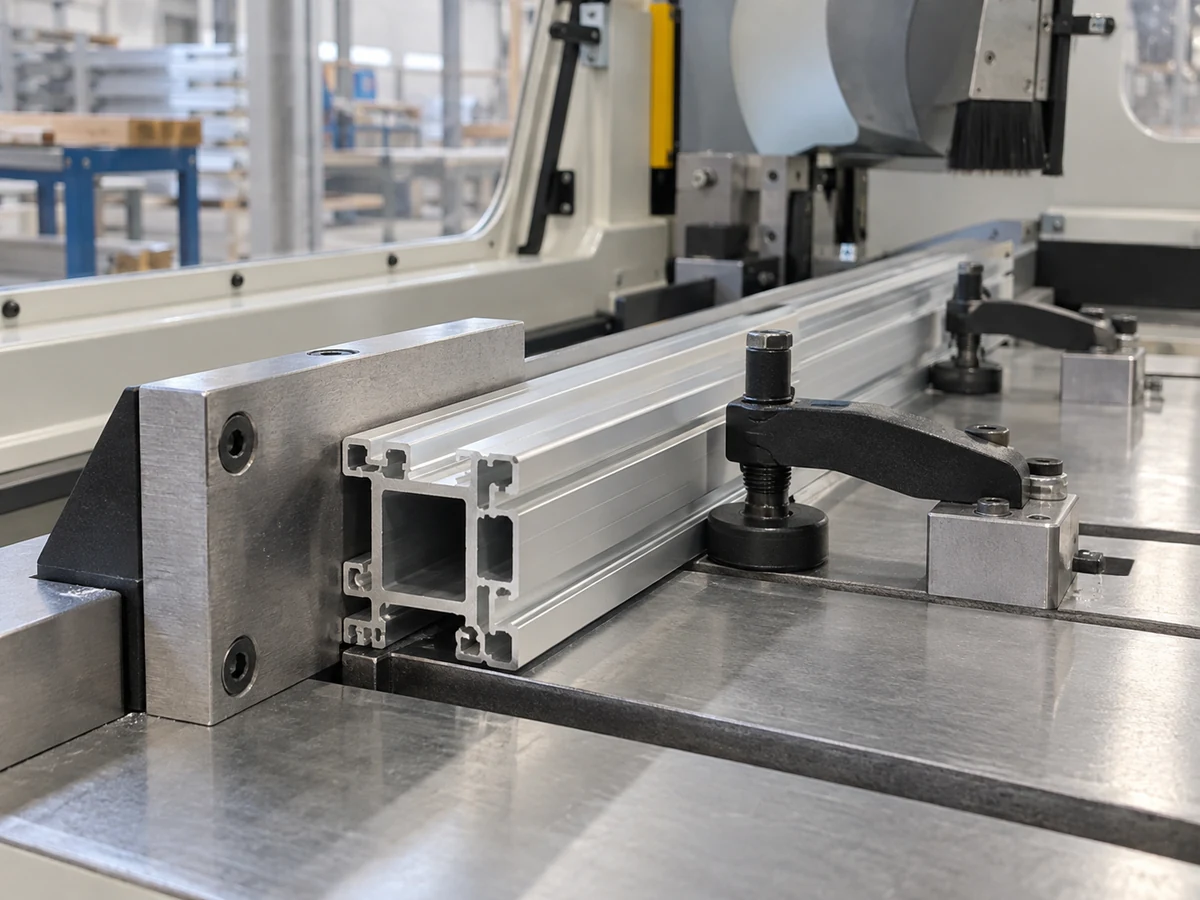
In the first quotation route, the approved profile is naturally stable on the proposed supports and the supplier demonstrates that it remains correctly oriented through the full programmed cycle. In the second, the quote includes a supplier-approved locating, side-support or profile-specific fixture arrangement and its changeover parts. Name the included parts, adjustment access and who validates them. Do not assume that a stronger top clamp is an anti-rotation solution; it may contact the wrong face or distort a thin wall. Carr Lane’s locating and clamping principles explain why support and clamp placement matter. This is a general fixture-design reference, not evidence for a JiurunCut configuration.
Make the regrip trial able to fail
Choose representative released stock, including the section most likely to change attitude, and agree on the exact blade, support, clamp and feed arrangement offered. For aluminum profile rotation during regrip, the supplier should show the setup at loading, after each relevant feed-clamp transfer, immediately before the cut, and at the accepted part. A controlled observation mark or a repeatable photo reference can make a small rotation visible without claiming that the mark itself is a measurement instrument.
Run the sequence that the production order actually needs. If a long part requires repeated feed strokes, a one-stroke sample is insufficient. Include a stop and approved restart if that occurs in normal operation, and repeat the check after a changeover between the profile families named in the RFQ. Record the stock identity, programmed sequence, contact arrangement, operator observations and the receiving check for the cut parts. Any numerical angular or feature limit must come from the released drawing or agreed acceptance plan, not from this article.

What to do if the profile moves
Classify the failed handoff before asking for a revised price. If the stock turns on the external support, review that support and the transfer into the machine. If it changes when a jaw closes, review the locating and contact faces. If the cut is correctly oriented but the finished part is wrong, check the drawing hand and the part-identification path. The supplier can then propose a specific revision and demonstrate the same complete cycle again.
A quote addressing aluminum profile rotation should state whether the remedy is included, whether it is profile-specific, how changeover is performed and what additional stock the buyer must supply for a witnessed trial. Keep the saw’s cut-length acceptance separate from orientation acceptance; passing one does not establish the other. If the available evidence cannot resolve aluminum profile rotation, keep the option conditional rather than treating a catalog picture as proof.
What the Jiurun video can and cannot show
The JiurunMachinery video below is a general automatic aluminum-saw operation example. It gives context for machine feeding and cutting movement. It does not document the pictured profiles in this article, a rotation event, an anti-roll device, the quoted configuration, a customer trial or an achieved tolerance. Ask for a witnessed run of your own section and sequence before accepting a regrip claim.
Send one decision-ready RFQ package
Send the released cross-section with the required face and end marked, stock lengths and condition, finished cut list, feed-stroke pattern, support space and receiver’s orientation check. Request two clearly priced answers if both routes are feasible: the standard support arrangement demonstrated as stable, and the supplier-approved additional restraint or fixture with its changeover and spare scope. Require the same trial record for either route.
The useful decision is whether the offered system preserves the part’s required attitude through every handoff at a cost and changeover effort your shop can accept. The multi-stroke feed guide covers repeated indexing and length; the orientation RFQ guide helps define the initial faces and handed ends. This article’s release gate is what happens between those states.
Request a configuration review: send JiurunCut the marked profile drawing, feed pattern and available sample, then ask which support and clamping arrangement can be demonstrated on the proposed saw. Discuss Your Profile and Regrip Trial →