
An aluminum door threshold may arrive at the cutting station as an extrusion, but the installed part is more than a length of metal. A chosen section can have a seal or insert path, a visible walking surface, a thermal break, and ends that must meet a particular door opening. The purchasing question is therefore which work ends at the saw.
If a supplier quotes straight cut blanks while a buyer expects notched, drilled, finished, site-ready thresholds, both sides can agree on a length and still disagree about the deliverable. This guide gives an OEM or fabricator a practical way to specify aluminum door threshold cutting, inspect a representative blank, and compare machine or cut-part quotations without claiming that a saw trial qualifies a finished doorway.
Aluminum door threshold cutting starts with the deliverable
Write one sentence that names the accepted unit: a straight sawn extrusion, a prepared threshold with agreed end work, or a fitted and installed assembly. These are different stages. In a published National Guard Products threshold installation sheet, cutting to the required size appears alongside possible frame notching, floor fastening and base caulking.
That is useful evidence of why a buyer should not silently include all installation operations in a saw quote. It is an example from another manufacturer, not a process specification for a Jiurun machine or for every threshold design.
| Quoted stage | Length and end definition | Who accepts the next operation? |
|---|---|---|
| Sawn blank | Drawing datum, straight end condition and cut allowance | Buyer or downstream fabricator handles fitting and later features |
| Prepared threshold | Approved cut plus separately specified notch, hole or insert work | Buyer checks the supplied preparation against the released drawing |
| Site-fitted assembly | Opening-specific fit, fastening and sealing scope | Installer or project owner verifies the installed condition |
1. Identify the exact section and revision
Do not ask a saw supplier to infer the profile from the phrase “aluminum threshold.” Send the released cross-section, profile code, revision, finish, material designation if known, and a sample of the actual stock. Mark the upper face, the underside, the side with any insert or seal channel, and the surfaces that a clamp may touch.
A manufacturer product example combines an aluminum threshold body with a separate rigid spline and silicone component. Other product families use different geometries. The saw trial must therefore use the buyer’s real section and approved component state. A sample image, a similar-looking extrusion, or the nominal top width alone cannot prove that the supplied stock matches the released section.
2. Define factory blank length against the site-fit length
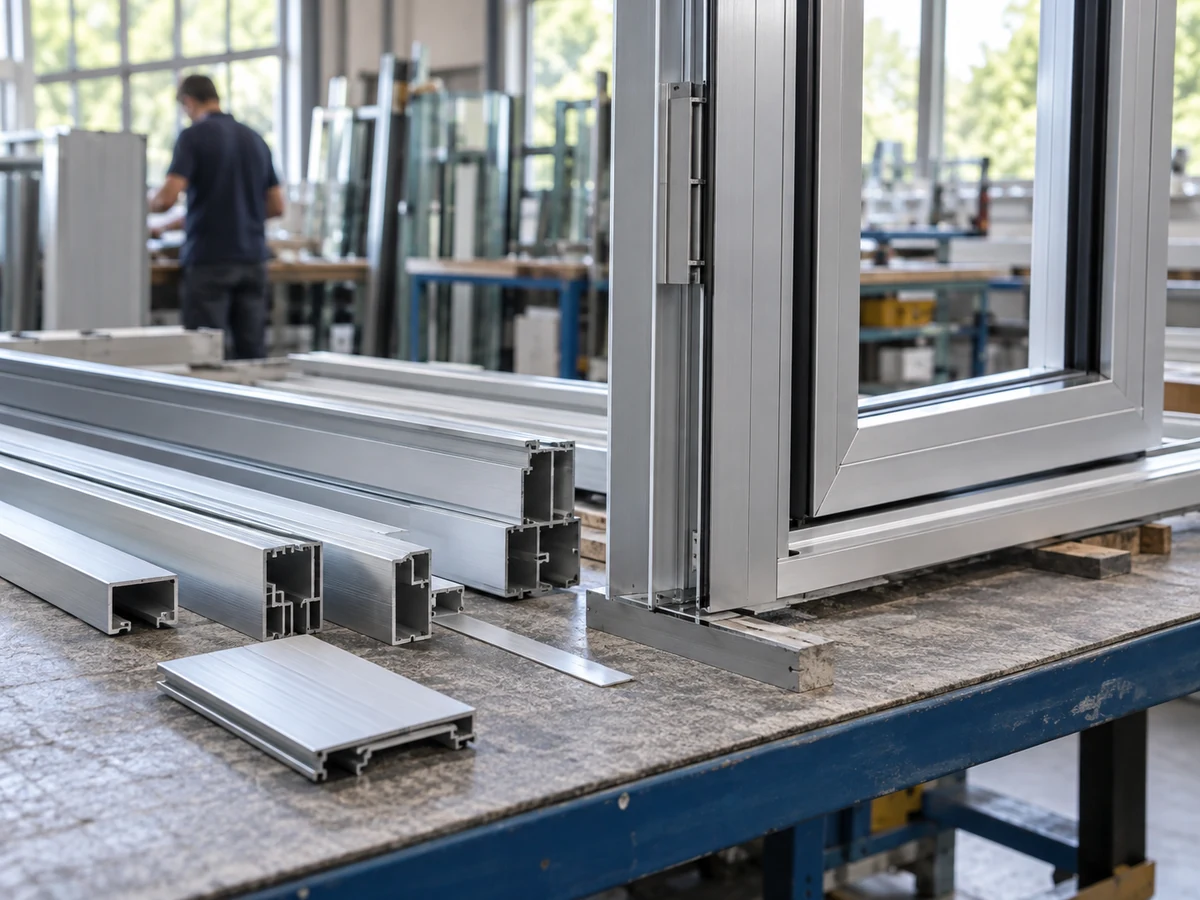
In aluminum door threshold cutting, a field instruction to cut a threshold to size does not automatically tell the factory the dimension of its straight blank. The opening may have jamb details, an end gap, a later notch, a cap or a seal that changes the reference. On the RFQ drawing, identify the datum faces and state whether the dimension is measured over the long edge, short edge, or another named reference. If a site team will trim or notch later, state the intended allowance and who owns final measurement.
If the factory will deliver final-cut lengths, provide a released opening schedule rather than a rough nominal door width. Keep tolerance and measuring method as explicit drawing requirements; this article does not prescribe a universal threshold tolerance. For stock utilization, include the actual blade kerf and trim allowance in the cut plan; the separate kerf and stock-length calculation guide explains that arithmetic.
3. Separate straight sawing from notch and fastening work
An end notch around a door frame is geometrically different from a straight saw cut. Likewise, a countersink, drilled hole, deburred slot, insert installation or seal trimming is a separate operation unless the quoted configuration and routing explicitly include it. Ask the supplier to mark each feature as “before saw,” “saw,” “after saw,” or “site work.” The NGP installation example places optional frame notching after cutting the threshold to size.
That sequence illustrates the boundary, but the buyer’s drawing governs the actual job. If a trial blank has only a straight end, do not accept it as evidence that a later notched end, fastener layout or installed seal will fit. A quotation should identify the responsible party and inspection point for every operation outside the saw.
4. Protect the contact surfaces and insert path
Threshold profiles often have a visible top and relatively thin edges or channels. A clamp that grips a strong-looking outer face can still mark a finish or deform a groove needed for later assembly. Show the permitted clamp faces on the drawing and ask the supplier to explain how the part is supported near the blade. If inserts or seals are supplied loose, clarify whether the extrusion is cut before they are fitted.
If supplied installed, obtain the component maker’s cutting instruction before trialing it; do not assume the same blade and clamping setup is suitable. Specify what constitutes an unacceptable burr, crush mark or channel obstruction using an approved sample or drawing. A cosmetic photograph can help discussion, but the first-off check must be made on the real threshold section.
5. Trial the real stock length and support route
The most convenient short sample may hide the handling issue that appears on a production length. Supply the actual incoming bar length, maximum and minimum finished blank lengths, expected batch mix, and the available infeed and outfeed space. Confirm where the stock is supported before it reaches the saw and where the cut part lands after separation.
Ask for a representative trial with the approved section, finish and orientation, especially at the shortest retained blank and any end that may expose a seal channel. A related long-extrusion feed image can show the kind of support question to discuss; it cannot establish that a particular Jiurun configuration has been tested on your threshold or that the shown rollers are suitable for it.

6. Inspect the first-off blank before discussing rate
For aluminum door threshold cutting, agree on a first-off check that the buyer can repeat. Record the stock identity and orientation, cut length against the named datum, end squareness or specified end angle, edge burr condition, visible-surface condition, and whether the insert or seal path remains usable. Use a real threshold sample, the drawing and the agreed measuring tools. Photograph both ends and the reference face so a later batch can be compared with the accepted sample.
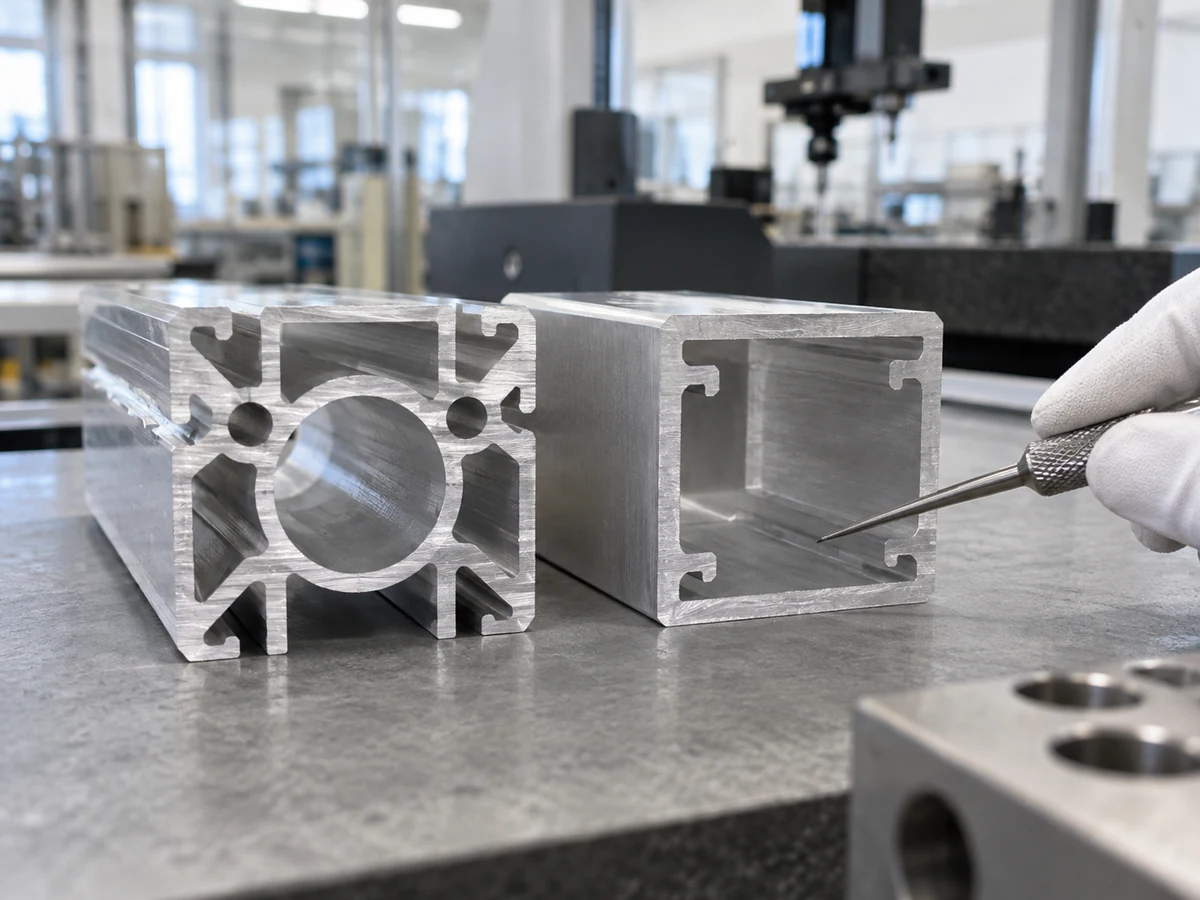
Keep a distinction between a clean cut face and a complete fit: the straight blank can pass its saw inspection while a site-fit notch or installed seal remains unverified. If a drawing calls for a downstream operation, note that the sample is awaiting it rather than signing off the entire assembly. The image below is a generic end-face review scene, not this threshold’s measured result.
7. Compare complete-batch cost and ownership
Two saw offers can have the same quoted cycle time yet different delivered value. Ask each supplier to state the saw and fixture configuration, changeover assumptions, sample requirement, operator tasks, expected handling of short blanks, and which inspection or downstream operations are excluded. For cut-part buying, compare the price per accepted blank and the cost of rework or rejected ends, not a machine demonstration alone.
For a machine purchase, witness the trial on the buyer’s section and record the setup and first-off results before discussing throughput. Do not extrapolate an isolated video or a generic profile cut into a production rate, yield, seal function, accessibility compliance or completed-door performance. Those claims require their own product-level evidence and acceptance authority.
Send this package with the RFQ
- Released threshold section drawing, profile identifier, revision, finish and actual stock sample.
- A cut list with each factory blank length, named datum, end condition and allowed trim or site-fit allowance.
- A route map for inserts, seals, notches, holes, deburring, packing and installation, with one owner for each step.
- Permitted support and clamp contact faces, incoming bar length, shortest retained part and available shop-floor space.
- First-off inspection points, acceptable reference sample, batch mix and the exact stage at which the buyer accepts the goods.
If any of those inputs are still open, ask the bidder to show the assumption in the quotation. That makes the missing decision visible before equipment selection or a full batch is committed.
Equipment video: a general aluminum-saw example
The Jiurun Machinery video below shows an aluminum saw and stock-feed equipment context. It helps visualize a guarded cutting station. It does not show a door threshold, the exact quoted machine configuration, a customer job, a threshold trial, accepted dimensions, installed fit or product performance.
Before you order
Choose the output stage first, then request a witnessed cut on the released profile. If the supplier can return a first-off blank with its datum, edge condition, setup and remaining work clearly recorded, the purchase discussion becomes much more precise. To discuss an aluminum-profile saw trial with Jiurun, send your drawing and representative stock details. The team can review the actual cutting scope and identify assumptions that still need the product owner’s decision.