
An astragal closes or covers the meeting edge between a pair of doors, but the metal supplied to a saw may be a plain extrusion, a seal-carrying strip or a hardware-prepared set. Aluminum door astragal cutting starts with the released product and the accepted output stage. A length quote alone cannot tell a buyer whether the supplier should deliver straight blanks, installation-length pieces, or a finished set that must retain its hardware preparation.
This guide is for door-hardware buyers, fabricators and equipment purchasers specifying an aluminum cutting operation. It separates saw work from door fitting and product approval. It does not set a universal trim allowance, saw parameter, door clearance, fire rating, seal result or installation method.
Aluminum door astragal cutting: first classify the product
The word astragal covers materially different constructions. One manufacturer instruction for a plain 139A-series metal astragal begins with cutting the astragal to fit, then positioning it on the door and marking the screw holes. In that route, a straight metal cut can precede door-side hole work. The same sequence should not be assumed for every profile.
A separate metal-edge and astragal-set instruction says its set was ordered and manufactured to the net door height and that cutting or trimming should not be required; changing length affects hardware-prep alignment. This is a different purchasing object. If a customer orders a prepped set, a saw operator must not treat it as generic oversize stock merely because both products contain metal.
A spring-loaded 140S adjustable astragal seal instruction gives an end-specific shortening restriction near its adjusting screw. That restriction belongs to that product and instruction, not to all astragals. It illustrates why the approved manufacturer document, component state and adjustment hardware must travel with the released part number.
| Input in the RFQ | What the saw may deliver | What remains outside a straight blank |
|---|---|---|
| Plain aluminum astragal stock | Approved straight length and end condition | Door-side positioning, holes and final fit if specified |
| Seal or adjustable assembly | Only the permitted metal/component cut under its own instructions | Seal handling, adjustment and door closing checks |
| Net-height hardware-prepped set | Usually no generic field shortening assumption | Released prep alignment and product-specific acceptance |
Use the table as a quotation-routing prompt, not a substitute for the selected product drawing. A door threshold is a horizontal opening component with its own blank-versus-site-fit decision; it is not the vertical meeting-edge astragal discussed here.
1. Freeze the part identity before length planning
Ask for the manufacturer, product family, exact part code, revision, material, finish and approved cross-section. Record whether a seal, brush, adjusting screw, end component or hardware preparation is already present at the cutting stage. The buyer should mark the face that meets the door and any surface that must remain visible after installation. A photograph of a similar strip is useful for discussion but is not a released drawing.
The section controls how the stock rests, which face can be clamped, and whether a protrusion or channel is at risk. If more than one door pair or hand is in the order, identify the applicable part and orientation on every line. A supplier should return assumptions as open RFQ questions rather than quietly selecting a convenient profile from its sample rack.
2. State which length is the saw dimension
A door opening height, a net door height and a metal blank cut length are not automatically the same number. Identify the dimension reference: overall metal end to end, a named shoulder, the top of a pre-installed component, or another released datum. State whether the cut is made before or after finish, seal insertion, hardware preparation and door fitting. Define the units and approved drawing tolerance; do not apply an article-wide tolerance to unrelated products.
For a plain stock-to-fit route, specify who takes the final door measurement and who owns any field trim. For a net-height prepped set, show how its pre-machined openings relate to the door and prohibit unreviewed shortening. If the customer requests cut blanks rather than ready-to-install astragals, write the remaining hole, fastening, seal and fit tasks into the purchase order so the accepted unit is unambiguous.
3. Protect end-specific hardware and insert paths
A marked end can carry an adjuster, hole pattern, insert or factory-prepared interface. Before a saw trial, ask whether stock may be shortened from either end and whether the manufacturer limits how close a cut may approach a feature. The 140S instruction is a concrete example of a product-specific end restriction; using it on a different astragal would be an unsupported extrapolation.
Confirm the seal state at the saw: loose, partly inserted or installed. If the metal extrusion alone is to be cut, separate that operation from cutting the compliant seal component. If an assembled product is presented, obtain its specific cutting and reassembly guidance first. A metal-cutting trial cannot certify the seal, door latching, smoke control or fire-door application.
4. Prove support and clamping on the actual section
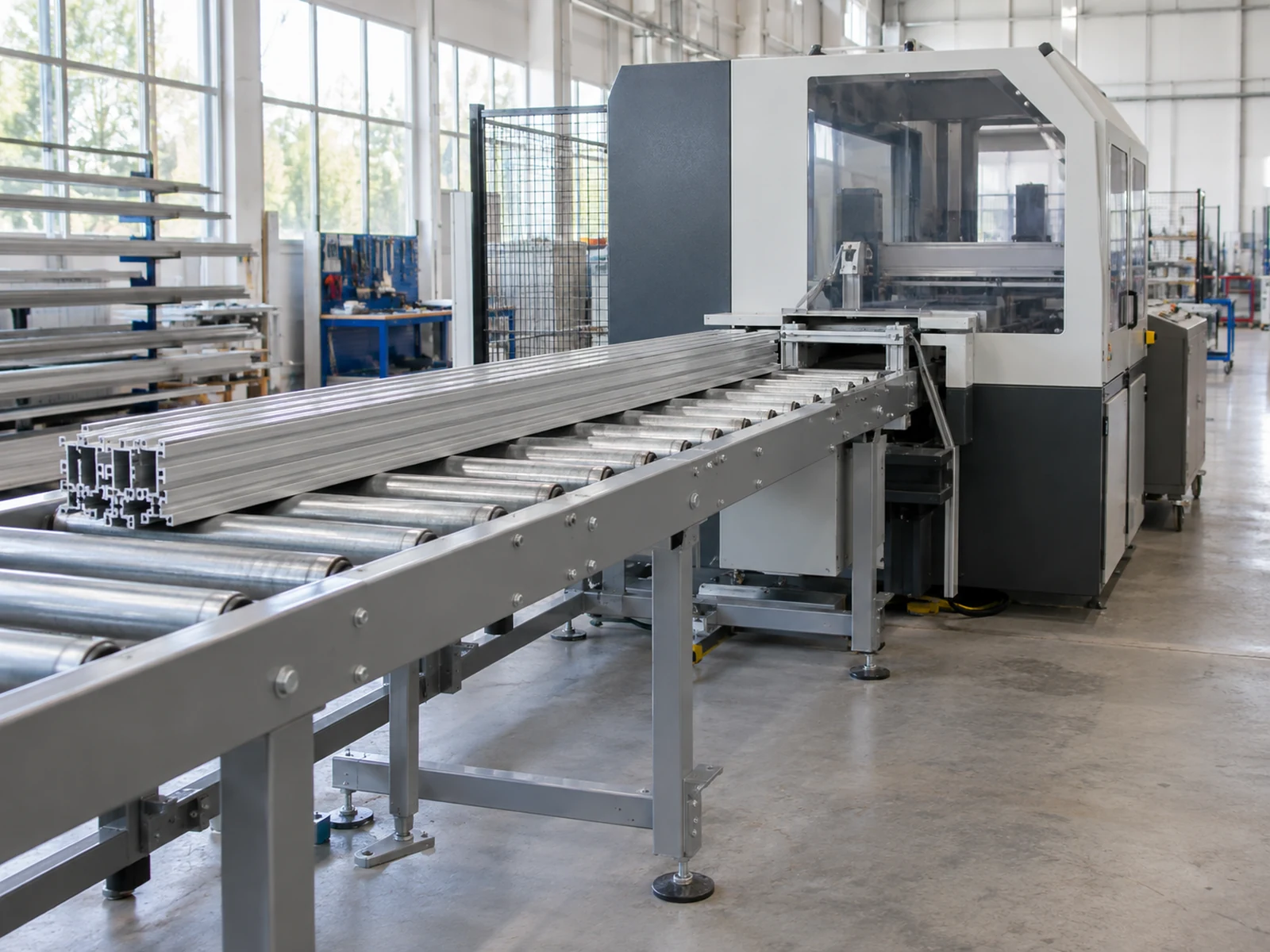
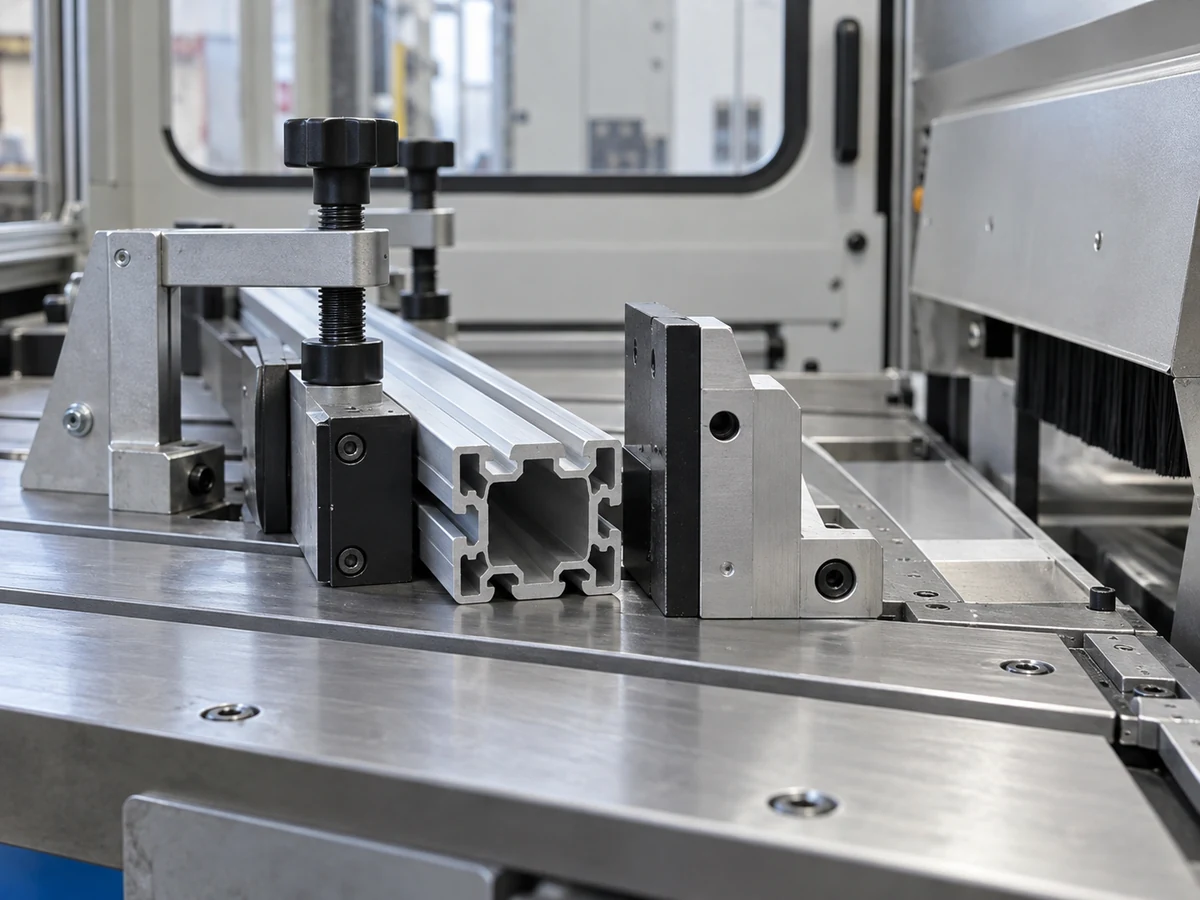
Long, narrow aluminum sections can bow, twist or shift if the infeed support and clamp faces are assumed from another profile. Put the released stock length, weight, bow condition, allowed contact faces and visible finish surfaces into the trial plan. Ask the equipment supplier to show the part at the entry, cutting and outfeed positions, with any stop or pusher engaging the intended datum.
For thin flanges or open channels, the trial should show whether the clamp bears on a supported region and whether the cutting end remains stable. A machine photo can illustrate the kind of fixture question, but only an actual run with the buyer’s section establishes a useful setup record. Do not infer clamp force, blade choice or an approved guarding configuration from an unrelated image.
5. Separate a clean cut from a prepared door edge
A first-off blank can pass a length and cut-face check while the later door assembly still fails to fit. Define the saw-stage inspection as its own record: correct part and orientation, measured length at the agreed datum, end squareness or released angle, burr condition, visible-surface marks and damage to any seal path. Photograph both ends and the reference face against the accepted sample.
Then name the next owner for screw holes, hardware prep, seal insertion, mounting and closing checks. The 139A instruction places hole marking after positioning on the door; a prepped set has a different sequence. A quote that includes only a straight cut must not be compared as if it includes every subsequent operation. Keep the handover drawing and inspection record tied to the same part revision.

6. Compare a witnessed batch, not a demonstration clip
For a machine purchase, use the buyer’s released section and representative lengths. Include the shortest acceptable blank, the longest stock, finish sensitivity, changeover between product families, cut-off handling and the planned end inspection. Require a first-off before discussing an hourly rate. Record operator tasks, setup changes, rejected samples and rework scope alongside any observed cycle time.
For outsourced cut parts, compare price per accepted unit at the same stage. One bidder may supply simple metal blanks; another may provide an approved prepped set. The delivered quantity, packaging orientation, end protection, traceability and remaining installation work affect the comparison. A generic saw video does not prove an astragal cut, product acceptance or a door assembly result.
RFQ package: give each bidder the same decision record
- Released product code, manufacturer document and cross-section, with revision and finish.
- Input state at the saw: bare aluminum, installed seal, adjuster or hardware-prepped set.
- Dimensioned cut length, named datum, end direction, tolerance and end-specific restrictions.
- Representative stock length, allowed clamp faces, support route and cut-off handling.
- First-off inspection method, accepted sample, photo record and rejection conditions.
- Clear ownership of holes, sealing, door fitting, latching and any rating or code review.
- Required delivery stage, quantity mix, packaging, changeover assumptions and quotation exclusions.
If a drawing or installation instruction conflicts with a generic shop practice, stop the quotation assumption and resolve it with the product owner. The RFQ should carry the answer forward to the operator, inspector and receiving team. That avoids a cheap saw blank being mistaken for a prepared door-edge set.
Equipment video: general aluminum saw context
This Jiurun Machinery channel video shows a general aluminum saw example. It helps visualize an enclosed cutting station and profile handling. It does not depict an astragal, the cited manufacturer’s product, the customer’s section, a witnessed astragal trial, an accepted door fit or a performance claim.
Before you issue the order
Choose the accepted object first: cut metal blank, permitted adjusted component or manufacturer-prepared set. Send the released section and its cutting restrictions, then request a first-off on the actual stock. If the required cut point, hardware prep or seal state is still unknown, the next step is a drawing and product-owner decision, not a guessed saw setting. For a machine discussion, send JiurunCut the profile drawing, sample, target blank schedule and acceptance checklist so the quotation can state what was actually evaluated.