
Shared aluminum saw capacity can look sufficient on a daily total and still fail two production lines at the same hour. Imagine Line A and Line B each asking for a complete batch before their own assembly release. One saw can cut both jobs in sequence, but it cannot give both lines exclusive access at once. Before buying a shared cell, the buyer needs a time-stamped job mix, a priority rule and a witnessed handoff—not a brochure throughput figure.
This guide deals with the decision to buy one saw for two downstream lines. It does not treat the pictured equipment, charts or video as evidence of a Jiurun two-line installation or a promised production rate.
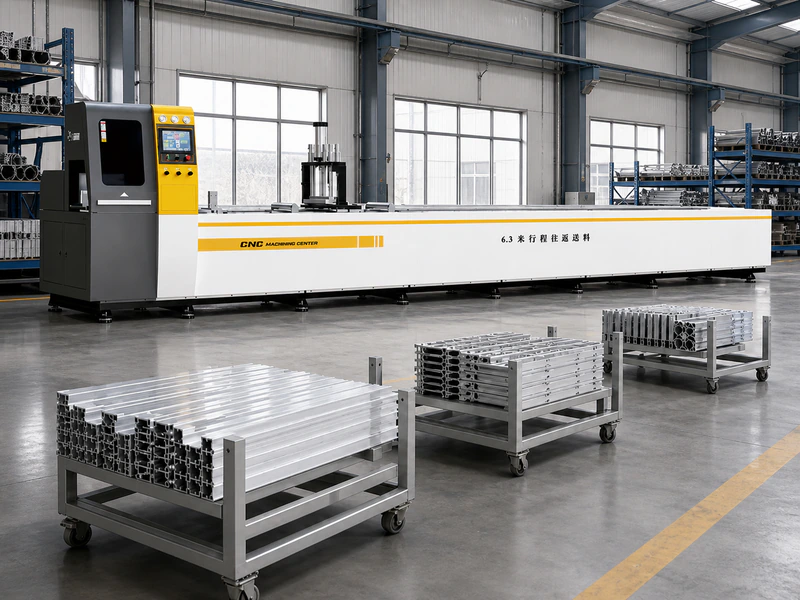
Start with the two line releases, not a machine cycle
For each line, write down the approved profile and cut list, the incoming stock state, the accepted part count, the earliest time stock is available and the latest time the complete batch must reach its receiver. Name who owns stock staging, changeover, inspection and delivery. A cut that leaves the saw at 11:55 is not an on-time release if inspection and transfer finish after the line needs it.
Keep the job families separate in the trial. Different sections may require different support, clamp setup, blade selection, cut program and acceptance checks. Do not add their isolated catalogue rates as though the changeover and material movement were free. The batch cycle-time guide explains why machine motion alone is an incomplete time account; here the additional question is whether two receivers can meet their deadlines from one queue.
Shared aluminum saw capacity: reconcile the full window
The first check is arithmetic. In a hypothetical 240-minute window, suppose the accepted Line A batch takes 100 minutes, Line B takes 90, changeovers take 30 and inspection takes 10. That allocates 230 minutes and leaves 10. These are invented teaching values, not JiurunCut test data or a recommended allowance. Even if a supplier demonstrated the two cutting times, the remaining ten minutes would not establish a reliable schedule: loading, transfer, held parts, blade checks and normal variation might consume it.
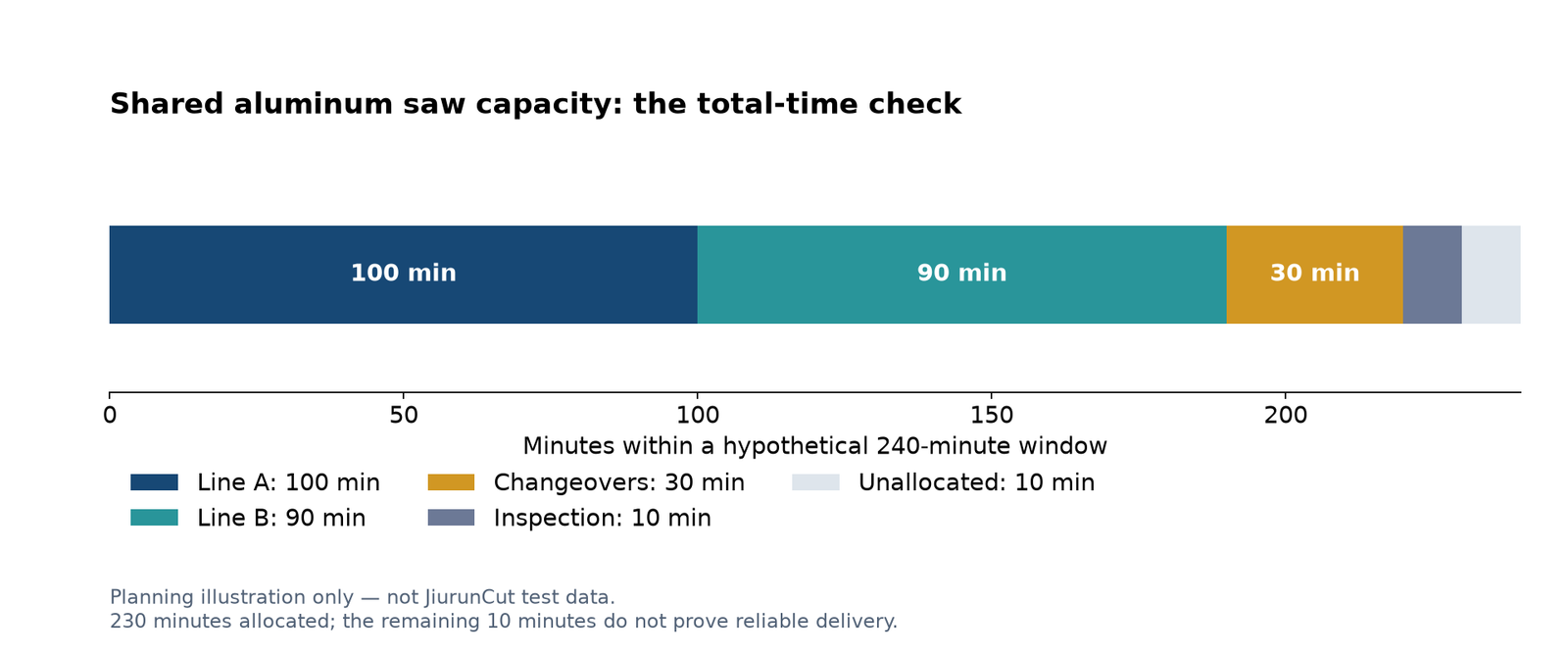
Replace every illustrative entry with a timed, accepted batch from your own profiles. Record the start and finish of setup, first good part, last good part, inspection and arrival at each line. Include rejects and rework in the result rather than silently dividing them out. If a proposed machine changes any of these durations, ask the supplier to show the test conditions and the boundary of its responsibility.
Then test the common deadline
A second check can overturn a passing daily total. In another deliberately simplified illustration, both complete batches are due at minute 120. Line A takes 100 minutes of exclusive saw time and Line B takes 90. If A runs first, B finishes no earlier than minute 190; reversing the order still leaves the second batch late. This ignores setup, inspection and delivery, so reality cannot be better without changing the assumptions. A larger daily window does not cure a simultaneous release requirement.
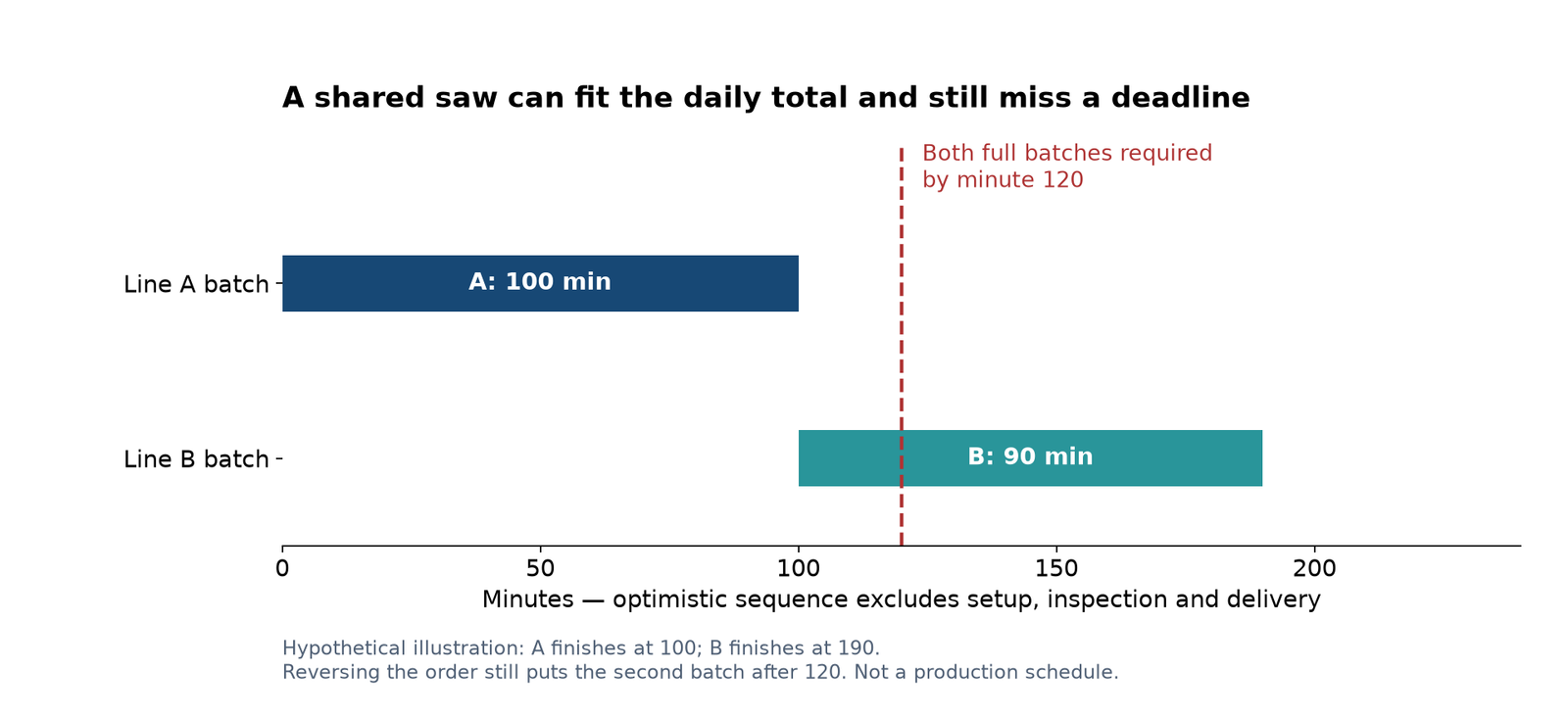
Check your actual release pattern at its busiest representative point, not only an average shift. If the deadlines overlap, test whether earlier stock release, a documented buffer of accepted parts, a different batch split or a separate cutting route is operationally allowed. Do not assume an assembly line will accept an early batch, partial kit or mixed revision without its owner signing off.
Make queue ownership part of the purchase
A shared saw needs one rule for conflicting jobs. Who may reserve a slot? Which line can interrupt a running batch, if any? Who approves a revised cut list and who marks the physical stock and finished parts so they do not cross into the other line’s kit? Put the queue owner, order identifier, revision, due time, priority changes and exception route in a simple trial record. If production planning depends on software integration, quote the interface and its failure behavior; a spreadsheet or manual board may be enough when the volume and change frequency are modest.
The U.S. National Institute of Standards and Technology describes production scheduling as assigning activities to resources over time and identifies due dates, setup, resource availability and sharing among the constraints. That general framework explains why a one-saw decision needs both a time account and a release rule. It does not validate any particular Jiurun configuration.
Compare the alternatives at the same receiver boundary
Ask for three comparable routes if the shared case is tight: one saw with the agreed slot and buffer policy; one saw plus an approved overflow cutting source; and a second saw or dedicated route where the job mix justifies it. Compare accepted batches arriving at each line on time, not theoretical cuts per hour. Include floor space, staging, operators, inspection, changeovers, stock traceability, training and recovery after downtime in every route. The second-saw guide addresses whether an added machine should duplicate or complement the current cut route; this article tests whether one saw can serve two line calendars at all.
A supplier can quote the saw and its specified accessories. Your plant must also confirm its line release times, material route, staffing and acceptance authority. Keep those owners visible in the quotation so a machine trial is not mistaken for approval of the whole factory schedule.
Witness a mixed-job day before accepting the shared plan
Provide representative approved stock and drawings for both lines. Run the proposed sequence with the real changeover and inspection steps, label the output by line and revision, and record when each accepted batch reaches the agreed handoff point. Add one realistic priority change and one held part. The test should show who changes the queue, how the cut program and stock identity are checked, and whether the other line’s deadline survives. Record what was demonstrated, what was simulated and what remains a site responsibility.
What the Jiurun video shows
The official Jiurun video below shows a JR-650CNC-3A-1S automatic aluminum profile feeding and cutting sequence. It helps a buyer discuss where a job occupies the saw. It does not show two production lines, the illustrated carts or charts, a shared queue, a changeover trial, on-time delivery or the performance of a proposed configuration.
Send a two-line RFQ that can fail the trial
Send JiurunCut the two approved profile and cut-list sets, the incoming stock lengths and surface requirements, each line’s accepted batch quantity and release deadline, the overlap pattern, available floor and staging space, and the person who owns the queue. Ask for a proposed saw and handling scope, a timed mixed-job trial and a written list of untested site assumptions. If one route misses the agreed release, ask for the revised route and cost before treating a nominal daily capacity figure as approval. Discuss the two-line cutting requirement with JiurunCut.