
A long extrusion enters a saw through one side of a guarded cutting zone and leaves through the other. Those necessary openings matter when the buyer asks for a quieter cell. An aluminum saw acoustic enclosure needs a defined sound boundary, workable material flow and a test at the operator position. A photograph of a closed guard cannot establish any of those outcomes.
Use this guide when comparing an acoustic enclosure option for an aluminum cutting machine. JiurunCut supplies industrial aluminum and other nonferrous cutting equipment; whether an acoustic package is available for a particular machine must be confirmed in the quotation. The images below show related saw layouts and do not document an acoustic treatment, customer installation or measured reduction.
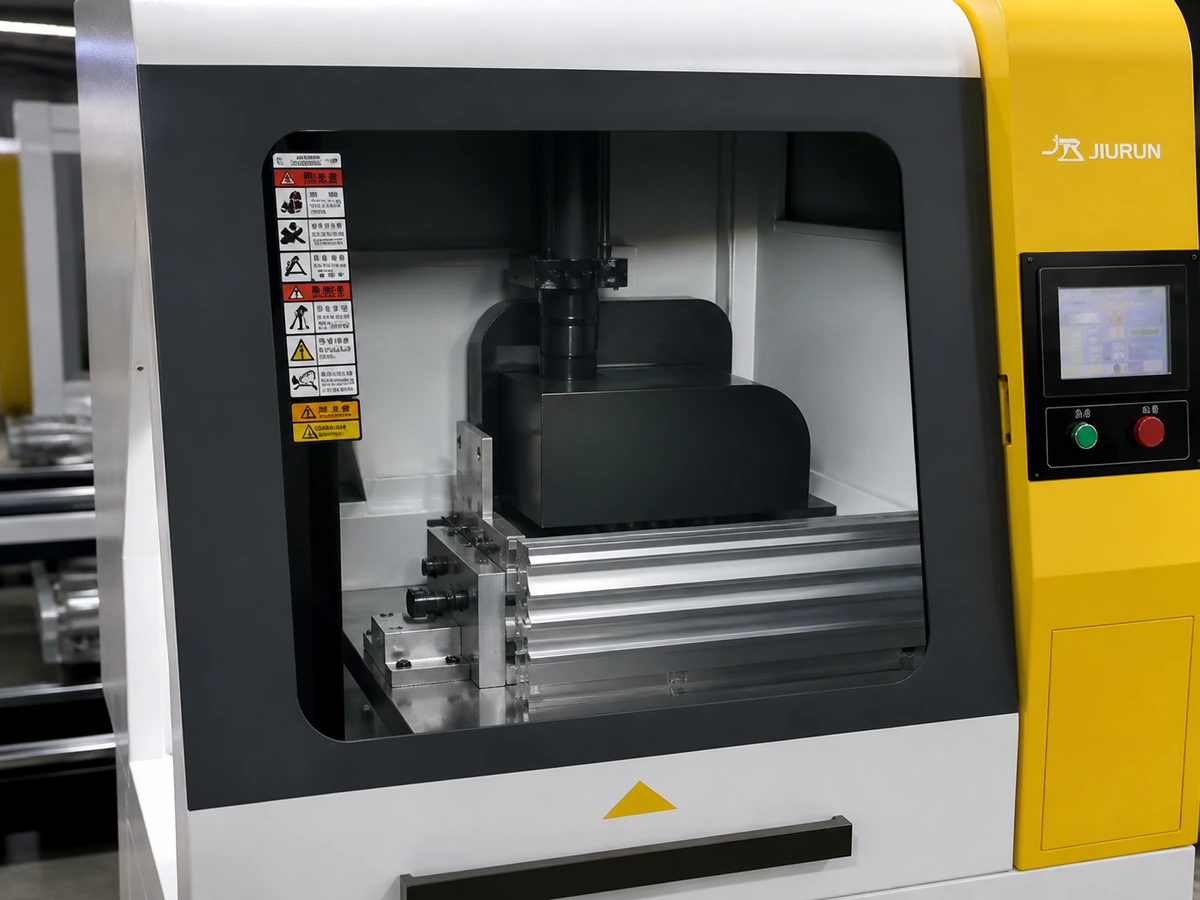
Aluminum saw acoustic enclosure: define the exposure first
Tell the supplier where the operator stands during automatic cutting, loading, offcut collection and blade changes. Identify nearby workstations and the usual doors-open or doors-closed operating state. A single sound number without machine state, material and measurement position is hard to compare across offers. If other machines contribute to the workshop level, record their operation during the check.
Ask for the baseline and acceptance method before discussing a promised decibel change. Specify the profile family, blade, speed or program, extraction state, room condition and microphone location. The acceptance record should identify the measuring instrument and whether background noise was considered. For an aluminum saw acoustic enclosure, a reduction quoted for an empty, idling machine is not an acceptance result for your cutting job.
The UK HSE engineering-noise guidance lists machine enclosures among possible controls and advises buyers to specify noise requirements when re-equipping. NIOSH engineering-control guidance explains why access openings and leaks matter. Neither source establishes a result for a Jiurun machine or your site.
Draw every break in the acoustic boundary
For an aluminum saw acoustic enclosure, put the stock route on a layout. Mark infeed and outfeed apertures at the largest section, bundle handling points, chip removal, extraction ducts, air inlets, cable entries and service doors. At each opening, ask what remains open while the saw cuts. A fully closed panel is of limited value if the stock slot or exhaust path leaves a direct sound path toward the operator.
For a long bar or profile, the buyer may need a treated entry or exit passage, flexible closure or another engineered detail. Its geometry must still allow the actual section and feed cycle. HSE notes that material-pass openings can leak noise and describes acoustic tunnels as one possible treatment. Treat that as a design question for the supplier, not a promised feature of the photographed saw.

Protect access, cooling and extraction in the same drawing
Blade change and cleanout are recurring tasks. Request a door and removable-panel schedule that shows which parts need frequent access, the clear space for a blade or scrap container, and how a seal is inspected or replaced. Define the safe isolation and interlock sequence with the machine supplier. Do not accept a proposal that depends on leaving a panel open for routine production.
An aluminum saw acoustic enclosure can alter heat removal and airflow. Ask where make-up air enters, where motors or control equipment shed heat, and how mist or chips leave the cutting area. The acoustic treatment of a duct matters because a ventilation opening can become another sound path. The final arrangement should preserve the machine’s specified cooling, extraction and service access. The HSE noise-control guide explicitly raises treated stock openings and quiet ventilation paths as design checks.

Make the quotation testable
Ask for a marked aluminum saw acoustic enclosure scope drawing, not a loose promise of “quiet operation.” The drawing should identify the panels and materials, door and seal arrangement, stock openings, extraction and ventilation connections, controls or interlocks affected, and the floor area needed for service. The quote should say who supplies each interface and who verifies it after installation.
- Operating case: profile section and length, blade and cut cycle, number of active machines, extraction setting and operator location.
- Boundary case: which doors are shut during cutting, the largest material opening and any necessary open service access.
- Measurement case: baseline and final positions, instrument and operating record, plus the agreed acceptance criterion.
- Handover case: seal inspection, cleaning access, ventilation maintenance and responsibility for later changes to the stock path.
If the supplier cannot meet the requested acoustic target while retaining the needed openings, ask for the limitation in writing and compare alternatives such as source treatment, layout or separation. A guarded machine may still be suitable for the process even when a separate acoustic package requires more engineering. For a broader noise-quote comparison, see our aluminum saw noise buying guide; for source-level blade trials, see the low-noise saw blade article.
A video can show the cycle, not the sound result
The Jiurun Machinery video below shows automatic aluminum-saw stock feeding and cutting. It helps a buyer identify the moving stock path and the working zone. Its audio, camera position and machine configuration are not a controlled acoustic test; it does not verify an enclosure option or noise reduction.
Send the supplier one usable decision brief
Share the profile drawing, longest and widest stock, cut program, workshop layout, operator station, extraction arrangement and target measurement method. Ask the supplier to return the acoustic-boundary drawing and the acceptance conditions with the machine quote. Contact JiurunCut with those details to discuss whether an enclosure option can be engineered for your cutting line. The decision should rest on the agreed layout and a witnessed operating test, not on a brochure photograph.
Frequently asked questions
Does a closed saw guard count as an acoustic enclosure? A guard provides a physical boundary around the cutting zone. Acoustic performance depends on the complete sound path, including panels, openings, ventilation and the actual test conditions. Ask for the quoted aluminum saw acoustic enclosure scope and evidence.
Can a long extrusion pass through a sealed enclosure? The stock needs a usable route. For an aluminum saw acoustic enclosure, the supplier can evaluate treated openings or passages, but must show that the proposed detail passes the largest section and allows the production cycle.
What should be measured at acceptance? Record the agreed operator or nearby workstation positions while cutting representative material, with the agreed blade, extraction and door state. Compare those readings with a documented baseline under comparable conditions.