
An aluminum saw air quick coupling can look like a small line item until the machine reaches the buyer’s factory. The machine may have a socket, while the shop hose ends in a plug that looks similar but will not lock into it. Or both halves may fit, yet nobody has specified what happens to air trapped on the machine side when the line is disconnected. A useful quotation names the mating pair and its disconnect behavior before the saw ships. The aluminum saw air quick coupling must be specified as an assembly, not a vague accessory.
This is a buying guide for a proposed saw configuration that uses compressed air, such as an option with pneumatic clamping. It is not a claim that every Jiurun model has the same connection, or a procedure for working on a pressurized machine. The aim is to make one small interface testable and to assign its supply boundary to the right party.
Aluminum saw air quick coupling: identify both halves
“Quick connector included” leaves out the most useful purchasing detail: which half is supplied on the machine, which half is needed on the plant hose, and whether those two exact parts are approved to mate. A hose outside diameter or a threaded port size does not identify the plug profile. Two fittings can share a nominal thread and still use different quick-coupling series. The earlier NPT versus BSP guide addresses the threaded connection; the question here is the removable socket-and-plug pair.
Ask for the maker, series and part numbers of both halves on the offered machine. The quotation should say whether Jiurun supplies the mating plant-side plug, an adapter or only the machine-side socket. If the buyer already has a plant standard, send the actual plug part number or a labeled sample to the supplier before approving an alternative. Do not rely on a photograph, color, nominal bore or the words “universal coupling” as proof of interchangeability. For example, Parker’s instructions for particular Rectus safety couplings name the compatible steel plug series explicitly; that product-specific pairing cannot be generalized to every coupling.
Record the connector’s rated pressure range, relevant flow data, sealing materials and environmental limits from its actual data sheet. The saw supplier should then confirm the assembly against the offered machine’s air demand, including the intended hose and any filter-regulator arrangement. The broader compressed-air quotation checklist covers supply pressure, flow and air quality. A coupling choice should use those requirements; it does not replace them.
Ask what happens when the pair is released
Quick couplings do not all disconnect in the same way. A socket may close its supply side, a design may close both sides, or a specified safety coupling may vent the downstream side in stages before the plug is released. Festo’s coupling range distinguishes ordinary quick-release products from safety shut-off and venting variants. Those catalog categories are reasons to request the exact part description, not proof of what is installed on this saw.
Put three questions beside the part number: Which side closes when separated? Does the selected pair vent any trapped air, and from which side? What operating condition does its manufacturer require before uncoupling? If the answers are not known, leave disconnect behavior as an open engineering item. A connector advertised as “self-sealing” does not, by that phrase alone, show that downstream pressure has been removed. Even a venting connector must be assessed in the actual circuit, where valves, reservoirs or other branches may retain energy.
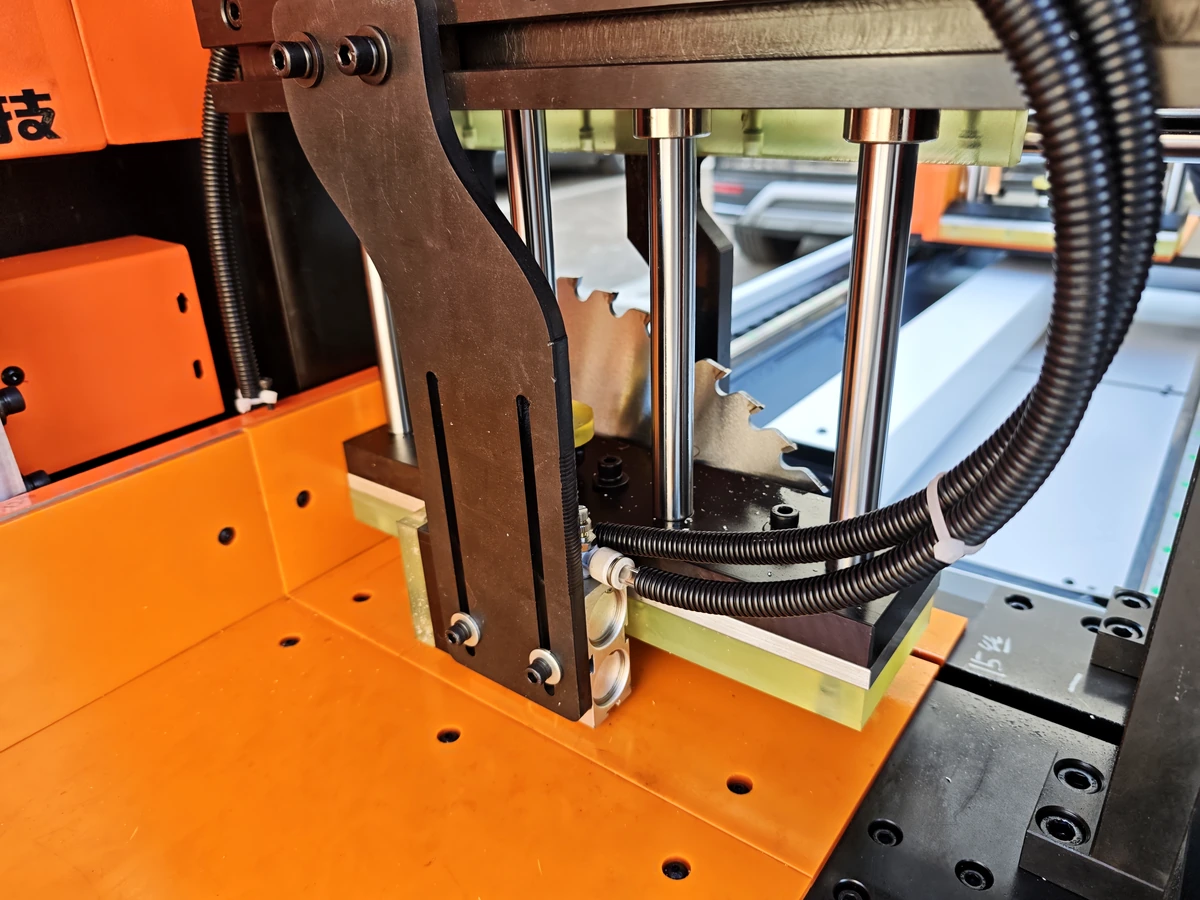
Also ask where the coupling will be located. A buyer needs room for the prescribed motion of the connector and for hose routing without pulling on the machine inlet. The supplier should show the proposed position on the layout and identify any guard or service panel that affects access. Do not infer a safe reach from an unobstructed sales photograph.
Draw the supply boundary on the quotation
The same coupling can be included in two offers with different handover scopes. One seller may provide only the machine inlet; another may include the matching plug, a short hose or a regulator assembly. Ask for a one-line connection sketch or marked machine photograph with the exact handover point. Name who supplies the upstream hose, the mating half, any support or restraint, the filter-regulator and the separate means of isolating the air supply where required by the site. The answer should match the actual build, not a generic brochure diagram.
A practical RFQ can state: “For the offered pneumatic option, identify the machine-side air quick-coupling socket and its matching plant-side plug by manufacturer and part number. Mark the connection location; list which half, hose and upstream items are included; provide the maker’s connection and disconnection instructions; and identify the FAT and site-acceptance evidence.” This text requests facts about the delivered interface without inventing a universal pressure or connector standard.
If the plant prefers a different connection family, treat the change as an engineered substitution. Check the full mating pair, port connection, hose compatibility, rating, flow and available mounting space. Ask the supplier to update the drawing and bill of materials. A local adapter can solve a thread mismatch yet leave the original quick-coupling mismatch untouched.

Keep a convenience connector separate from energy control
A quick coupling can make a service connection convenient. It should not be described as the machine’s complete hazardous-energy control scheme. On a U.S. site where it applies, OSHA’s hazardous-energy rule addresses isolation and stored energy for servicing. The buyer’s qualified safety team must decide what devices and procedures the actual machine and site need. The saw energy-isolation buying guide covers that wider source-to-isolator map. This article concerns the mating pneumatic connector and the supply scope, with the isolation boundary recorded separately.
Do not ask a buyer to disconnect a live hose to discover whether it vents. Ask the coupling supplier for the product instructions and have the saw supplier explain the installed circuit. Any demonstration of connection, release or residual pressure belongs in a controlled acceptance plan carried out by qualified personnel under the relevant site procedure. If a risk assessment calls for a lockable upstream device, list it as its own item rather than assuming that a release sleeve supplies it.
Accept the actual assembly, not a catalog promise
At factory acceptance, compare the installed socket and supplied plug with the approved part numbers and drawing. Ask the supplier to show that the pair engages and remains connected as the manufacturer specifies, that the routed hose does not strain the inlet during the intended operating envelope, and that the assembled connection does not leak under the agreed operating states. Record the observed conditions and exceptions. This is different from the separate whole-machine pneumatic leak check, which surveys a broader air path.
At site acceptance, repeat the identification against the buyer’s actual hose and utility connection. An accepted factory pair can still fail to mate with the plant’s plug if the site half was never included in the quotation. If a substitute is needed, update the approved parts list and repeat the relevant fit and functional checks. Do not record “quick coupling passed” merely because a hose happened to attach once; the acceptance record should identify both halves and the operating state.
Compare two offers on the same interface
Offer A says “standard air connector,” with no plug part number and no statement about what happens on separation. Offer B names both halves, includes the required plant-side item, identifies the circuit behavior from the selected component documentation, and marks the handover point on the machine layout. Offer B is easier to assess even if its price is higher. The buyer can put the omitted adapter, hose, documentation and acceptance work beside Offer A before comparing total installed scope. This is a hypothetical comparison, not a claim about a Jiurun model or customer.
If neither offer has the final plant-side specification, agree who will provide the sample or part number and by what date. Keep the connector choice open until the supplier confirms the completed pair. That is a more useful hold point than accepting “compatible with factory air” and discovering the mismatch during commissioning.
Related Jiurun equipment footage
The video below shows a related Jiurun aluminum saw and guarded cutting area. It is general equipment footage. It does not show or verify the quick-coupling type, the plant air connection, the quoted saw configuration, a disconnect test or pneumatic performance.
Send the connector details with the saw enquiry
Send the profiles and cutting job, the pneumatic option being considered, a photo or part number for the plant’s existing air plug, and the preferred machine connection point. Ask JiurunCut to identify the offered mating pair, included supply items and a practical acceptance record in the quotation. If your facility has a required connector family or energy-control standard, include that requirement for engineering review. Contact JiurunCut with those details so the connector question can be resolved before the machine arrives.