
A hollow aluminum profile can meet its free-state drawing dimensions and still change shape when a saw jaw closes on an unsupported wall. If that movement alters the cut or the downstream fit, an internal backer may be worth testing. It is a fixture decision for the actual section and machine, not a default accessory for every hollow extrusion.
For hollow aluminum profile clamping, the useful question is where the force goes. The buyer should establish whether the existing jaws and supports hold the part without a cavity insert before adding another component to the cut station.

Find the wall that carries the jaw load
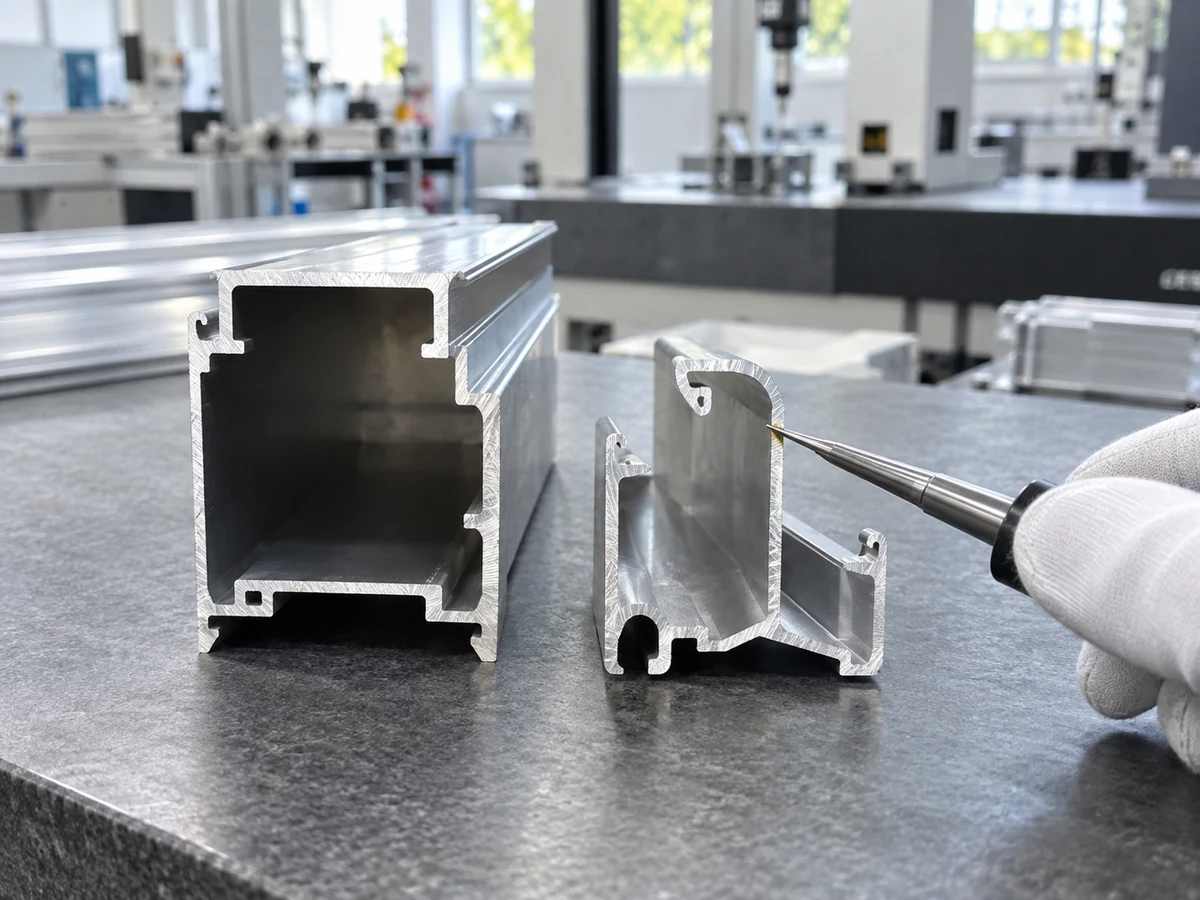
Start with the released cross-section, not just its outside width and height. Mark the jaw faces, support points, blade plane, functional grooves, and any cavity that may deflect. A jaw over a solid web is a different situation from a jaw centered above a long, thin unsupported roof. Compare the stock section before clamping with the section under the proposed holding condition. A change seen before the blade advances should not automatically be attributed to the blade.
Record which dimension matters in assembly: a rail slot, a mating cap, a screw channel, or the outside envelope. A small elastic movement that disappears after release may have a different consequence from a permanent crease or a shifted functional groove. The drawing owner must set the acceptable limits; this article supplies none. For related acceptance questions, see our thin-wall cut-end guide.

Hollow aluminum profile clamping: compare the fixture first
A backer is only one possible response. The supplier may be able to move a jaw onto a supported web, widen the contact area, change the support nest, or use an approved lower holding force while keeping the part stable. These options must be judged against movement during the actual cut and the machine manufacturer’s limits. For example, elumatec describes a low-pressure clamping device on its DG 102-P; that feature is specific to that machine and does not establish a setting or capability for a Jiurun saw.
Ask the supplier to show the released part, the clamped but uncut part, and the cut part using the same reference points. Repeat the comparison at representative bar locations and on a blade condition agreed for the trial. Keep incoming section variation separate from fixture-induced change. If an adjusted external fixture passes shape, security, and cut-end checks, an insert may add needless handling and another source of error.
If an internal backer is tested, define its boundary
Specify the backer’s material, fit, insertion depth, location relative to the blade, and removal method on a drawing or trial sheet. The backer must not enter the blade path or obstruct the stop, guard, feed, or chip evacuation. Check whether it can scratch an internal surface, trap chips, leave fragments, or remain in a delivered part. A snug fit in one extrusion lot does not prove fit after section variation or coating. Have the machine and fixture supplier approve the arrangement before any powered test.
Fixture changes that require access inside a guarded work zone belong to trained personnel following the site’s machine-specific isolation procedure. The OSHA hazardous-energy standard is a US reference for servicing and setup exposure; local requirements and the actual machine manual govern the site. A production operator should not improvise an insert during a running cycle.
What the buyer should accept from a trial
For hollow aluminum profile clamping, a useful trial record links the drawing to observable results. Name the profile revision and alloy/temper, identify the permitted contact faces, and record the approved jaw and backer arrangement if one is used. Inspect the free section, clamped section where safely measurable, released cut end, functional groove, and a mating component. Note any chip or insert-removal issue separately. Compare a no-backer setup and a proposed backer only where both are safe and machine-approved; do not infer benefit from one visually neat cut.
The decision is specific to the part. Accept no backer if the approved external fixture holds the profile and the released part meets the agreed geometry and fit. Accept a backer only if it improves a documented failure without creating a new interference, contamination, or handling problem. Pause the quote if the drawing lacks an acceptance reference or the fixture cannot be approved for the intended saw. The Hydal extrusion design manual provides broader fabrication context; its sawing discussion does not substitute for a profile-specific trial.
Send the section, not just a profile name
When asking Jiurun about a saw for a hollow aluminum section, send the section drawing, sample length, cut angle, target length and tolerance, permitted jaw faces, cut-end acceptance, and the mating feature that must still fit. Include a photograph or measurement showing the suspected wall movement and say whether an insert is already part of your approved process. We can discuss a machine and a witnessed cutting trial around those facts; configuration and achievable result must be confirmed for the actual part.
The Jiurun channel clip below gives general saw and clamping context. It does not show this section, an internal backer, the proposed fixture, or a validated cut result.
Send Jiurun your drawing and clamping question to define the trial and quotation scope.