
Multi-piece aluminum profile cutting sounds like a direct capacity gain when a saw handles several sections in one cycle. It is only useful when the proposed group fits the actual clamp, stays supported through the cut, and yields acceptable parts from every position. A trial with one easy bundle cannot establish that a different section, wall thickness or finish will behave the same way. Use the steps below to turn “multi-piece” into a testable quotation.
Jiurun supplies industrial aluminum and nonferrous-metal circular saw equipment. The possible piece count is a property of a specified machine, blade, fixture and workpiece combination; it should not be inferred from a model name or a short video. The same principle appears in elumatec’s automatic-saw listing, which describes multi-part clamping as an option. That is an example of a configuration question, not a Jiurun machine specification.
Multi-piece aluminum profile cutting starts with the arrangement
Send the saw supplier the drawing of each profile and a sketch of exactly how the pieces would sit at the cut. Specify section width and height, wall thickness, length range, alloy and temper where relevant, protected faces, and whether the profiles arrive straight, bowed, nested or separated. A group of four identical square tubes presents a different support problem from four open channels or a mixed order of unequal extrusions. “Four at a time” describes quantity, not a repeatable setup.
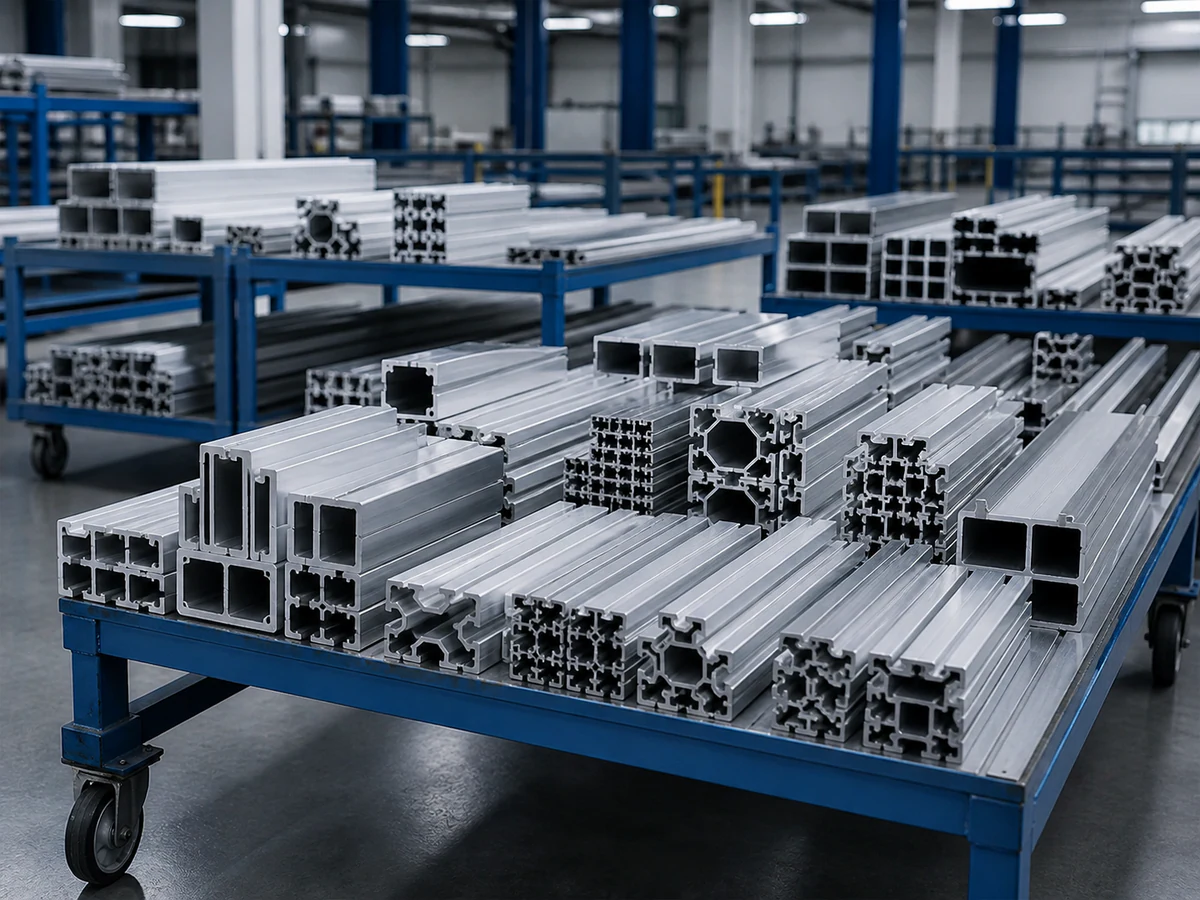
Ask for a drawing or clear photograph of the proposed loading orientation. Identify the datum against the fence, the number of pieces in each layer, the contact points under each section, and the surfaces touched by top or side clamps. If a profile can rotate, collapse or climb over its neighbor, a higher nominal count has little value. The supplier should state which pads, separators, supports and clamp jaws are included in the offer, and which are custom. Elumatec’s aluminum industry catalog likewise describes multiple-bar processing with special accessories and profile-specific adjustment. Treat that as a reason to ask about the quoted hardware, not as proof that any particular Jiurun setup has it.
Watch what happens to the first and last piece
A useful trial records more than the moment the blade passes through the group. Observe loading, alignment, clamping, the cut, blade return, unclamping and removal. Mark each profile’s position before the cut: front or back, upper or lower, left or right. Mark the resulting parts so an acceptable piece from one position cannot hide a problem in another. Check that the offcuts are controlled as well as the incoming stock.
Inspect all positions against the released drawing. Depending on the part, that may include length, squareness or miter angle, burr condition, cut-end damage, surface marks and fit with the next operation. Use the buyer’s actual tolerances and inspection method. Do not turn a single displayed measurement into a general accuracy claim. Repeat after normal unloading and reloading, and after any blade or clamp adjustment the supplier says is routine.
Compare good parts per shift
For multi-piece aluminum profile cutting, parts per stroke is a poor proxy for delivered output. Time the full cycle from ready stock to the next ready stock: sorting, loading, aligning, clamping, cutting, unloading, deburring if required, inspecting and resetting. Record rejected pieces and the time to change over to another section. A four-piece arrangement that takes longer to load or produces a damaged piece may lose its apparent advantage. Compare the same order mix, operator tasks and acceptance criteria for single-piece and grouped cutting.
| Trial record | What the buyer should receive |
|---|---|
| Workpiece identity | Drawing revision, material, section, length range and the exact arrangement in the clamp |
| Quoted configuration | Machine version, blade, clamp jaws, support blocks, separators and any custom fixture |
| Every cut position | Position-marked pieces, agreed measurements and visible surface or burr checks |
| Repeat run | Several load-cut-unload cycles with setup changes and rejects recorded |
| Time study | Whole-cycle time and changeover time, with operator work included |
What the machine footage can and cannot tell you
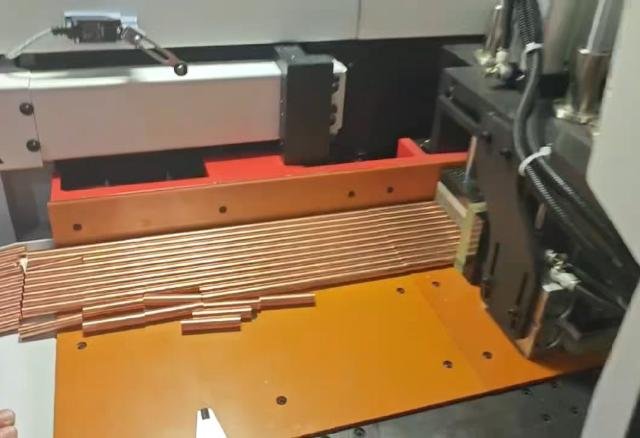
The following video from Jiurun Machinery’s YouTube channel shows a JR-455Y hydraulic semi-automatic cutter and material handling. It is an equipment demonstration. It does not validate the section arrangement, cut quality, cycle time or tolerances for the workpiece discussed here. Ask for a witnessed test with your material or an agreed equivalent before accepting a multi-piece capacity statement.
Before placing an order, send Jiurun the profile drawings, finish requirements, intended group arrangement, cut length mix, inspection limits and target shift output. Ask them to return a configuration-specific trial plan and a quotation that separates standard equipment from fixture work. The JR-455Y trial guide covers the wider operator and machine handoffs. For a trial built around your sections, contact Jiurun with the drawings and the acceptance criteria.