
Exhibition stand corner upright cutting starts with the approved extrusion drawing, not the phrase “40 mm post.” A corner upright may carry a panel edge, a fabric groove, a connector or a cover. Two profiles with the same outer width can present very different clamp faces and mating details. Before asking for a saw quotation or a batch of cut members, the buyer needs to define exactly which upright is being cut, what its ends must accept, and where the cut-part supplier’s responsibility stops.
This guide is for buyers who already have an approved stand system or a controlled custom section and need to specify saw-cut upright blanks. It is not a booth design, a drawing for a particular supplier’s profile, or evidence that a Jiurun machine has cut an OCTANORM part. If you are selecting a saw for all the members and reused stock in a show kit, begin with our broader exhibition stand manufacturing guide. Here the unit of purchase is one identified corner-upright blank and its acceptance route.
Why the section ID matters more than the nominal width
A manufacturer example shows the risk. OCTANORM describes its S 382.01 as a 90-degree aluminium corner upright with a silicone-edge groove for octawall 40 frames and lists a matching S 383.35 end cap. Its M 1002.01 is a separate square extrusion with two system grooves and a different connection arrangement. Both pages list a 40 × 40 mm outer size for the specified versions. That shared envelope does not make the sections interchangeable, and neither page establishes compatibility with a Jiurun saw. Use these as examples of why the RFQ needs the exact system, part number and current drawing revision, not as specifications for every exhibition stand.
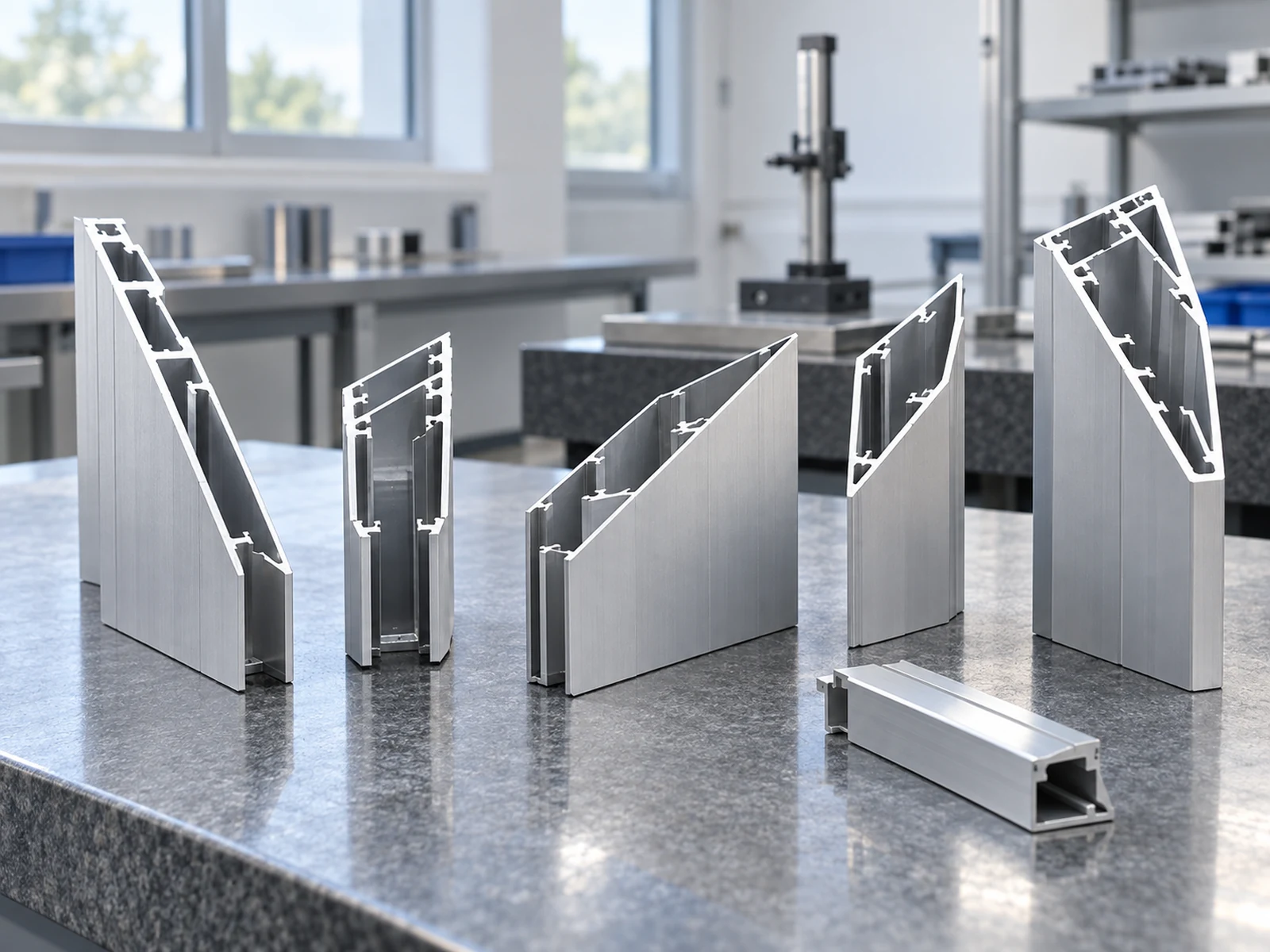
Seven RFQ checks for exhibition stand corner upright cutting
1. Identify the approved section and its orientation
Send the extrusion cross-section, system and part number, alloy and finish specification if known, revision and any permitted substitute. Mark the outward face, the panel or fabric groove, and the side that meets the next member. A photo of a finished booth is useful context, but it cannot replace a dimensioned section drawing. If the system supplier owns the design, ask it to confirm the released drawing before a machine vendor proposes clamps or blade access. A saw supplier can then assess the actual profile; a cut-part supplier can quote the actual stock rather than guessing from an outer envelope.
State whether the upright arrives anodized, painted or unfinished. A cosmetic surface changes how stock should be handled and where temporary clamp contact may be acceptable. Do not infer that a finish survives a proposed handling route merely because a sample profile in a catalogue looks similar.
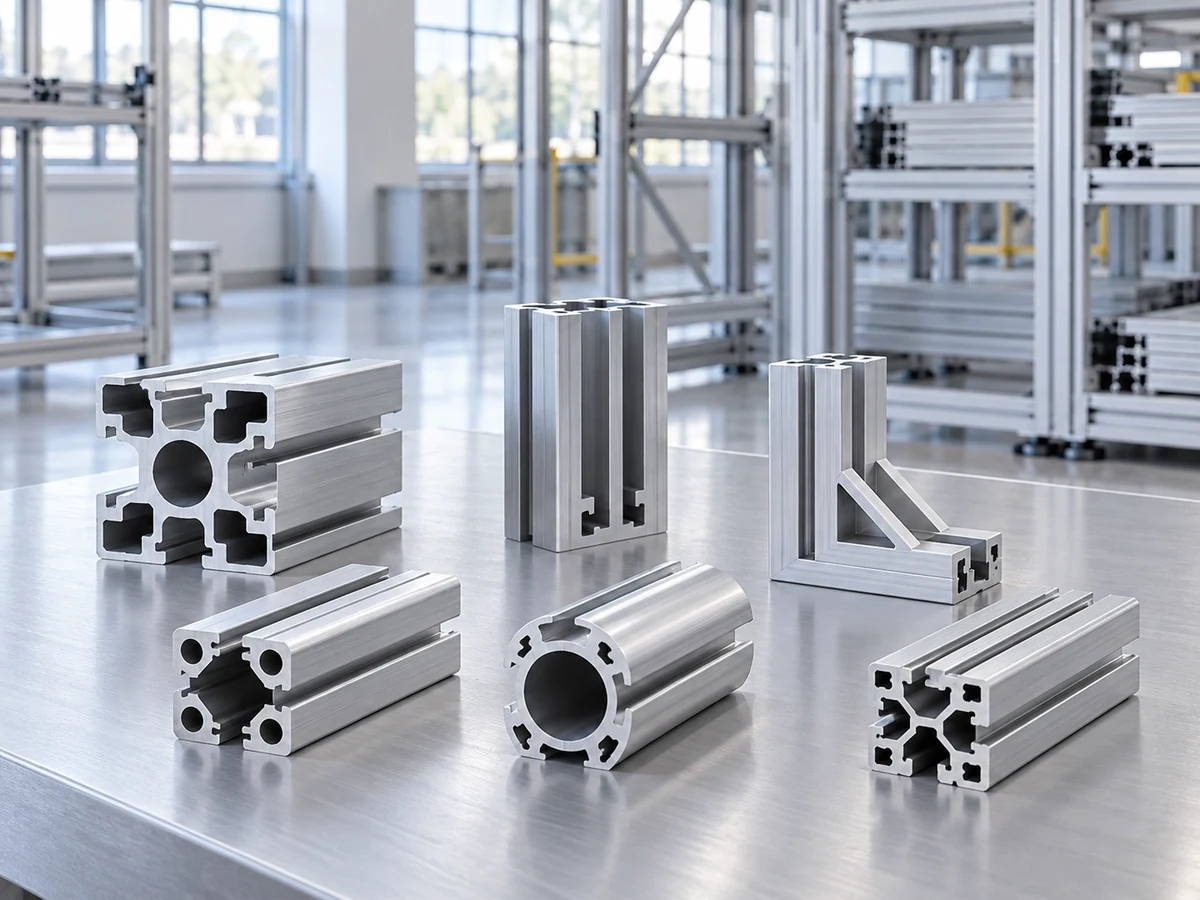
2. Define the finished length and the datum
Give a member schedule with quantity by finished length and say where each length is measured. Is it the metal-to-metal distance between cut faces, a visible height after a cap, or a position in the assembled stand? These are different dimensions. Include the stock length and any existing end damage or first-end crop allowance if the batch uses reclaimed lengths. The OCTANORM examples above list 5,000 mm stock for the cited items, and a related M 1002 version is listed at 6,000 mm; those are product-page examples, not a universal input length.
Ask each bidder to state how it will establish the first end, locate subsequent cuts, handle kerf and record the finished dimension. Agree a tolerance against the controlled drawing and measurement method. A machine’s catalogue positioning figure, if any, is not automatically the tolerance of a finished upright assembled with caps and panels.
3. Specify the end condition and mating part
Do not assume that the word “corner” means a 45-degree miter. A corner upright might have square saw-cut ends and a separate cap or connector; another system might require a different end geometry. Show both end views on the member drawing and identify any top and bottom difference. Provide the mating cap, lock, connector or base plate reference, plus the clearance and fit that the receiving team will check. The end-cap reference on one OCTANORM product page is a useful reminder to name the mating component, not permission to use that cap on another section.
If the part needs a milled pocket, drilled hole, notch, tap or installed connector after sawing, list that as a separate operation and owner. Jiurun supplies industrial circular-saw cutting equipment; do not treat a saw quotation as an automatic quote for milling, assembly or final booth acceptance. For general miter-joint geometry, see our different-width profile corner guide.
4. Map support and clamp contact to the real section
Long, slotted stock can twist or mark when supported at the wrong point. Mark a stable web or sacrificial face for clamping, the face that must remain unmarked, and the orientation in which the section can be loaded repeatably. Ask where infeed and outfeed supports hold the stock through the cut. If a short finished member is hard to hold safely, request a handling plan rather than asking an operator to improvise a grip near the blade.
For a machine RFQ, request a drawing-based review of the proposed support, clamp and blade path for the actual section. For a cut-member RFQ, ask how first-off setup and subsequent batches preserve the chosen datum. Neither an exterior machine photograph nor a general demonstration verifies the fixture for this upright.

5. Quote the batch and changeover pattern
Give the number of uprights per length, the frequency of repeat orders and the mix of section variants. A one-time uniform batch and a small, frequently revised event schedule put different demands on stops, program control, labeling and first-off checks. Ask bidders to show how they will separate revisions and protect any reusable stock from being mixed with new material. Keep the quotation scope on the corner uprights; do not silently include every beam, panel and reused item in the whole show kit.
If buying a saw, include representative long and short upright lengths and the actual stock condition in a proposed trial. Ask for the blade, supports, clamps and changeover steps that are included in the offered configuration. If buying cut members, ask for unit and batch pricing at the same quality boundary, including who supplies stock and who owns rejected parts. A headline cycle time without the real job mix is not an acceptance test.
6. Agree first-off and receiving inspection
Choose a first-off sample that represents the difficult face, length and end condition, then make the acceptance sheet before production. Typical checks to agree include finished length from the stated datum, end squareness or the drawn angle, burr and edge condition, visible-face marks, groove integrity and fit with the specified cap or connector. Use the approved drawing to set actual limits; this article does not assign a numerical tolerance to an unknown section.
Record who measures, with what gauge and at which stage. A supplier may show a clean cut face, while the stand builder still needs to test a cap or panel fit. Decide whether that fit is part of the cut supplier’s contractual acceptance or the buyer’s downstream assembly check. If the first-off fails, the RFQ should say whether the cause triggers a fixture adjustment, a drawing clarification, a new blank or a separate secondary-process quote.
7. State the supply boundary and handover package
Write one sentence that defines what the supplier delivers: loose saw-cut uprights, labeled member sets, finished and capped uprights, or a complete assembled stand module. Then itemize what is excluded: secondary machining, finish repair, caps, fasteners, panel installation, packing method and site assembly. A quote for loose cut blanks should not be judged as if it promised a finished booth. Conversely, a booth assembler’s price may include fit and installation work that a saw-cut supplier never offered.
Ask for a quotation that names the exact profile revision, finished-length schedule, proposed machine or cutting route, support and clamp concept, first-off plan, inspection records, packing and exclusions. This makes bids comparable and gives both sides a clear route for a revised drawing.
How to compare the two practical supply routes
Buy cut upright blanks when a qualified fabricator can source the approved section, control the cut ends and deliver the required labels and inspection. Check who owns rejected stock, finish damage and late drawing changes. Cut in-house when recurring work justifies the machine, fixturing, operator control and inspection burden. Ask the machine supplier to assess a real section and member schedule; the fact that a guarded saw can cut an aluminum sample is not proof of this upright’s fit or cost.
The decision can change if the stand system requires proprietary connectors or if finishing occurs after cutting. Price both routes at the same delivered boundary. A machine quotation for raw cut blanks cannot be compared directly with a fabricator’s quote for capped, labeled and packed members.
Video: general angle-saw equipment context
The following clip is from the Jiurun Machinery YouTube channel. It shows a guarded saw, angle table and clamp/feed area. It does not show the corner upright, the OCTANORM sections cited above, a selected customer configuration, a first-off trial or measured cutting performance.
Send a quote package that can be answered
- Approved corner-upright section and member drawings with revision, system ID, visible faces, groove orientation and end views.
- Stock condition, finish, quantities and finished lengths, including first-end crop or reclaimed-stock rules where applicable.
- Mating cap or connector references and a clear boundary for drilling, milling, assembly, labeling and packing.
- First-off sample, measurement datum, agreed tolerance and receiving fit check.
- Representative batch and changeover pattern, and whether you seek a saw proposal or purchased cut blanks.
If you are evaluating a Jiurun aluminum cutting machine for this work, send the controlled profile and member drawings to JiurunCut. Ask for a written review of section support, clamping, blade access, included handling equipment and a representative sample plan before selecting a configuration. A request without the actual upright drawing can receive only a conditional discussion, not a validated performance claim.
Frequently asked questions
Is a 40 × 40 mm size enough to quote the upright?
No. It states an outer envelope, not the location of grooves, internal webs, connector chambers or visible faces. The two cited OCTANORM product pages illustrate different 40 × 40 mm sections. Supply the exact section drawing and revision.
Must an exhibition corner upright have mitered ends?
No default end angle follows from the word “corner.” Specify the actual top and bottom end views and the mating parts from the approved system drawing. Treat any secondary notch or hole as a separate scoped operation.
Does a machine demo prove the finished stand will fit?
No. A general saw video shows equipment context. Fit depends on the approved section, cut-member dimensions, end preparation, mating hardware and downstream assembly. Agree a representative first-off and receiving check for your job.
Sources and scope
Manufacturer examples: OCTANORM S 382.01 corner upright product detail and OCTANORM M 1002.01 square extrusion product detail. Their dimensions and accessories apply to the cited products only. This article is independent purchasing guidance and does not claim endorsement, interoperability, a Jiurun cut trial or a finished-stand performance result.