
Fire truck shutter bottom rail cutting is a narrow manufacturing request within a complete equipment-compartment door. A vehicle body builder may need a saw-cut aluminum bottom-rail blank, while another supplier provides the curtain, guides, seals, handle, locks and final installation. The RFQ becomes comparable only when the buyer identifies the approved rail section, the finished blank datum and the operations that remain after sawing.
This guide applies when the current vehicle or shutter drawing actually specifies an aluminum extrusion for the bottom member. It does not assume every fire truck shutter uses the same section or even the same material. It also does not treat a clean cut as proof that the completed compartment door will open, seal, lock or satisfy any vehicle requirement.
First identify the bottom rail in the shutter system
Manufacturer examples show why the part must be named precisely. Dover’s Nyloy 30 vehicle-shutter description distinguishes the extruded aluminum bottom rail from the interlocking curtain laths and side guides; its example bottom rail carries a grip feature and a seal holder. Locksystem’s N30 description lists bottom-rail lock options alongside guide tracks, seals and a bar lock. Rosenbauer’s compartment-shutter overview likewise treats profiles, guide rails, seals, locks and optional features as elements of a complete shutter. These are product examples, not specifications for the buyer’s own fire truck or evidence that Jiurun has cut their parts.
Ask the shutter designer or vehicle body owner for the released bottom-rail part number and section drawing. If only an overall shutter width is available, the blank is not yet defined. The bottom member may contain a finger grip, seal channel or hardware interface that affects how the extrusion is held, cut and inspected.

Fire truck shutter bottom rail cutting: seven RFQ checks
1. Release the exact section and revision
Supply the cross-section drawing, part code, revision, approved alloy and temper if specified, finish condition and source of incoming stock. Mark which groove holds the bottom seal, which face is visible and where any handle or lock hardware attaches. Do not substitute a similar-looking box section: an internal cavity, seal seat or edge lip can change the fixture contact and the downstream fit. If the shutter maker controls a proprietary section, confirm who can authorize a sample or alternate supplier before quoting a trial.
2. Define the cut length from the correct datum
Show the blank length on the released part drawing and identify its two measured end faces. The curtain’s nominal width, the vehicle-compartment opening and the rail’s saw-cut length may differ because of guides, end pieces or later machining. State whether both ends are square, whether one is a datum end, and whether an end remains long for a downstream operation. Record the permitted saw tolerance from the OEM drawing rather than borrowing a number from a generic machine brochure.
For multiple shutter widths, give a length-and-quantity matrix keyed to vehicle model, compartment location, rail revision and finish. Identify left/right or front/rear variants where they exist. This makes the quotation and labeling plan traceable to the actual member rather than to the appearance of a finished door.
3. Protect the grip, seal seat and hardware interfaces
Mark functional edges on the section view before asking for an end-face standard. A burr in a seal channel or damage to a visible grip can matter even when the overall length is correct. Ask the owner to specify which edges need deburring, which chips must be removed and which faces may show fixture contact. If the rail arrives anodized or coated, define how exposed cut ends and handling marks are judged. The cutting supplier should not promise that sawing restores a surface finish or qualifies a seal.
4. Separate saw work from lock and seal assembly
List the output stage in the RFQ: a loose cut blank, a cleaned and labeled blank, a rail with later holes or inserts, or a complete prepared bottom member. Identify who owns slots, drilling, end caps, seal insertion, handle or lock fitting and shutter assembly. The LockSystem and Dover examples illustrate that hardware options exist, but a saw quotation cannot infer which one belongs to this project. Make the downstream owner explicit so a low cutting price is not mistaken for a complete shutter component.
5. Prove support and clamping on the actual extrusion
Send representative stock from the released section for a guarded setup review. Identify a stable support face, a stop datum and clamp positions that avoid crushing a hollow wall or damaging a seal seat. Include both the longest order length and the shortest retained piece if the process handles them differently. The proposed setup should be recorded for the actual profile and finish; a photograph of another extrusion demonstrates only a general workholding question.
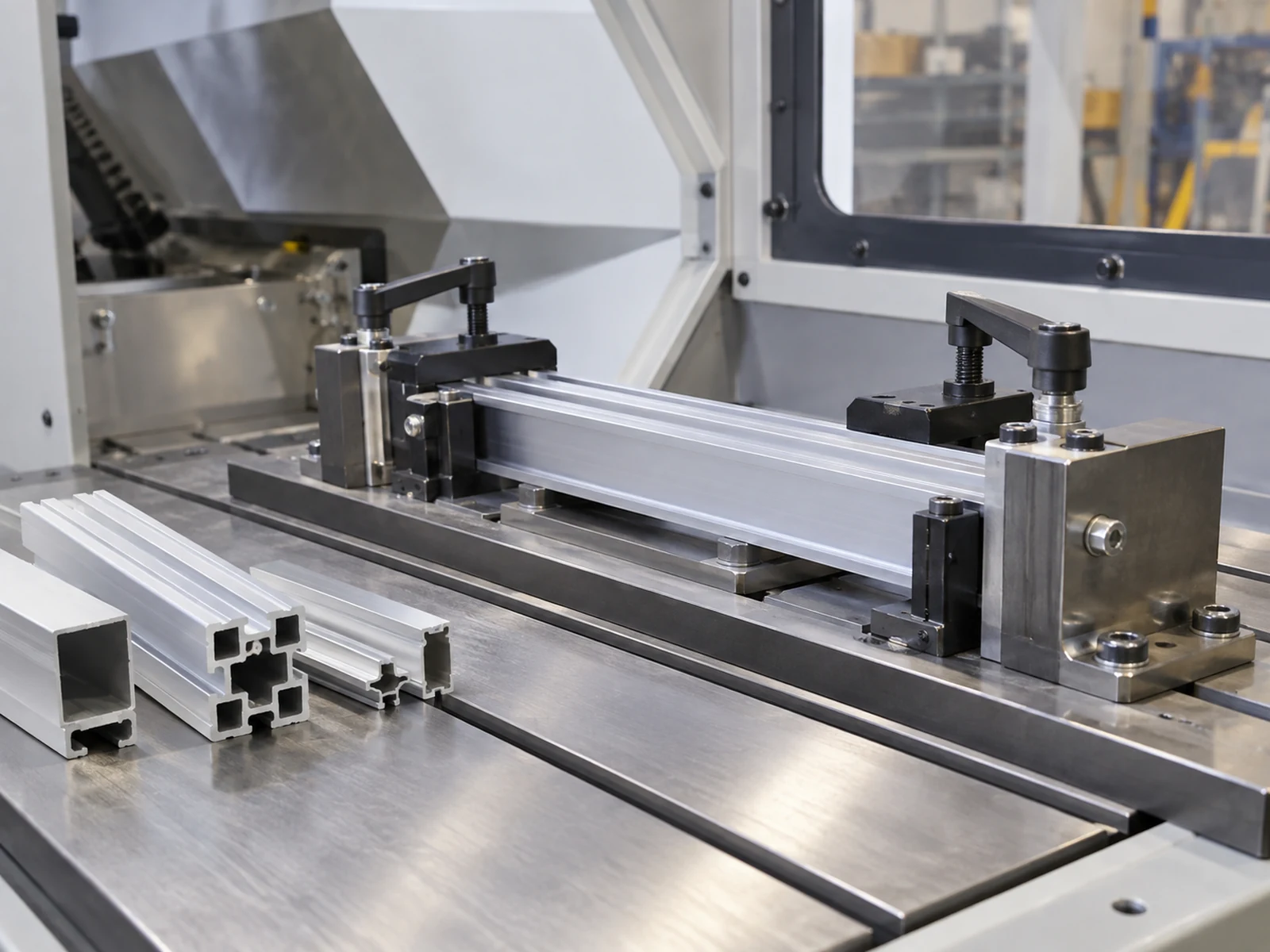
Ask for the stock feed and outfeed plan as well as the cut itself. Long bars need support before the blade, and finished pieces need a path away from the work area that protects the visible face. If the approved section has a protruding lip or an uneven base, the fixture needs a real sample review before production commitments are made.
6. Approve a measured first-off rail
Agree on a first-off checklist before batch cutting: part and revision, measured cut length from the named datum, end squareness if specified, end-face and burr condition, seal-channel clearance, visible-face damage and correct identification. Use the inspection instrument and acceptance limits required by the drawing. The vehicle or shutter owner should determine whether a fit check with the real curtain, guides and hardware is needed; a loose blank measurement does not replace that system check.
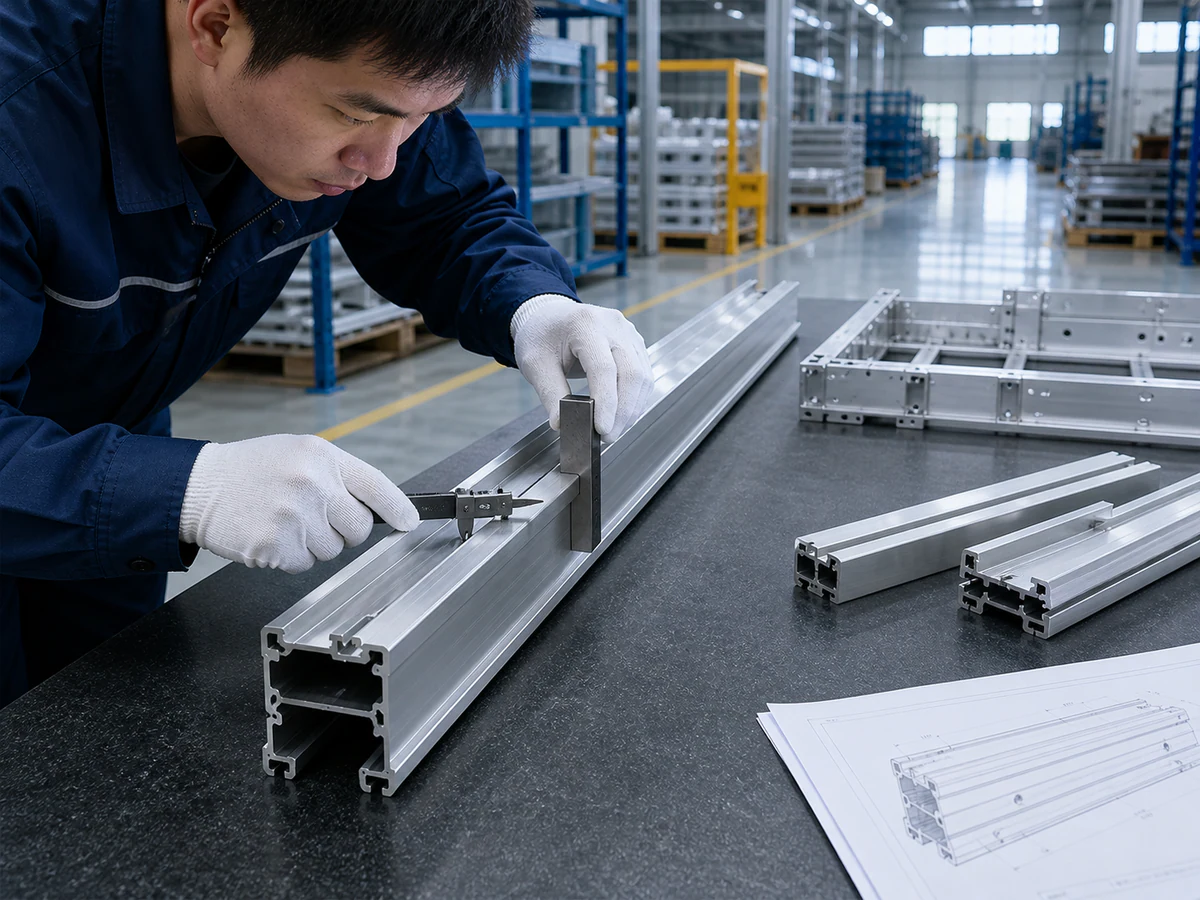
Record what happens when the first-off fails. Hold the batch, identify the affected part and revision, correct the setup and obtain the specified approval to resume. Store accepted and rejected pieces separately. A repeatable procedure is more useful than a photograph of one good-looking cut face.
7. Compare quotes at the same supply boundary
Give each bidder the same section, stock condition, length matrix, annual or batch volume, first-off plan, finish requirement and packaging unit. Separate fixture development, trial cutting and recurring part price. Ask who supplies extrusion stock, who owns offcuts and who pays for a drawing change. Compare a saw-cut blank to another saw-cut blank; any prepared rail or installed shutter requires its extra operations and responsibilities to be listed separately.
Package labels should show the rail code, revision, length, compartment or kit identifier and quantity. Protect finished faces and open grooves during shipping. The receiver should be able to distinguish similar-looking rails without assuming that all silver profiles belong to the same vehicle or shutter system.
Copy-ready RFQ input list
- Vehicle and compartment identifier; shutter-system owner and contact.
- Released bottom-rail section drawing, part number, revision, material and finish.
- Saw-cut blank length, datum, end form, quantity mix and stock length.
- Functional grip, seal and lock interfaces; protected faces and chip/burr criteria.
- Representative sample stock, support/clamp constraints and first-off inspection method.
- Explicit scope for downstream holes, seals, locks, assembly, packaging and final acceptance.
If the approved part drawing or material is missing, obtain it from the shutter designer before selecting a saw or promising a cut tolerance. The manufacturer’s published shutter description is useful context; it is not a substitute for this project’s released rail drawing.
General Jiurun saw demonstration
The video below is from Jiurun Machinery’s own YouTube channel and shows a JR-455CNC aluminum-profile cutting machine. It is a general equipment illustration only. It does not show a fire-truck shutter rail, approved rail material, customer trial, confirmed fixture or performance result for this article.
What to send Jiurun for a cutting review
For an OEM-approved aluminum bottom rail, send the section and cut-length drawings, stock and finish state, a sample bar, the length mix and the first-off criteria through the JiurunCut contact page. Jiurun can review the saw-cut blank and a representative cutting setup against those inputs. The shutter designer and vehicle body builder retain responsibility for the complete curtain, guides, locks, sealing, installation and vehicle-level acceptance.
If your purchase is for a different member, see our aluminum roller-shutter guide-rail replacement RFQ guide. That article addresses a side guide; the present checklist is limited to the bottom rail and its saw-cut supply boundary.
Buyer questions
Can the bottom rail be cut to the shutter’s advertised width?
Only if the approved design explicitly defines that number as the rail’s saw-cut length. Otherwise, ask for the part drawing and its datum; curtain width and compartment opening are separate dimensions.
Does a successful cut prove the shutter will seal or lock?
No. The cut blank can be inspected against its own drawing. The shutter owner must validate the completed door, hardware, sealing and installed function through the relevant assembly and acceptance process.
May the supplier choose a similar aluminum profile?
Only with approval from the design owner. A different cavity, grip or seal channel can change the part’s interfaces even when the outside shape looks close.