
Aluminum cornhole board frame cutting is a small but easy-to-misquote fabrication step. A buyer may ask for “cornhole board frames” while expecting anything from loose cut rails to welded, painted boards with legs and playing surfaces. A saw supplier can help define repeatable aluminum member blanks, but a finished game board also depends on the joint design, top, legs, hardware and assembly. This guide turns a board concept into a cut-member RFQ that a shop can actually evaluate.
First identify what the board is made from
There is no single aluminum-board architecture. For example, AAE Sports describes an aluminum top, welded aluminum frame and folding aluminum legs in one finished set. PONGO presents an all-aluminum board with adjustable feet. These are product examples, not Jiurun projects or a specification for every board. Their published overall board dimensions cannot be copied into a rail cut list.
Start with the released assembly drawing. Does the design have four separate perimeter rails, a folded panel that forms an edge, a welded subframe, or another construction? Are legs made from the same extrusion as the perimeter? Where are braces, hinges and feet attached? A quote for sawn lengths should name the individual members and their end conditions instead of assuming that “one frame” means four identical cuts.
Aluminum cornhole board frame cutting: build the member map
| Possible item | Cutting question | Scope boundary |
|---|---|---|
| Long and short perimeter rails | Quantity per board, profile orientation, datum length and end angle? | Joining and squareness of the assembled frame are separate acceptance steps. |
| Folding leg blanks | Separate profile, blank length and left/right identification? | Hinge holes, feet and final opening angle need their own drawings. |
| Cross brace or support | Is it actually present, and how is it joined? | Do not add a brace to the saw order from a generic board photo. |
| Top panel, coating and hardware | Are these in the same purchase order? | They are not supplied by a rail-cutting quote unless explicitly included. |
For each cut member, attach a profile drawing or physical sample, alloy and temper if specified by the designer, surface-finish requirement, annual volume and lot size. State who owns extrusion sourcing. Also separate the board maker’s play-surface and stability requirements from the saw shop’s dimensional work.
Check the stock presentation before discussing cycle time
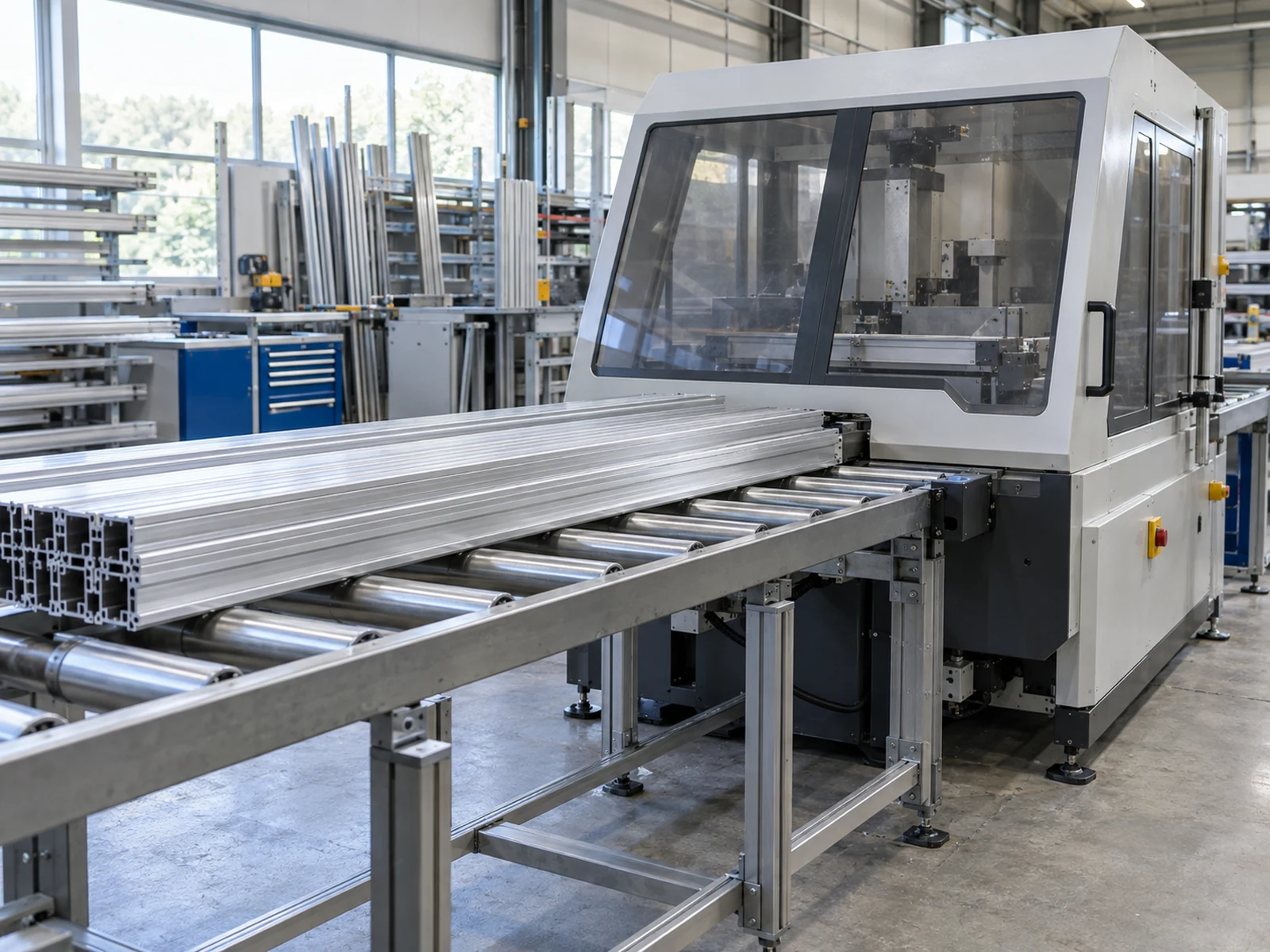
Long or thin-wall aluminum extrusions can be difficult to present consistently to a saw if they are poorly supported, bowed or allowed to rotate. Ask the cutting supplier how the actual profile will sit on the infeed, where it will be clamped, and whether cosmetic faces require protective contact. A trial should use the approved extrusion in the relevant orientation; a video of another profile only illustrates a machine operation.
Specify the end geometry with a usable datum
“Cut at 45 degrees” is insufficient for a mitered rail. Indicate which visible face is outside, the direction of each miter, and whether the required length is measured at the long point, short point or a named datum. If a joint is square, call for a square end rather than copying a miter from another design. A symmetrical-looking extrusion may still have a finish face or groove that makes handed parts different.
The finished board’s outside dimensions are a design input, not necessarily the stock length. Joint allowance, weld preparation, machining allowance and subsequent finishing can all alter the blank. Put the approved nominal length, angle convention and acceptance tolerance on the member drawing; do not infer a universal tolerance from saw specifications. For a broader explanation of how end geometry changes measurement, see our aluminum miter cutting guide.
Approve a first-off set that represents the order
For aluminum cornhole board frame cutting, a useful first-off inspection includes at least one member from each distinct profile and end orientation. Check length against the declared datum, end angle, burr condition, profile crush, cosmetic-face marks and any specified flatness or distortion. Label left and right parts if the design has handed miters. Record the approved sample and inspection method before releasing a production lot.
Then test the cut parts in the actual downstream joining process. A clean saw cut alone does not prove that the welded or bolted board will be square, stable, compliant with any game standard, weather resistant or suitable for a claimed load. Those claims require separate product-level evidence from the board manufacturer.
Compare quotes at the same handoff point
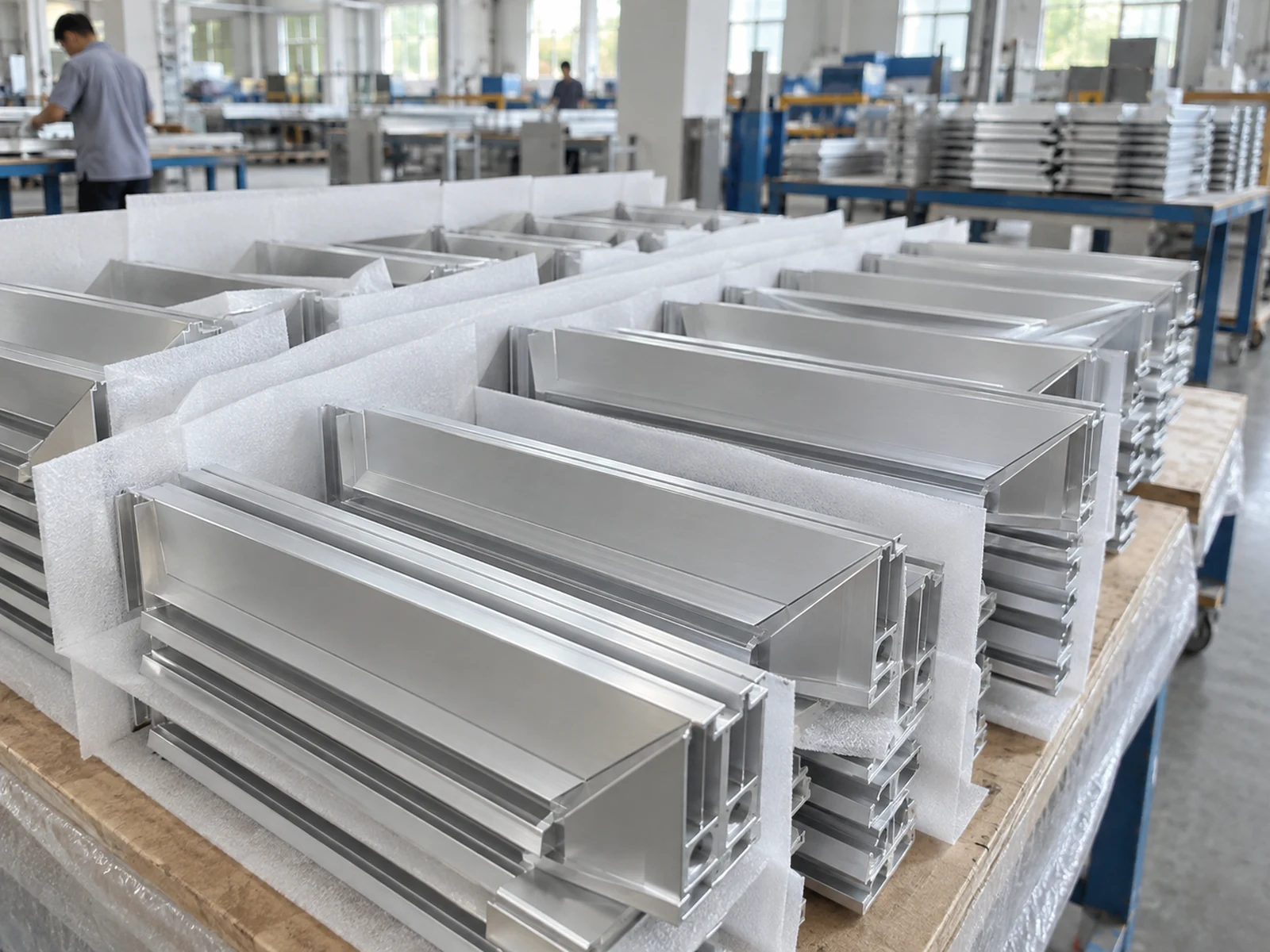
In aluminum cornhole board frame cutting, a low per-cut price can hide extra handling if parts arrive mixed or need deburring, remeasurement or rework. Ask each supplier to price the same deliverable: loose sawn blanks; inspected and labeled member sets; drilled or otherwise machined sets; or welded and finished frames. Note the lot quantity, acceptable remnant policy, packaging, protective separation, inspection records and who bears scrap from defective incoming extrusions. Divide the accepted delivered cost by usable board sets, not by raw saw strokes.
RFQ checklist for frame-member cutting
- Released board assembly and separate member drawings, including revision numbers.
- Actual extrusion cross-section or sample, finish face, material specification and sourcing responsibility.
- Quantities per board and per lot for each rail, brace and leg that really exists in the design.
- Cut length datum, end angle, orientation, handedness and drawing-based tolerances.
- First-off acceptance method for length, angle, burrs, deformation and visible surfaces.
- Included secondary operations, inspection records, labels and protective packaging.
- Expected volume, delivery cadence and exact handoff point in the assembly workflow.
Related saw operation video
The Jiurun footage below shows a related aluminum saw operation. It is a machine illustration only; it is not a cornhole-board project, a test of the specified member, or proof of an assembled board’s performance.
Questions buyers often ask
Can the finished board dimensions be used as saw lengths?
No. Derive each cut blank from the approved assembly, joint detail and length datum.
Does a cut-rail quote include legs and a top?
Only if the quotation names them. A complete board and a kit of sawn frame members are different deliverables.
How should a supplier prove the cuts are suitable?
Use approved-profile first-off samples and a documented dimensional and visual inspection, followed by the buyer’s separate assembly fit check.
Ready to request a cutting review? Send the released member drawings, actual profile details and intended handoff scope through the Jiurun contact page. We can discuss the cutting route and sample checks without assuming that a finished-board claim follows from a saw demonstration.