
A Pilates reformer rail can be part of a finished exercise machine, but a saw shop needs a much narrower purchase order. Does the buyer need raw extrusion, a paired set of cut rail blanks, rails with holes and finishes, or a validated complete reformer? Those are different deliverables. This guide frames Pilates reformer aluminum rail cutting as a drawing-controlled OEM sourcing decision. It does not prescribe a universal rail shape or claim that a cut blank alone makes a carriage run correctly.
Real product examples show why the distinction matters. Merrithew describes C-channel aluminum rails in one reformer package and identifies a separate carriage, rolling mechanism, springs and accessories. A Peak Pilates Premier Reformer manual refers to an aluminum track and gear block. These manufacturer references establish that rails and interfaces can be significant parts of particular designs. They are not specifications for every reformer, Jiurun customer work, or the profiles pictured below.
First decide what the rail supplier is quoting
Write the supply boundary before discussing a machine. Raw extrusion is stock to be cut elsewhere. A cut rail blank has defined end geometry and length but may still need holes, deburring, coating or assembly. A prepared rail adds explicitly drawn secondary operations. A rail-and-carriage assembly introduces alignment, rollers, stops and functional checks. A finished reformer adds the frame, spring system, accessories and product-level validation. A saw quote should name which line it covers and which work belongs to another supplier.
This boundary prevents a common RFQ error: sending a picture of a completed reformer and requesting a price for “two aluminum tracks.” The picture does not reveal the section, datum, left/right differences, joinery or finish. Ask the designer or assembly owner for released drawings, a part-numbered bill of materials and an approved physical sample where practical. If those inputs are not settled, quote a sample review rather than an assumed production cut.
Freeze the exact section and the carriage interface
The rail drawing should state alloy and temper where specified, extrusion cross-section, wall and lip dimensions, finish state, protected faces and revision. Identify surfaces that the carriage contacts, that a stop or gear block locates against, and that the fixture may contact. A groove, open channel or hollow rib can change the clamping plan even when the outside width looks familiar. The saw operator must not infer a proprietary rail profile from a brand name or a general application photograph.
Release left and right rails as separate part numbers if their holes, notches, ends or finish faces differ. If they are nominally identical, say whether a matched pair must come from the same extrusion lot and be measured against the same datum. The assembly owner should define rail spacing, parallelism and carriage engagement. Cut length alone cannot establish those assembled relationships.
Define the length from a measurable datum
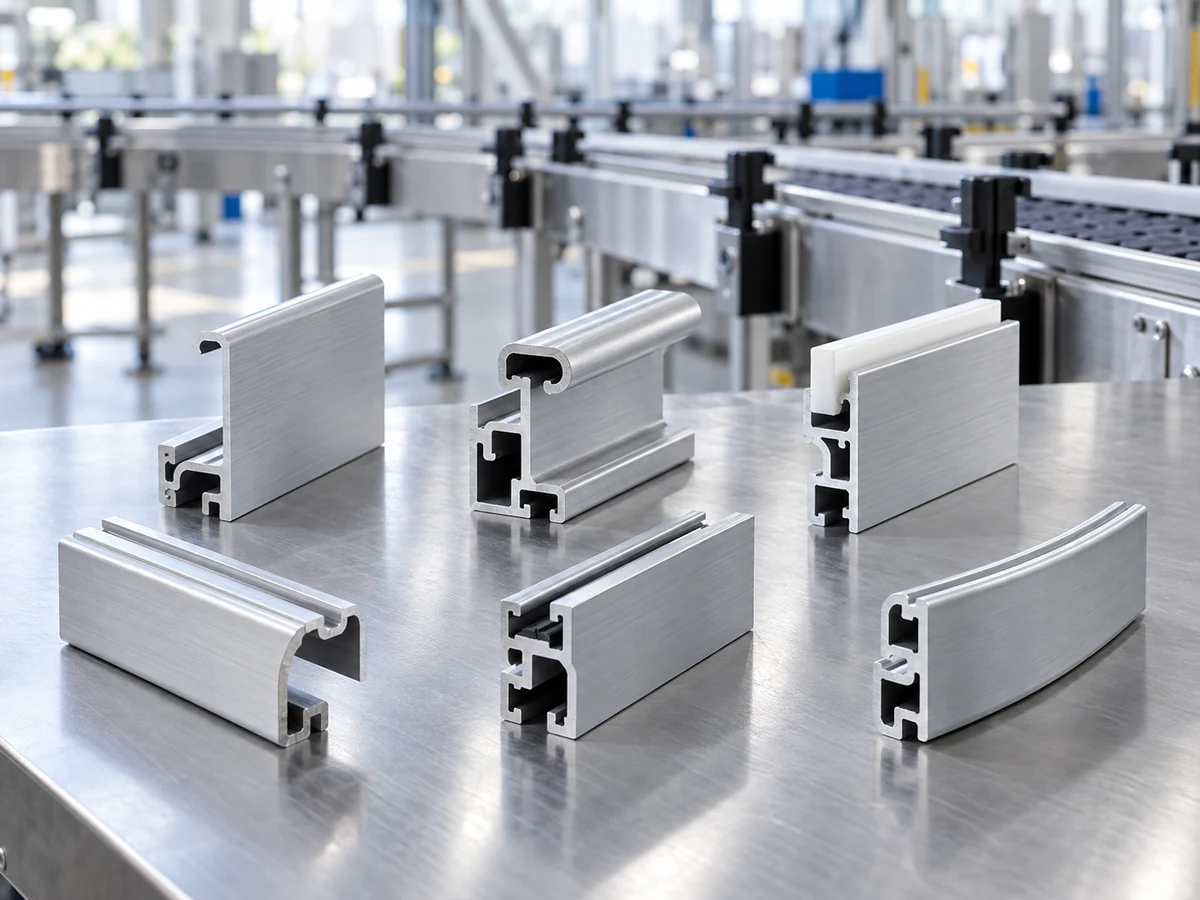
For each rail, state the nominal blank length, tolerance, end angle, orientation and inspection method. Mark whether the dimension runs between raw saw faces, finished faces, connector seats or an assembly reference. Do not quietly subtract a frame end cap or carriage-stop allowance from an overall product dimension; the design owner must release that allowance. If a pair is supplied, specify whether the two blanks have an additional pair-to-pair length difference limit and how that limit is checked.
Give a cut list for short and long variants, including drawing revisions and intended quantity. For a long rail, discuss usable stock length, infeed and outfeed support, gripped length and safe handling of the last cut. A setup sample or a short remainder should have its own disposition. These details affect repeatability and waste, but a quotation cannot honestly promise a yield number without the actual stock and nesting plan.
Review clamping without assuming the pictured fixture fits
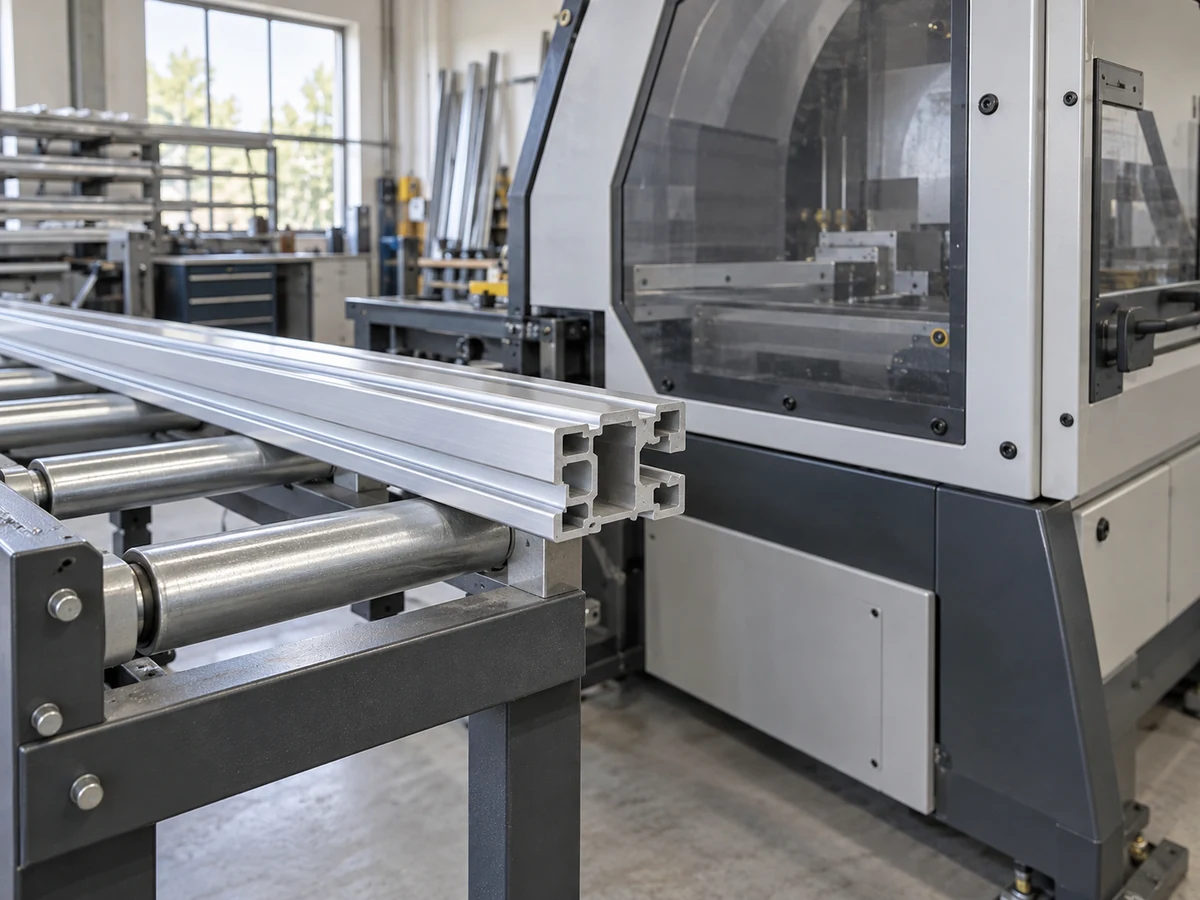
Bring a real section sample to the machine review. Mark contact lands that may be clamped and surfaces that must remain cosmetically or functionally untouched. An open channel may need internal support or shaped jaws; a thin lip can distort under a flat clamp. The correct solution depends on the submitted geometry and the sample result. Ask the supplier to show where the stock is supported before the blade, at the cut and after separation, and how a long member is prevented from moving or marking.
Specify any protective film, finish or surface direction before trial cutting. If coating or anodizing occurs later, identify which measurements apply before and after finishing. A photo of an extrusion under clamps can help reviewers discuss contact points, but it cannot qualify a different rail profile or prove that a carriage-contact surface remains within drawing limits.
Separate saw-end acceptance from functional rail approval
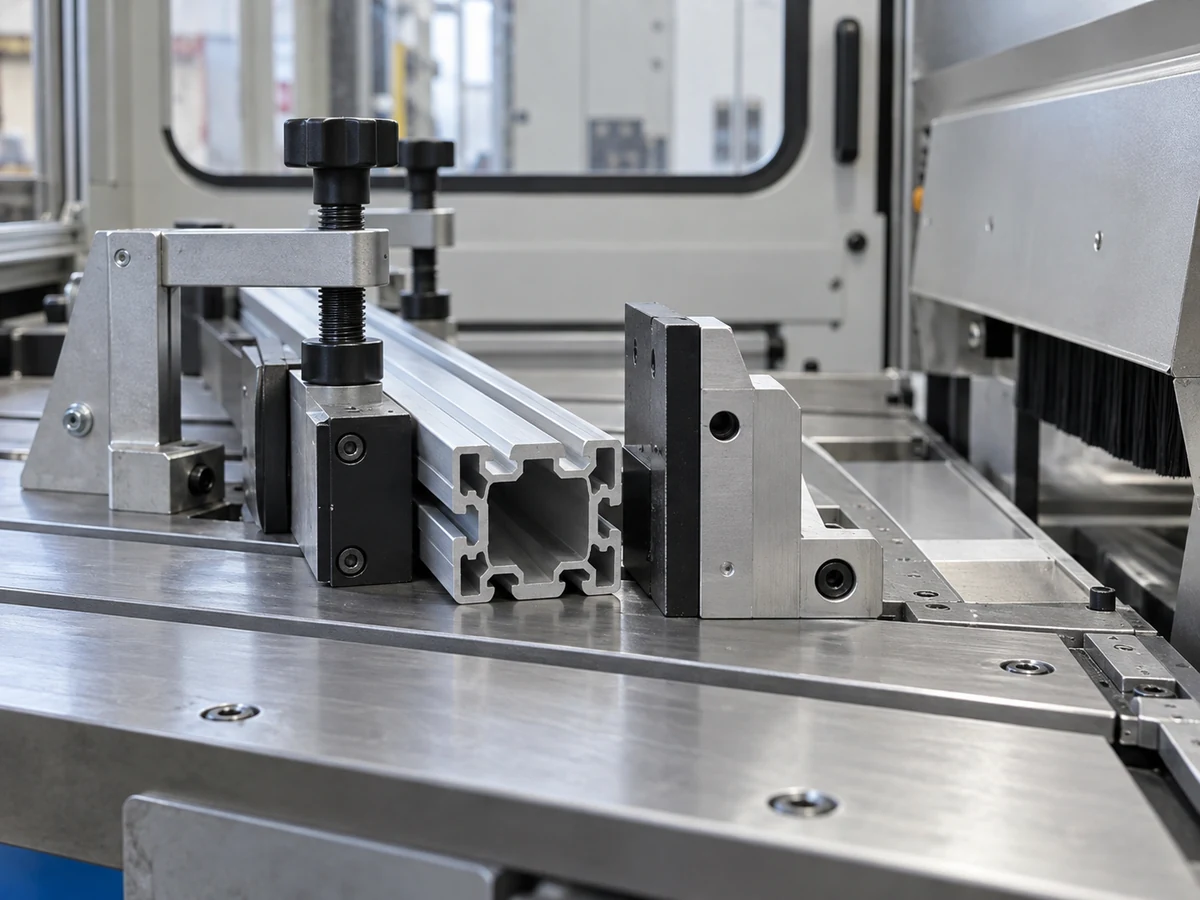
Define cut-end squareness or angle, length, burr limit, sharp-edge treatment, deformation and cosmetic damage in terms a receiver can inspect. Name the measuring tool, datum and sampling frequency. If a rail receives a bolted end fitting, state whether holes and end preparation are included in this supplier’s scope. If a carriage wheel or stop approaches the end, the design owner should identify the keep-clear features and any required downstream finishing. Do not treat an attractive cut-end photograph as metrology evidence.
Request a first-off pair from the approved stock, drawing revision and intended workholding method. Record actual measurements and visible-surface observations; then let the assembler check fit with the real frame, carriage, rollers, stops and hardware. The assembly owner—not the saw-cut blank alone—must assess travel, retention, loads and the finished product’s applicable requirements. A cutting-machine example does not establish exercise-equipment safety or durability.
Make the RFQ and handoff unambiguous
A usable Pilates reformer aluminum rail cutting RFQ contains the released section and rail drawings; left/right part numbers; alloy, temper and finish state; raw stock length; blank lengths, end angles and datums; permitted clamp contact; burr and cosmetic limits; secondary-operation exclusions; first-off quantity; batch volume; and inspection records. Add the assembler’s interface drawing so the cutting supplier knows which surfaces and end features matter, without assigning finished-product validation to the saw shop. For general saw selection and extrusion workholding questions, see our industrial aluminum extrusion cutting guide.
Packaging deserves a line item. State how paired rails are labeled, separated, protected from rubbing and tied to a drawing revision and material lot. A supplier can deliver dimensionally acceptable blanks that are difficult to assemble if left and right parts, sample pieces or revisions are mixed. The receiving inspection should be able to identify every pair before it enters a reformer assembly line.
Equipment video: process context only
The following video from Jiurun Machinery’s own YouTube channel shows an industrial aluminum angle-saw demonstration. It gives a visible example of a related cutting process. It does not show the reformer rail discussed here, an approved section, a specified machine setup, a customer production run or a verified performance result. Select and validate a process against the actual rail drawing and stock.
Send the rail drawing before choosing a saw
JiurunCut can review a cutting approach for a specified aluminum extrusion and a proposed first-off sample. Send the profile drawing, rail cut list, actual stock or sample, finish requirements, quantity and acceptance method through our contact page. We will discuss the cutting question against those inputs; the reformer designer and assembler remain responsible for the complete rail-and-carriage system.