
Automatic pool cover track cuts should start with the approved cover-system layout, not a generic saw length. A track may sit on the deck, be recessed into it, or run below the coping. Those arrangements use different profiles, interfaces and installation sequences. A factory-cut kit can reduce field measuring and trimming when the geometry is released; site cutting can preserve adjustment when the deck or coping dimensions are still being confirmed. The question for a buyer is which dimensions are truly fixed before the saw runs.
This guide is for purchasing and process teams evaluating aluminum extrusion cutting. It does not specify a pool safety cover, substitute a rail from another manufacturer, or approve an installation. The selected system supplier and qualified installer must control track compatibility, layout, anchoring and final operation.
Identify the approved track system before buying cut blanks
Request the cover supplier’s current track and channel drawing, installation instructions, part list and revision. Separate the guide track, any surrounding channel or encapsulation, the mechanism lid and the fasteners. They are not interchangeable pieces of aluminum stock. Latham’s explanation of top, recessed and under-track choices shows why the installation location changes the material package. Cover-Pools describes distinct track and channel components in its own system. These are examples of product-specific routes, not Jiurun specifications.
For each proposed cut member, record its actual supplier part number or released extrusion drawing, alloy and finish if specified, cross-section, groove orientation, straightness requirement, stock length, required blank length and whether holes or end features are already supplied. Ask who is authorized to alter the profile or length. A visually similar open channel is not proof that a cover glider, splice or fixing method will fit.

Factory cut or site cut: where should the final datum live?
Use factory cutting when the approved system, measured opening and end conditions have been released and the factory can identify every left and right member. Use a controlled site trim allowance only when the cover supplier’s procedure permits it and the installer owns the final measurement, cutting, deburring and acceptance. Do not silently treat a saw-cut blank as a finished installed track.
Geometry
Factory-cut: released pair lengths and reference ends are available. Site-trim: final site dimensions remain to be measured.
End condition
Factory-cut: the factory receives an approved end-face and burr specification. Site-trim: the installer follows the system supplier’s field-cut and edge-finishing method.
Accountability
Factory-cut: the supplier inspects and labels blanks before shipment. Site-trim: the installer records final dimensions and fit at the pool.
Transport
Factory-cut: finished ends and guide channels need packaging protection. Site-trim: full stock lengths need handling room and secure transport.
A Coverstar installation guide hosted by Latham instructs installers to check guide spacing, length and diagonals, cut a guide at the mechanism end, and file the ends so burrs do not damage the cover. That is a specific installation example, not permission to apply its cut location or dimensions to another cover design. Read the supplier’s guide against the exact system being ordered.
Release the drawing package before a saw trial
A useful cutting RFQ includes a profile drawing with revision, a dimensioned length schedule, a view showing the measured datum and permitted end, quantities by length, finish-protection requirements and the next operation. Mark any ends that must remain uncut, any sections that arrive predrilled, and any pair-matching or splicing rules. If the required length is a field dimension, label it provisional rather than hiding it in a factory nominal value.
Keep the saw’s responsibility narrow. It can produce a reviewed blank to a defined cut and acceptance plan. It cannot establish deck geometry, replace the supplier’s track design, approve anchors, or certify the automatic cover. If drilling, milling or other downstream work follows the cut, specify the handoff between those operations. The prior pool-enclosure saw selection guide addresses a broader frame/module purchasing problem; a cover-track order needs its own approved parts and geometry.
Trial the real section, orientation and support
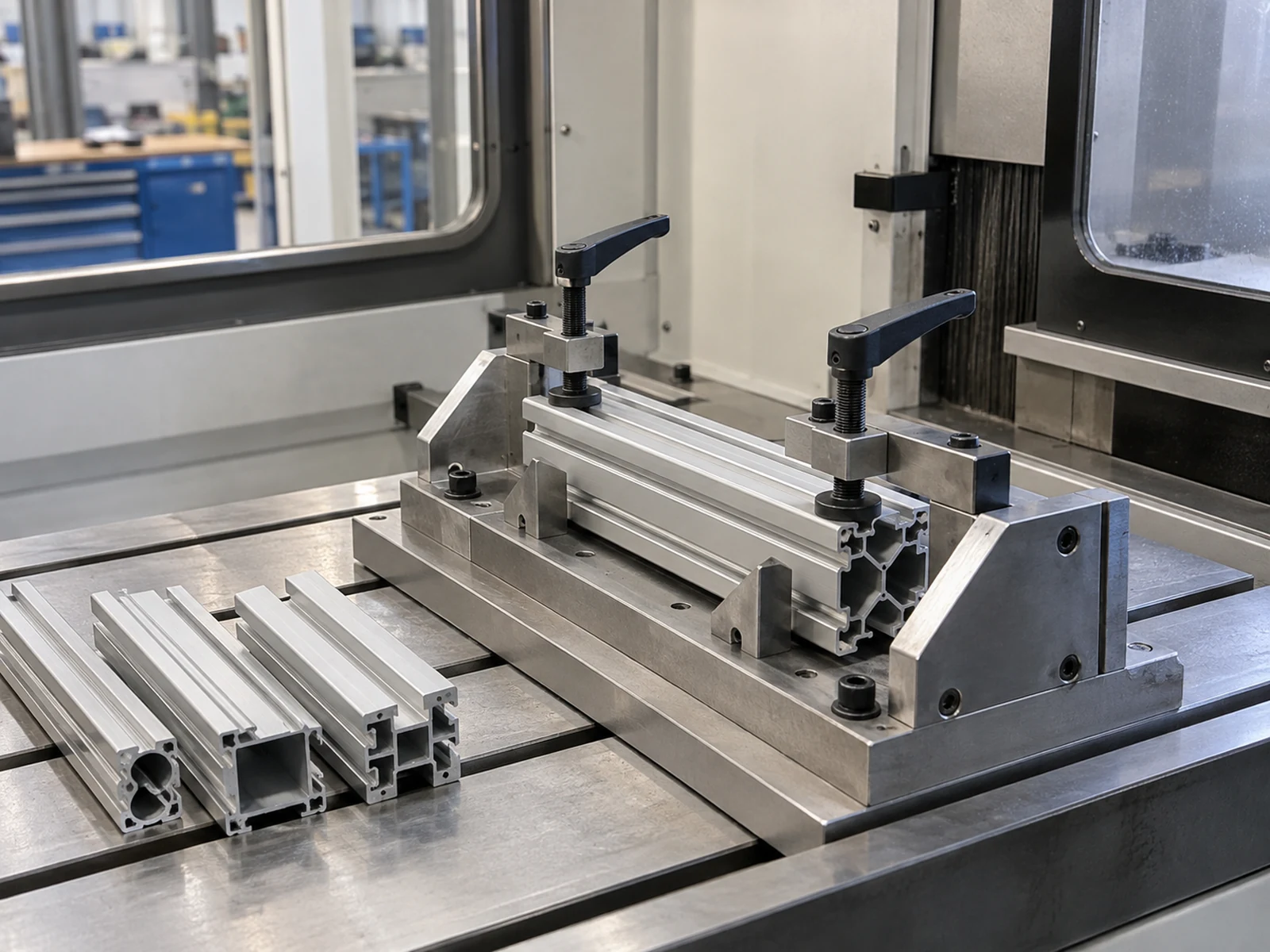
For a retained in-house cutting operation, give the saw supplier the released section and representative stock lengths. Ask for a stopped setup review before any cutting: where does the section contact the table, fence and clamp; does the guide channel stay clear of contact damage; and can the long extrusion be supported on both sides without sag or twist? Check feed clearance and the cut-piece collection path. Thin lips and open grooves can require a different contact strategy from a closed box section.
Then witness a small sample set covering the longest and shortest released lengths and any different profile families. Record the setup, blade and support arrangement, then check the resulting end condition. Trial results are evidence only for the particular stock, setup and acceptance criteria used. They do not prove compatibility with a pool cover or performance in service.
Inspect the blank without inventing cover-system tolerances
Ask the cover-system owner to define the dimensions and inspection method for the supplied blank. A purchasing drawing may need overall cut length, squareness to the specified datum, visible end damage, burr condition, coating or anodized surface condition, and the state of the guide groove. Decide whether the factory checks individual members, samples a lot, or fits a pair in a separate receiving step. Do not import a generic saw catalog accuracy claim into a safety-cover track specification.
Photograph a representative accepted and rejected end. Use an actual drawing to locate the measurement points and record instrument condition and sample identity. Keep section-envelope measurement separate from cut-length measurement: a caliper across a profile is not an installed track alignment test. The Latham guide’s warning about burr damage makes the edge condition a practical handoff item for that system, but the applicable supplier instructions remain decisive.

Package pairs and protect the guide path
Identify every member by system, project, drawing revision, side, length and lot. Keep the two sides of one installation traceable as a pair if the approved kit calls for it. Separate fragile edges from other metal parts, protect the channel from loose chips and transport rub, and record whether the installer will make the final cut. For long stock, agree handling, rack and packaging dimensions before quoting. The general long-part staging guide can help frame those handoff questions.
At receipt, check labels, profile identity, visible damage, completeness and the drawing revision before parts reach the job site. A clean factory cut cannot repair a wrong system profile or a missing splice component. Send discrepancies back through the cover supplier’s approval route instead of fitting a similar-looking substitute.
Send a usable automatic pool cover track cuts RFQ
Give the cutting-machine supplier the approved extrusion drawing and sample, the length and quantity matrix, stock/finish condition, end-face and burr acceptance criteria, allowable cut location, packaging requirement, and the current downstream operation. Ask the supplier to state what the proposed machine actually cuts, how it supports the profile, what must be demonstrated in a witnessed trial, and which items remain outside its scope. Avoid a model recommendation based on cover type alone.
If the geometry is still provisional, quote an engineering trial or a full-length supply route first. When the dimensions and responsibility are settled, send Jiurun the drawing and cut list for a specific saw-process review. The cover-system supplier and installer retain responsibility for the approved track assembly, installation and safe operation.
Watch a general aluminum-saw example
This video from the Jiurun Machinery channel shows general aluminum cutting equipment. It is an equipment illustration only: it does not show a pool-cover track, this job’s material, a specified model configuration, a customer project, an accepted trial or cover-system performance.