
An aluminum saw for rainwater system manufacturing should be specified against the parts your factory actually cuts, not against the name of the complete drainage system. A supplier may sell cast gutter sections, extruded gutters, pressed gutters, extruded downpipes and bought fittings under one rainwater catalogue. Those are different production routes. Before asking for a machine quotation, separate the straight members retained for sawing from formed, cast, pressed or purchased parts that will never enter the saw.
This guide is for manufacturers and contract fabricators deciding whether a sawing cell belongs in their own supply mix. It is a procurement framework, not a claim that Jiurun has cut the pictured rainwater products or approved a particular gutter or downpipe profile. Capacity, finish and cut quality must be proved on the buyer’s released samples.
Start with the supply route, not the finished system
A rainwater product list can conceal several manufacturing methods. Alumasc’s aluminium rainwater range separately lists heritage cast gutters and downpipes, extruded gutter ranges, pressed gutters and several downpipe systems. Its heritage page describes cast gutter profiles, extruded downpipes and loose cast sockets. This is useful evidence of why a complete system should not be treated as one sawable family. It does not define your factory’s actual make-or-buy boundary.
Build a part register for every released product family. For each line, record whether the incoming form is an extrusion, a straight pipe, a casting, a pressed blank, a prefinished length or a purchased fitting. Add who performs forming, drilling, coating, assembly and packaging. Only then mark the cuts that might be carried out in-house. If the supplier already delivers to final length, a saw may add no value for that line. If lengths are bought long and cut to order, capture that flow separately from any bought cast or formed elbows.
| Part family | Possible saw scope | Separate question for purchasing |
|---|---|---|
| Straight extruded gutter | Length cutting when the actual section and finish permit it | Who owns the profile drawing, cut-end acceptance and joint allowance? |
| Straight aluminium downpipe | Length cutting on released tube or pipe stock | Which end enters a socket or fitting, and what happens after cutting? |
| Cast or pressed gutter piece | Do not assume a straight-stock saw operation | Is it received to size, formed elsewhere or finished by another process? |
| Loose socket, outlet or elbow | Usually a separate sourced or formed item unless the process owner says otherwise | Who owns the interface check and any secondary machining? |
The distinction is a buying decision. A quotation for a universal rainwater-system saw can hide unnecessary fixtures and omit the handoffs that determine whether cut members actually fit downstream components.
Define the gutter family that will reach the blade
Extruded gutters may have an open, asymmetric cross-section, rolled or decorative edges, and visible faces. The buyer should release the actual drawing and several physical sections rather than ask a saw vendor to infer geometry from a catalogue picture. Record the profile orientation at the blade, the surface allowed to contact supports, the datum used to measure final length and the destination of each cut end. A thick open industrial channel is only a visual analogy for an open section; it is not proof that a specific gutter will be supported or cut correctly.
For each family, classify the required cut as a standard length cut, a mitre or a special end preparation. Keep these operations distinct. A mitered installation corner, for example, should not be presumed from a straight-gutter quotation. If a lip cannot be clamped without damage, the inquiry must ask how the section will be supported and located. If the extrusion arrives coated or factory finished, ask whether the cut is before or after finishing and who accepts cut-edge appearance.
Alumasc’s Aqualine page describes an extruded gutter system with several profile choices and dry-jointing. That illustrates why one profile sample is insufficient for a whole product family. The point is to map each of your actual sections and joints; it does not mean the pictured Jiurun media depicts Aqualine stock.
Define the downpipe family separately
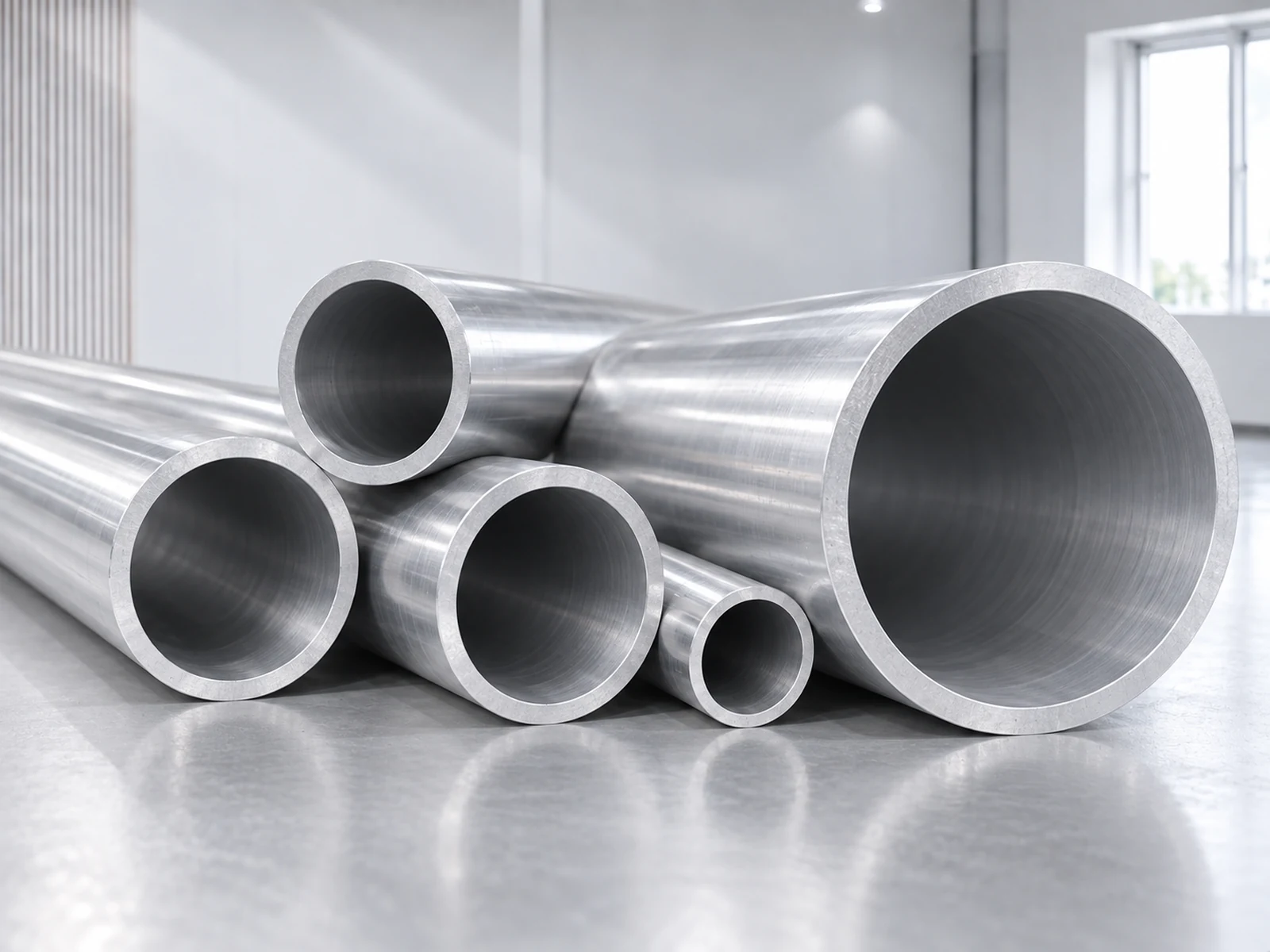
A downpipe cutting trial should start with the released tube, its wall and outer profile, its finish, and the end that has to enter the mating socket. List round, square or other sections only if they are in your own programme. For every cut length, specify whether the assembly drawing measures the pipe alone, the pipe plus socket, or another installed reference. Otherwise the saw vendor may demonstrate repeatable feeding against the wrong finished dimension.
Ask the supplier to identify contact and clamping points that avoid visible dents. A thin finished wall and a heavy industrial tube may need very different support. The round tubes pictured here help explain the location question only; their size, wall, surface and provenance do not establish a downpipe setting. Keep joint fit, paint or coating repair, drainage design and installation compliance with the product owner, rather than transferring those duties to a saw quotation.
Plan the cut and downstream handoff together

Choose an inspection point that matches the next operation. For straight gutter sections, that may be a length and cut-end review before joining, finishing or packing. For downpipe sections, it may be a trial insertion into the actual approved socket. Record which department signs off the surface condition, burr condition, length reference and fit. The saw provider can show how its cutting and material handling work on submitted samples; acceptance of the complete rainwater assembly remains the buyer’s responsibility.
Separate the sawing cell from fabrication steps it does not perform. The buyer’s routing should show where outlets are introduced, where corners or bends originate, where coatings are applied and which items are bought complete. For pressed or cast parts, do not force a saw demonstration simply because the assembled system contains aluminium. The GX pressed-gutter range in Alumasc’s catalogue is a useful reminder to ask how the blank becomes the final section before deciding which process, if any, belongs at a saw.
Cut parts need a controlled exit. Identify whether operators label by family and length, whether protective separators are needed, and how the first downstream station receives a mixed order. Outfeed buffer planning can help frame this handoff, but the required buffer and packaging method must be established from your orders and finish requirements.
Aluminum saw for rainwater system manufacturing: supplier trial
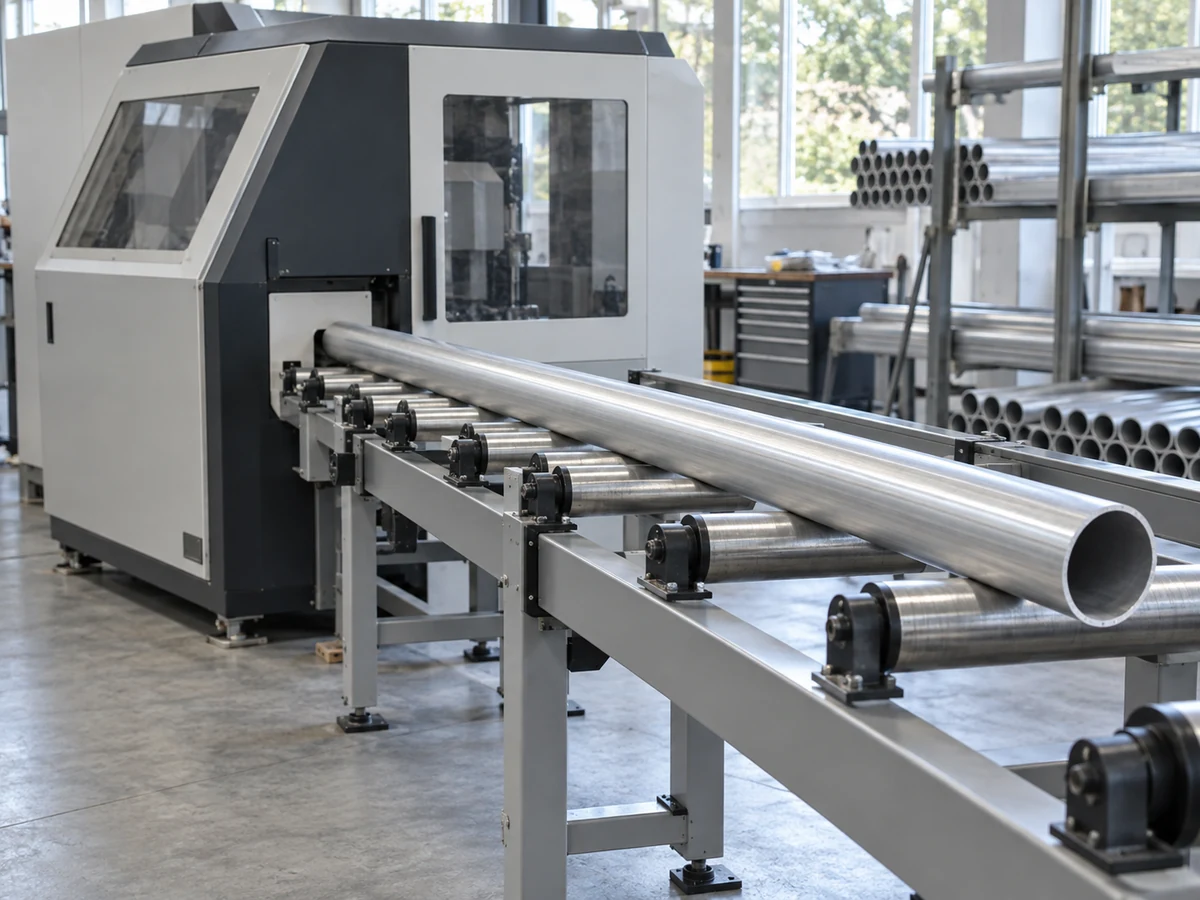
Send a deliberately mixed trial pack rather than only the easiest straight piece. Include the smallest and largest released section that you genuinely intend to cut, the most delicate visible face, a normal production length and a short ordered length if both occur. Include a coated sample if cutting after coating is part of the proposed route. Mark drawing revision, incoming stock condition and the precise dimension to inspect.
In the trial request, ask the vendor to show stock loading and support, datum selection, clamping contacts, blade entry, cut-piece collection, changeover between profile families and the inspection of each accepted cut. Record any secondary deburring or end treatment as a separate step. Do not equate a machine’s feed-position specification with finished-part dimensional accuracy. An agreed measurement method and a documented trial on the actual section are more useful than a catalogue tolerance transplanted from another model.
Request photos or a witnessable setup of any dedicated nests or supports for the open gutter and the downpipe. Confirm who supplies them, who maintains them and how new catalogue sections will be validated later. Setup-cut planning is relevant when the production mix changes often; the trial should make the changeover burden visible.
Compare buying options on the retained work
For an aluminum saw for rainwater system manufacturing, price comparisons should use the same make-or-buy boundary. One option may keep all length cutting with an extrusion or pipe supplier. Another may buy long stock and bring straight-member cutting in-house while continuing to source cast sockets, pressed corners and formed fittings. A third may retain some high-volume sections and outsource low-frequency shapes. Compare landed cut-part cost, inventory length mix, scheduling control, scrap ownership, inspection effort, fixture changes and packaging, not just the machine price.
A low-volume buyer might benefit more from a clear supplier cut list than from a new cell. A manufacturer with a broad daily mix may value changeover and traceability more than the fastest demonstration on one section. The decision depends on the actual portfolio and order pattern; no generic machine video proves the commercial answer.
Video: a general equipment view
The following video is from Jiurun Machinery’s own YouTube channel and shows general aluminium-cutting equipment footage. It is provided to illustrate equipment handling only. It does not demonstrate a rainwater gutter or downpipe, a specific model configuration, a customer project, a trial of the sections discussed here, or a performance result.
What to send with the inquiry
- A part register separating retained straight cuts from cast, pressed, formed and bought items.
- Current gutter and downpipe drawings with revisions, stock forms, finishes and expected order mix.
- Physical section samples, especially open lips, visible faces and the actual mating socket.
- Each required finished-length reference, cut type, inspection method and downstream handoff.
- Space, loading, outfeed, labour and fixture-change assumptions for the proposed cell.
- Trial acceptance criteria agreed by engineering, production and the product owner.
Send the retained cut list and representative samples to Jiurun when requesting an equipment discussion. We can review the sawing scope and propose a trial plan for those released members. The buyer should separately confirm system design, joint performance, installation requirements and any non-saw processes with the appropriate product and compliance owners.
Sources and scope note
The product-family distinction above is grounded in Alumasc’s aluminium rainwater range, its Heritage cast gutter and downpipe description, Aqualine extruded gutter description and GX pressed-gutter description. These are examples of supply routes, not an endorsement, a Jiurun customer case or evidence that the illustrated media depicts those products.