
Custom aluminum corner members are easy to misquote when a drawing shows only a single angled extrusion. A usable corner is usually a relationship between two or more cut members, their reference faces, a joining method and the assembly that receives them. Before comparing an aluminum saw quotation, define the matched set that must come off the cutting process. That turns a vague “45-degree corner” request into a trial that a supplier can actually inspect.
This guide is for buyers and manufacturing engineers preparing a saw RFQ for custom profiles. It separates the part specification from the machine decision. It does not claim that one cutting setup, angle or joining method works for every profile.
First decide what the supplier is expected to deliver
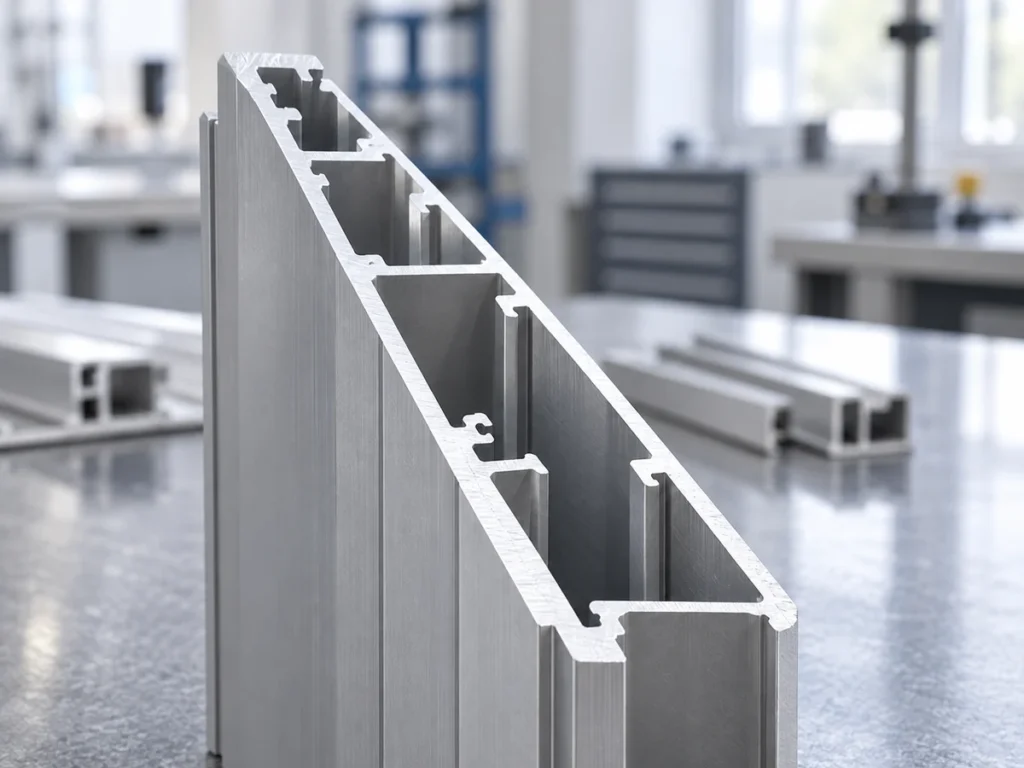
The word corner can mean four different deliverables: a stock extrusion cut at an angle; two handed cut members supplied as a pair; a kit with connectors and identification; or an assembled joint. Each level adds obligations. A machine trial that produces a clean loose end does not, by itself, prove that the left and right parts meet at the visible face or that a connector can be installed.
Write the purchase unit before the equipment request. If production receives loose cut parts, name the downstream team that controls the connector and assembly fit. If production receives a matched pair or kit, state how the two members are identified and whether a substitute from another batch is acceptable. If an assembled corner is required, specify who owns assembly and inspection. The saw quotation should cover only the operations actually expected of that saw.
Build a family map, not one “typical” sample
List every corner member in the intended family. For each part number and revision, record the profile section, material and finish condition, incoming bar state, nominal finished length, end angle, left/right hand, visible face, mating member, connector interface and expected order mix. Mark which members share a setup and which require a fixture, blade, program or orientation change. This map prevents a low-volume difficult hand from disappearing inside a high-volume average.
Choose trial samples from the extremes that matter to cutting: the thinnest unsupported wall, the widest section, the most awkward clamping face, the least forgiving cosmetic face and the shortest or longest retained length. These are selection principles, not universal machine limits. The actual profile drawing and physical samples should decide the test. A machine envelope that fits the outer dimensions may still leave the workpiece poorly supported at the cut.
Define the datum and the handed end
An angled end has meaning only relative to a reference. On the drawing, mark the face that locates against the fixture, the face that remains visible in the assembled product and the direction from which length is measured. Show the profile orientation as it enters the saw and the orientation used for inspection. A mirrored end can look acceptable on a bench but fail when a groove, lip or finish face must point outward.
Use a simple sample label such as part number, revision, hand, end A/end B and orientation arrow. Do not rely on “left” and “right” without a viewing direction. Our profile-orientation RFQ guide goes deeper on locating faces and end hand. For this corner-family purchase, the key decision is whether each member can be cut and inspected from a stable common datum or needs its own controlled setup.
Specify the joint before accepting cut quality
A visually closed miter is not the whole acceptance test. The joint may need room for a bracket, fastener, seal, weld preparation or other joining feature. Identify which design owns that interface and supply the connector drawing or sample when it affects the saw trial. An item fastening-set example illustrates why connector compatibility depends on the particular profile system; its published application and load cautions should not be generalized to a different frame.
State which gaps, offsets and burr locations are functionally unacceptable, and who sets the tolerances. If the drawing has no fit criteria, ask the design owner to release them before treating a sample as approved. Do not convert a supplier’s feed-positioning claim into a finished-corner guarantee. The retained cut pair, installed connector and assembled frame must be checked against the buyer’s own drawing and use case.
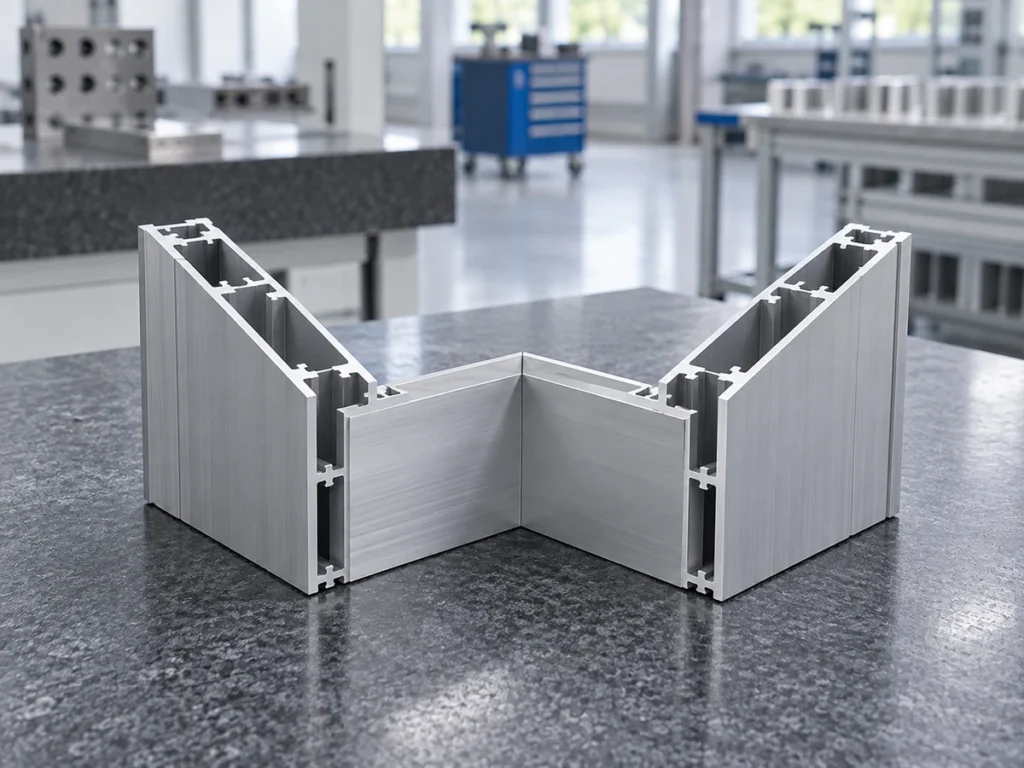
Approve a pair, not just two separate ends
For a first-lot review, measure each member from its stated datum, inspect both cut faces, then assemble the exact mating pair with the production connector or fixture. Record the visible face alignment and any gap at the required inspection points. Keep the part labels with the observations. If a corner fails, separate a wrong-hand or orientation error from an angle, length, profile variation or connector issue before changing the saw setup.
Ask for one sample after a changeover as well as samples from a steady run. A program-recall demonstration is useful only if the correct workpiece, hand, datum, clamping and inspection plan return with the program. If the family has many low-volume variants, the time and error exposure at changeover may matter more to the buying decision than headline cycle speed.
Compare quotes on the same retained output
Ask each bidder to state the quoted boundary: loading, cutting, handling, labeling, deburring if applicable, inspection and any kit preparation. Compare a common retained unit—a released pair or kit—rather than dividing machine price by a claimed maximum cuts per hour. Include setup and changeover labor, bar utilization, trial and scrap material, blade service, fixture changes, inspection and rework. These costs are buyer-specific; request evidence from the supplier’s trial instead of accepting a generic savings percentage.
Use the family map to weight the quote. A machine that is efficient on one straight member can be expensive for a family that repeatedly changes profile orientation or hand. Conversely, a flexible angle program has limited value if the joint is actually constrained by external connector work that the saw does not perform. Decide first which activities the machine can control, which remain in downstream assembly and which require separate equipment.
Request a trial package that can be audited
Send the released drawings and revisions, real profile samples, finish requirements, part-family mix, target retained lengths and angles, mating samples and connector details. State annual and batch quantities, current bottleneck and where a rejected corner is discovered. Include the acceptance points and the intended inspector. The Jiurun corner-cutting-machine page similarly asks buyers to provide profile drawings, angle and length requirements, and production targets so the feed, clamp and cut arrangement can be checked against the application. That page is a starting point for a configuration discussion, not proof that a particular family has passed a trial.
In the response, ask the supplier to identify the machine and fixture configuration actually demonstrated, the sample IDs, setup sequence, measured results, remaining manual operations and any untested variants. If a value is a machine-setting or feed-positioning specification, label it as such; do not report it as finished-part accuracy. Keep photos and inspection results tied to the same sample IDs and drawing revision.
Release production with clear change rules
Once a matched pair passes, retain a reference sample and an inspection record. Define what changes require another check: a new profile section or supplier, revised connector, changed visible-face requirement, different finish, new hand or a different fixture. A repeat order should name the approved drawing revision and the exact acceptance package. The packaging plan also matters because good corners can be mixed or damaged after cutting; our mitered-profile packaging guide addresses keeping frame sets together through shipping and receiving.
The buying decision is strongest when the equipment quote and the product release use the same definition of success: the correct handed members, cut from the correct datums, identified as a set and proven in the required joint. If that evidence is absent, keep the quote provisional and test the missing case with the actual profiles.
RFQ checklist for custom aluminum corner members
- Released drawing and revision for every member, plus the intended purchase unit: loose member, matched pair, kit or assembled corner.
- Profile section, material, finish, retained length, end angle, datum face, visible face and left/right viewing direction.
- Mating-member and connector drawings or physical samples, with the joint inspection points and design-owned acceptance criteria.
- Batch and annual mix, changeover frequency, actual bars and representative difficult profiles for a witnessed cut trial.
- Requested evidence: sample IDs, configuration, inspected retained parts, assembled pair, changeover sample and remaining downstream steps.
Share that package with Jiurun or another qualified supplier before asking for a final saw recommendation. The useful answer is a tested configuration and an explicit list of open assumptions, not a universal angle or precision promise.
Equipment video: a general cutting example
The video below is from Jiurun Machinery’s own YouTube channel and shows general aluminum-saw equipment. It is an equipment-view example only. It does not show these custom corner members, a particular material or model configuration, a customer order, an approved mating-pair trial or achieved performance. Use the drawings, samples and inspection plan above to judge a specific RFQ.
Send the matched-set RFQ
Send Jiurun the released profile drawings, handed-part list, real bar samples, connector interface, expected mix and first-lot acceptance method. Ask which saw and fixture configuration would be trialed and which operations remain outside the cut process. Contact Jiurun with your corner-member RFQ package; final joint design and acceptance belong to the responsible designer and buyer.