
Buying an aluminum saw before anodizing is a handoff decision as well as a cutting decision. The saw may produce a part with acceptable length and angle while leaving a condition the finishing shop cannot accept without extra sorting, cleaning or rework. A useful quotation therefore identifies the supplied stock, the state of the part when it leaves the saw, the surfaces that will remain visible, and who accepts each later step. It does not ask a saw vendor to guarantee the result of a separate anodizing process.
This guide is for a buyer planning to cut unfinished aluminum profiles and anodize the parts afterwards. If the stock is already anodized before cutting, the exposed cut end and protection of the existing finish create a different question that needs its own trial and acceptance criteria. Confirm your own drawings and finishing specification rather than treating a generic photograph or demonstration as a project trial.
Why an aluminum saw before anodizing needs a handoff plan
The Aluminum Anodizers Council’s technical bulletin on specifying anodized finishes explains two relevant limits: anodizing does not simply hide pre-existing surface defects, and pre-anodize treatment includes a cleaning stage in which dirt and oils are addressed. The bulletin describes typical possibilities, not a universal recipe. Your finisher must define the accepted incoming condition and its own process. For the saw purchase, the practical question is which condition the cut-part supplier can repeatedly present to that finisher and how both parties will judge it.
First identify what the buyer actually receives. It may be a cut blank sent to a separate cleaner, a deburred member sent directly to the anodizer, or a finished assembly whose surface treatment is outsourced. Those are different supply boundaries. Include the cost and schedule of the remaining route when comparing an in-house saw with purchased prepared parts. A cheaper saw quote has little value if the quote excludes the handling or inspection steps that the real route needs.
1. Define the cut part, not just the drawing length
Give the saw supplier a section drawing, stock condition, cut length and angle, datum, volume range and the actual set of profiles. Mark cosmetic faces, edges that will be assembled, and surfaces the anodizer will see. State whether material arrives as bare mill-finish extrusion, protected extrusion or some other condition. This article assumes the material is to be anodized after cutting; do not combine evidence from already-finished profiles with evidence for this route.
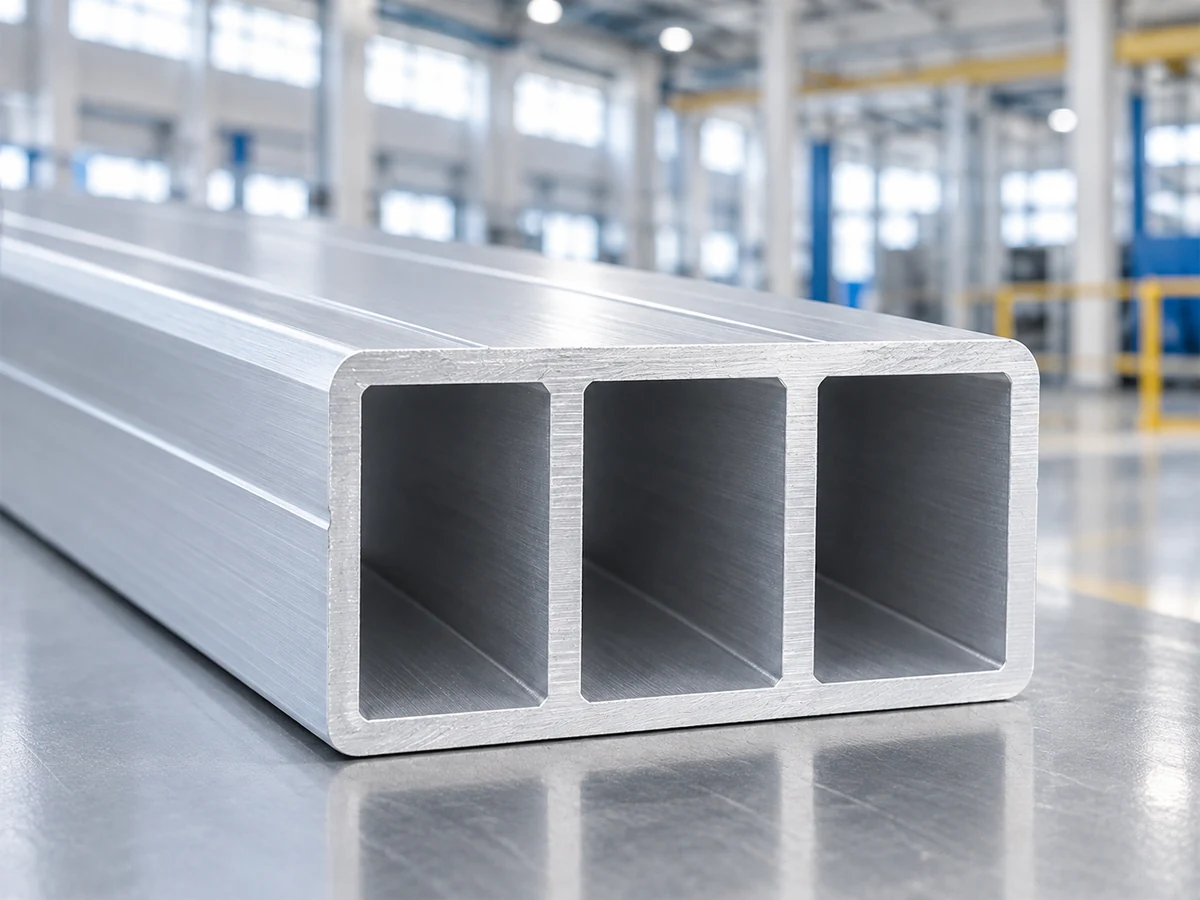
On a multi-chamber extrusion, distinguish the external face, each open cavity and the newly cut end. A photograph of a clean exterior face cannot establish the condition inside the chambers. Ask which spaces are open after cutting and which are accessible to the subsequent process. The finisher should decide whether the geometry and incoming condition are acceptable; the saw supplier should show how its proposed cutting and part-handling configuration treats the actual section.
2. Assign ownership of the condition leaving the saw
Write a short incoming-condition agreement with the anodizer before treating a saw trial as complete. Separate observable saw-stage questions from finishing-stage acceptance. For example, the saw trial can record visible chips, contact marks, loose debris and the appearance of a cut end under an agreed viewing method. The finishing shop decides its cleaning, pretreatment, racking and acceptance method. Neither side should silently assume the other will remove every trace from a hidden recess.
Ask the saw vendor what is included in the proposed machine and what remains a buyer task: part support, clamping contact, cut-piece collection, chip control, lubrication approach if any, and transfer containers. Request an explanation for the actual configuration quoted, not a general statement about all machines. If a cleaning or protective-packaging station is outside the saw scope, name its owner in the RFQ. An inspection at the saw exit is useful only if it measures the condition you have agreed to receive, not an invented promise of final anodized appearance.
A U-channel illustrates why this agreement should be geometric. Its open groove can be viewed and handled differently from its exterior faces. Ask for a sample photograph and inspection notes for the groove and both cut ends, not only an attractive front view. If the anodizer asks for additional preparation, obtain that requirement from the anodizer and price it as a separate operation.

3. Build a representative trial with two acceptance gates
A trial needs the production stock condition, not a convenient substitute whose finish or geometry differs. Include the section families that make the decision difficult: a simple open profile, a hollow or recessed profile, and any cosmetic face that is sensitive to handling. Use the proposed blade, support, clamping, lubrication and collection arrangement actually offered in the quotation. Record any deviations. A short offcut may prove that a section can be cut; it may not represent repeated production-bar feeding or the way released parts are collected. Our stock-length trial guide explains that separate limitation.
Gate A is the saw exit. Record the material identity, drawing revision, stock condition, machine configuration, cut sequence, observed cut-end condition and any visible marks or debris. Photograph the agreed faces and recesses using a repeatable view. Keep setup pieces apart from released trial pieces. Note what was merely observed and what passed an agreed criterion. A dimensionally acceptable sample can still need a separate surface-condition decision.
Gate B is the finishing handoff. Give the anodizer identified samples and the Gate A record. Ask it to evaluate the samples under its approved incoming inspection and pretreatment route, and to report any hold, additional preparation or rejection with a traceable part identity. Do not specify chemical concentrations, cleaning times or surface-treatment settings in a saw RFQ. Those belong to the qualified finisher and the applicable product specification. A successful Gate A does not automatically pass Gate B, and a successful anodized sample does not establish every future batch without a control plan.
4. Compare the real accepted-part route
Compare three routes at the same accepted stage and quantity: buy cut blanks; cut blanks in-house and buy cleaning/finishing services; or buy already prepared and anodized members. Include actual stock waste, setup and changeover, handling, inspection, packaging, outsourced preparation, transport between operations, holds and rejected-part responsibility. Put unresolved costs in an open-item column rather than assuming they are zero. The least expensive saw is not necessarily the least expensive accepted-part route.
For a finned profile, identify the fin spaces and base as separate observation zones. Specify which faces are cosmetic, which faces are functional in the later assembly, and what the finisher can access. A photo of the broad base alone is not a sufficient record of the narrow gaps. The image below maps geometry only; it cannot prove that a specific machine leaves those gaps clean.

What to put in the RFQ and acceptance record
- Part identity: profile drawing and revision, material/temper if specified, stock condition, finished length and angle, batch or kit identity, and the part receiver.
- Visible and hidden zones: label cosmetic faces, groove or cavity openings, fin spaces and cut ends; agree on photographs or a physical sample that shows each zone.
- Quoted saw configuration: request the actual support, clamp contact, blade/cutting approach, lubrication arrangement if used, chip handling and piece transfer included in the offer.
- Exit condition: state the checks the saw operator can make, the viewing method and who releases or holds a cut part. Keep dimensional and surface observations separate.
- Finishing boundary: ask the anodizer for its written incoming condition, cleaning responsibility, sample evaluation and reporting method; record outsourced work and rejected-part disposition.
- Trial traceability: connect stock lot, profile, sample, machine setup, saw-exit record and finisher feedback so that a failed appearance result can be investigated without guessing.
- Commercial comparison: price all three supply routes to the same accepted member, with handling, transport, extra preparation and rework shown explicitly.
If the vendor cannot yet confirm a contact face or process arrangement, leave that row open and request a configuration-specific drawing or demonstration. Do not convert an unanswered RFQ line into a machine capability claim. Likewise, a finisher’s sample approval is tied to that sample and documented route, not every alloy, geometry or future finish.
Video: general saw equipment context
The video below is from the Jiurun Machinery channel and shows general aluminum-saw equipment footage. It is included only to give visual context for machine handling. It does not demonstrate this article’s material, anodizing handoff, model configuration, customer, sample trial, cleanliness or performance.
Decide before you order
A credible purchase decision names the accepted part and the party who controls each transition. Approve the saw for its demonstrated cut, support and exit condition; approve the downstream preparation and anodized appearance through the finisher’s own evidence. If either gate remains open, record the missing evidence and the owner rather than hiding it inside a broad claim that the machine is “suitable for anodizing.”
Need a configuration review? Send JiurunCut the section drawing, material and stock condition, cut list, highlighted cosmetic faces, target quantity and your anodizer’s incoming requirements through the contact page. Ask for the proposed cutting and handling scope and a trial plan for your actual parts. JiurunCut can discuss an aluminum-saw configuration; the anodizer retains responsibility for its own pretreatment and finish acceptance.