
JR-455Y vs JR-550Q is a choice about the accepted cut end and the work required to produce it, not a contest between model numbers. Both directions need the real extrusion, a defined support and clamp setup, an operator plan, and a measured sample before a buyer can approve the quoted machine. Jiurun’s catalog identifies the JR-455Y as a hydraulic semi-automatic crosscut saw and the JR-550Q as a single-head angle saw. The useful question is whether your released parts are mainly repeat crosscuts or require a controlled family of angled ends, and how often that family changes during a shift.
This guide is a purchasing framework. It does not assert that every photographed machine has the same options, that a catalog angle range is usable for your profile, or that a saw alone guarantees finished-part accuracy. Ask the supplier to state the exact quoted configuration and to test the actual part and drawing.
Start with the accepted end, not the saw label
Build a part schedule before asking for a price. For each profile, include its drawing revision, cross-section, alloy and temper if relevant, incoming stock length, visible face, cut-end orientation, finished length, angle, batch size, and the next process that receives it. Distinguish a straight end from a mitered end, and distinguish an angle measured at the saw from an assembly corner that depends on two members and downstream joining. If a part has both end types, specify their order and whether the stock must be turned between cuts.
Use the drawing to name the inspection datum. A hollow or asymmetric extrusion may sit differently when rotated, so a nominal angle setting is only one part of the job. The quoted workholding must keep the selected datum and visible surface under control. Ask what support is needed at the stock entrance and outfeed, how the operator identifies the next part, and how a rejected piece is separated from an accepted batch.
When the hydraulic crosscut route deserves the first trial
Shortlist the JR-455Y direction when the purchase centers on operator-loaded straight crosscuts, a manageable number of profiles, and batches that can be staged and inspected at a staffed cell. Its hydraulic semi-automatic description tells you the type of saw cycle; it does not by itself define the loading, measurement, outfeed, or final inspection labor. Quote those tasks separately. Ask whether the operator positions each incoming length against a stop, how the stop is checked after a changeover, and which portion of the cycle is powered rather than manual.
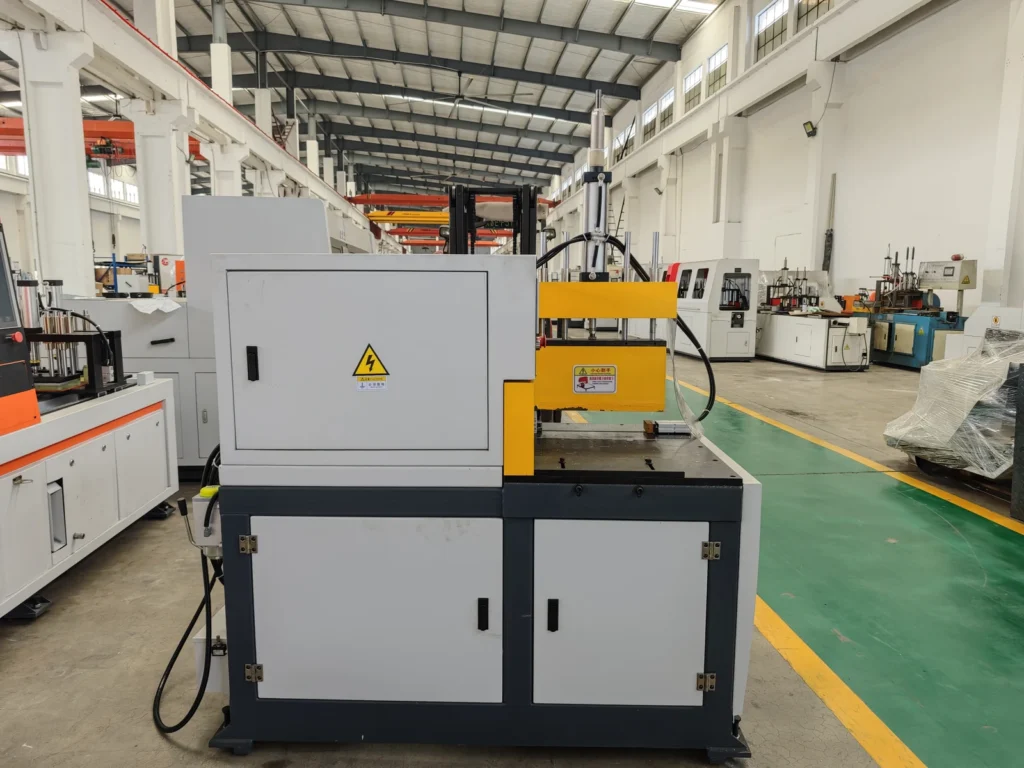
For the representative trial, include the smallest and largest relevant section, the shortest and longest accepted part, a visible-surface profile, and the batch size at which handling becomes burdensome. Observe first-piece setup, steady cutting, replenishment, chip removal, part identification, and rejected-part replacement. A single clean cut on an easy sample does not show the cost of the full staffed route.
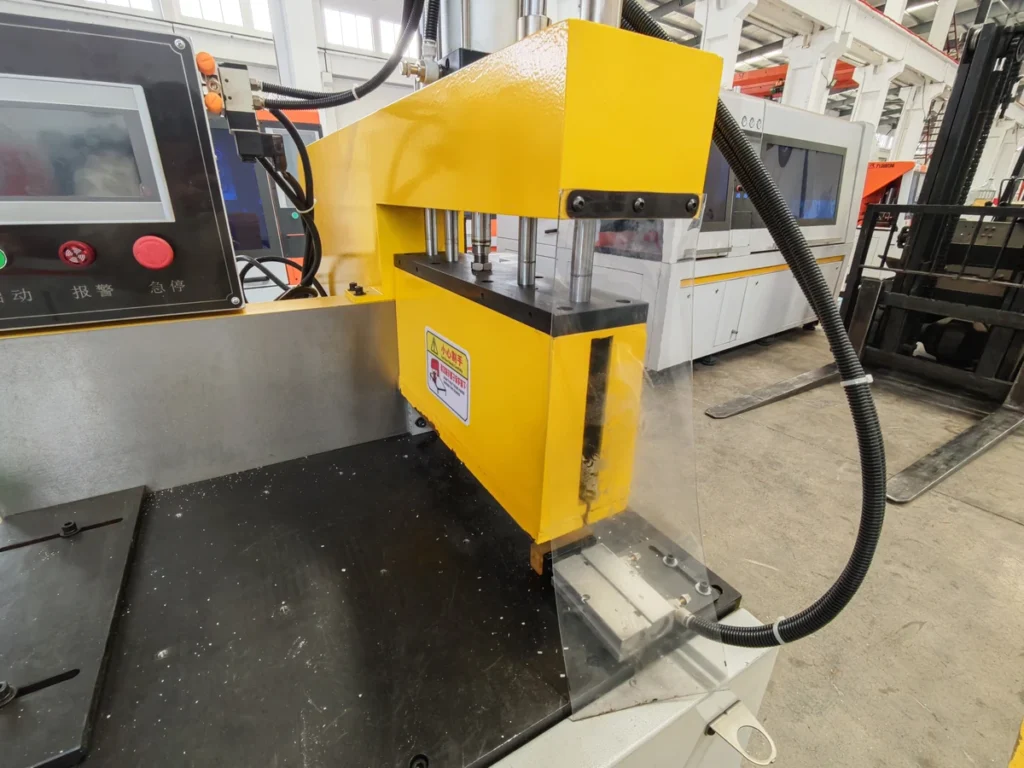
If your released drawings include mitered or multiple angle ends, do not assume a generic fixture converts this route into a substitute for a quoted angle saw. Require the supplier to identify the exact fixture, its angle adjustment and locking method, the supported profile envelope at each required orientation, and the separate acceptance result. The related JR-455Y hydraulic trial guide gives a deeper checklist for this staffed cycle.
When the single-head angle route deserves the first trial
Shortlist a JR-550Q quotation when released parts need a defined set of angled ends and a single-head setup can cover the part family without excessive reset, reversal, or inspection time. The Jiurun catalog describes an angle-capable direction, but the usable angle and section combination belongs in the specific quotation. Ask the supplier to show the actual angle adjustment, clamp contact, support clearance, reference stop, guard condition, and identification of the finished end for every required orientation. Do not transfer a specification from the automatic JR-550CNC-CORNER to a JR-550Q proposal.
An angle saw can be a poor purchase if the operation mostly produces straight repeated lengths and each occasional miter forces disproportionate setup or measurement. Conversely, a lower-priced straight-cut proposal can be misleading when most work involves changing end geometry. Count accepted pieces per representative order, including the first-piece check and the rejected or reworked members, rather than comparing nameplate strokes or unconstrained cuts per minute.
For angle parts, sample a pair of members that must meet at the real joint. Verify cut direction, included angle, finished length, burr and visible-face condition, then assemble or gauge the pair by the agreed downstream method. If fit depends on drilling, punching, joinery or a separate machine, assign that responsibility in the acceptance sheet. The JR-550Q pre-quote trial guide covers that model-specific evidence in more detail.
JR-455Y vs JR-550Q: compare with one production job packet
Send both bidders the same controlled packet: profile drawings, stock condition, finished-part drawings, cutting list, required angles and tolerances, surface limits, planned order sequence, annual and peak demand, normal batch sizes, and inspection method. State whether the price must include stock supports, stops, fixtures, blade, chip handling, outfeed protection, training, and installation. A quotation that excludes these items is not comparable with one that includes the complete workcell.
Make a matrix with a row for each genuinely different part family. Include the straight-only family, a single miter family, any reverse-hand or two-ended part, and the largest or least stable section. Record the proposed fixture and operator sequence for each row. Where one machine cannot serve a row, write “excluded” rather than assuming an accessory will be added later. The winning route may be one saw, two complementary cells, or purchased prepared members; the decision should follow the retained job.
Run a representative acceptance trial
Agree the trial before either supplier runs the saw. Identify the exact stock lot and profile, the drawing revision, the blade and fixture configuration, the required quantity for each job, the changeover sequence, the measurement instruments and the person who accepts the results. Run the ordinary operator method rather than a specially prepared one-off demonstration. For a mixed-angle order, include every required end direction and at least one transition between straight and angled work. For a straight-only order, include the normal length mix and stock replenishment.
Measure a first piece after setup, pieces across the batch, and a first piece after each material or angle change. Record length and end geometry using the drawing datum, along with visible marks, burrs, support damage and any rework. Report the accepted quantity and the elapsed staffed time for the whole packet. If the buyer needs a confidence limit or a formal capability study, define the sample and statistical method separately with the quality team; a few demonstration pieces cannot establish production capability.
Record failures with their causes. A clamp mark may indicate a contact-pad issue; an angle mismatch may stem from profile seating, a stop, a reversed part or a downstream joint; a length shift may require checking the datum and measurement method before blaming a positioning system. Make the supplier state which correction belongs in the delivered configuration and what must be retested. Do not turn a feeding-repeatability statement into a promise about every finished part.
Price the accepted route, including changeovers and operator work
Ask each bidder to provide a complete cycle map from raw stock at the cell to labeled accepted parts at the next station. Time loading, setting, clamping, cutting, outfeed, checking, sorting, chip handling and batch changeover. Include consumables, utilities and floor space only to the extent they are actually part of the quoted installation. If a quotation assumes extra labor or a separate inspection bench, include those costs in the comparison. Consider how many orders use each end geometry: a flexible angle feature has value only if it reduces retained work without adding disproportionate setup.
A buyer may discover that neither single saw is the best whole-plant answer. If straight crosscuts dominate and a small miter family can be purchased prepared, compare that supply route. If two part families run at the same time, consider whether separate cells avoid a bottleneck. Record those alternatives openly; the aim is accepted output with traceable responsibility, not a winner chosen from two catalog pages. For another angle comparison, see JR-455Q vs JR-550Q by part mix.
General equipment example: The Jiurun Machinery video below shows a hydraulic semi-automatic saw. It is not footage of this article’s buyer material, a JR-550Q configuration, a customer, a representative trial, or measured cutting performance. Use it only to visualize the staffed machine workflow; the quotation and part-specific trial remain the evidence for a purchase.
RFQ questions that expose an incomplete offer
- Which exact model, blade, angle mechanism and clamp/fixture package is being quoted for each drawing row?
- Which cross-sections, lengths, end directions and visible faces were actually tested, and which remain unverified?
- Who loads stock, establishes the length reference, changes angle, checks the first piece, sorts parts and replaces a rejected piece?
- What support, infeed, outfeed, extraction, utilities and site work are included in the delivered cell?
- How are the final length and end geometry measured, who signs the acceptance record, and what triggers a retest after a drawing or setup change?
Attach the answers and the representative cut record to the final quotation. If a line item says “standard machine” while the trial required a special stop or pad, ask for that item to be included explicitly. A clear exclusion is more useful than an assumed capability.
For a U.S. installation, OSHA’s general machine-guarding rule covers protection at the point of operation and from moving parts and flying chips. It does not certify either Jiurun model or replace a site-specific safety review. For other destinations, apply the local rules and review the delivered guarding, operator access and training with the responsible site team before release.
Choosing the next step
Choose the JR-455Y direction for a quoted, verified straight-crosscut workload when the staffed handling and accepted-piece economics work. Choose the JR-550Q direction when the real angle family, fixture clearance and changeover test justify an angle-capable single-head setup. Treat both as provisional until the supplier tests your stock and signs the intended handoff. Send JiurunCut the released drawings, cut list and batch mix through the engineering contact page at https://jiuruncut.com/contact/; request a side-by-side trial and a complete configuration statement rather than a generic capacity claim.
Source and scope: JiurunCut’s semi-automatic machine page (https://jiuruncut.com/products/semi-automatic-aluminum-cutting-machine/) identifies the JR-455Y hydraulic crosscut direction and its operator-led setup. The manufacturer catalog (https://jiuruncut.com/downloads/) lists JR-550Q as a single-head angle-saw direction. Those are reference descriptions, not a confirmed configuration or acceptance result for the reader’s part. The drawing, quotation and representative trial govern the final choice.