
A buyer choosing between the JR-550Q and JR-550CNC-CORNER should start with a part route, not a machine label. Both appear in Jiurun’s supplied catalog as angle-cutting directions, but they organize the work differently: the JR-550Q is a single-head, operator-loaded corner saw, while the JR-550CNC-CORNER is a programmed, automatic-feeding multi-angle machine. Neither name proves that your profile, fixture, finished length or assembly joint will pass. This JR-550Q vs JR-550CNC-CORNER guide turns the comparison into five testable buying decisions.
The catalog lists a 35°–145° cutting-angle range for JR-550Q and 30°–140° for JR-550CNC-CORNER. Those ranges are model-specific screening figures, not an interchangeable promise of usable capacity at every angle. Confirm the current quoted configuration and trial the actual section, orientation and mating part before accepting either route.

1. JR-550Q vs JR-550CNC-CORNER: test the part family and angle sequence
List every released profile family, drawing revision and finished member. For each line, record the stock cross-section, alloy and finish, stock length, finished length datum, required angle at each end, quantity per order and whether a left-hand and right-hand version exists. Mark visible faces and any cavities or ribs that restrict clamping. A single 45° sample says little about an order that alternates straight, acute and obtuse cuts across several sections.
Then map the actual sequence: how often does the operator change the angle, profile or support arrangement, and how many accepted pieces follow each change? An operator-loaded single-head route may suit lower-volume, changing work if the handling and checking steps remain practical. A programmed feed-and-angle route may suit a recurring multi-angle family, but only if its programs, material presentation and outfeed fit the real order. These are purchasing hypotheses to test, not throughput guarantees.
2. Compare the material route, not only the angle dial
For JR-550Q, ask the supplier to show who presents each profile, sets the length reference, supports overhanging stock, identifies the correct visible face and removes the finished piece. Record any roller stand, stop, fixture or extra operator action in the quotation. Do not assume the product image includes a complete infeed and outfeed system.

For JR-550CNC-CORNER, the catalog identifies automatic feeding and a maximum single feeding stroke of 4500 mm. A stroke figure is a movement specification, not a finished-part accuracy or output-rate result. Ask how stock is loaded and referenced, how the final length is established when a member needs more than one feed, how the tail is handled, and where accepted and rejected parts go. The product page lists a nominal 270 mm height by 170 mm width sawing envelope; usable fit still depends on angle, section orientation and the agreed clamp design.
Compare the full path from stock rack to accepted part. If the longest member bends between supports, if a hollow wall deforms under contact, or if the operator must reverse every piece to protect its visible face, that route belongs in the decision and in the trial record. Do not convert a brochure envelope or feeding number into a guarantee for a different drawing.
3. Test the finished joint with the same inspection rule
Choose the hardest representative members before asking for a demonstration: the largest relevant section, the shortest finished length, a visible-face part, and any mirrored pair. Use the actual alloy and finish where possible; if substitute stock is used, label the result as a limited screening test and plan a representative follow-up. Give both candidate routes the same drawing revision, datum, accepted tolerance, sample count and inspection method.
Measure the finished length from the specified reference points, inspect the correct angle convention and cut face, then try the mating parts in the intended assembly or an agreed fixture. Record each part, not only the best sample. ASQ’s measurement-system guide explains why variation in the gauge and method matters when comparing readings. Separate dimensional acceptance, burr or surface appearance, joint fit and material handling damage. A nominal angle setting can still produce an unacceptable joint when the wrong face is referenced or the part twists under clamp contact.
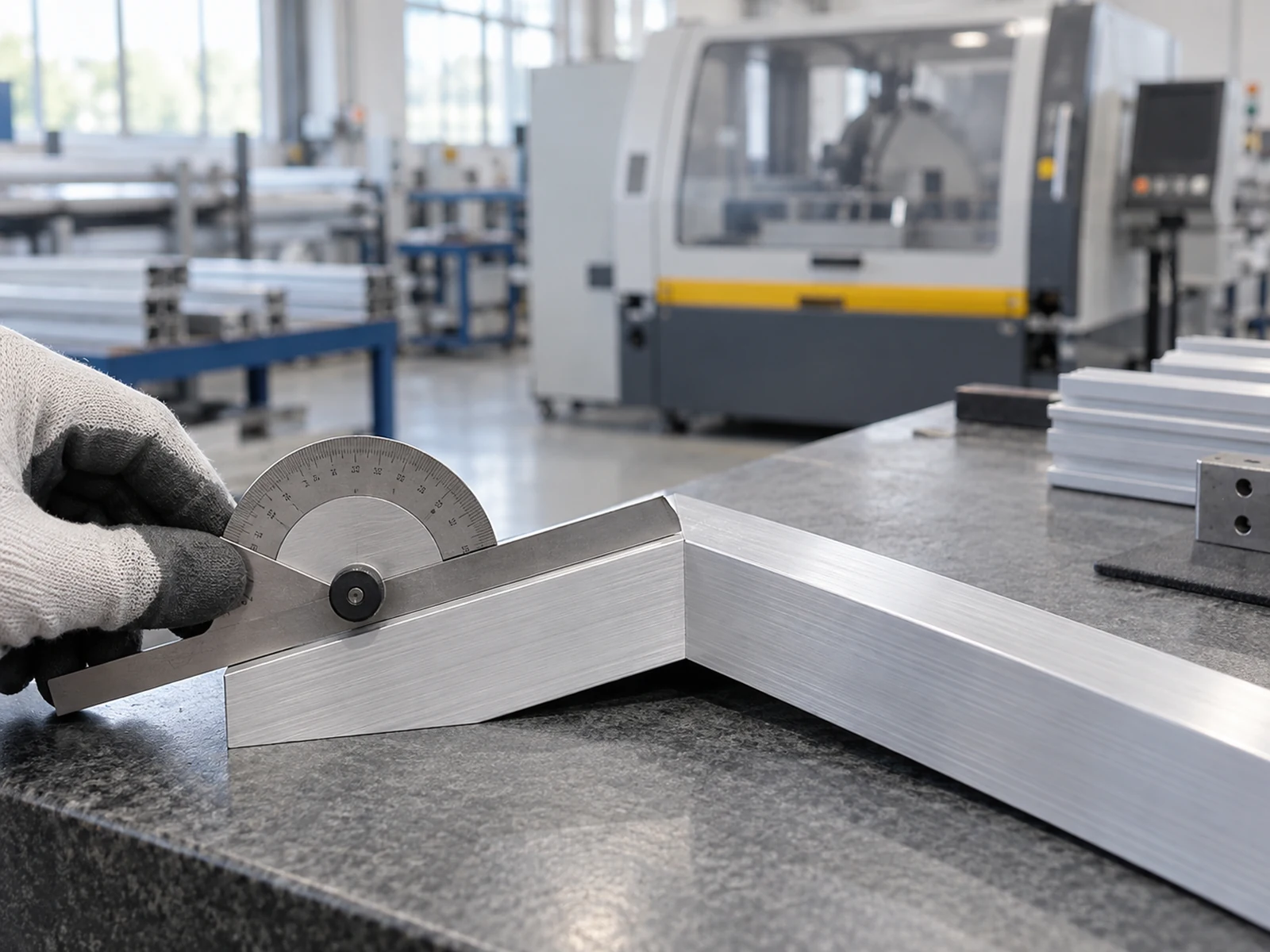
For each model, request a signed sample record with the part ID, machine configuration, fixture version, blade specification, operator, stock batch, settings or program revision, measurement readings, rejected pieces and any adjustments. A comparison is valid only when the quoted configuration is the configuration that made the accepted samples. If one candidate needs an unquoted custom fixture or an extra downstream operation, price and schedule that requirement explicitly.
4. Count changeover and operator work honestly
Create a short observed-work sheet. Time an ordinary profile and angle change from the last accepted old part to the first accepted new part, including loading, fixture checks, program or stop selection, test cuts, inspection and scrap disposition. Repeat the sequence for the order mix you actually expect. Do not substitute a no-load machine-cycle time for accepted output.
On the JR-550Q route, note the required operator attention at each load, index and unload step. On the JR-550CNC-CORNER route, note who selects and approves the program, confirms stock orientation, replenishes material and releases the first part after a change. Automatic feeding does not eliminate material preparation, inspection or supervision. If either route has a bottleneck after the saw, such as deburring, labelling or kit assembly, include it in the whole-cell plan.
Keep the safety and access review with the actual installation. Ask to see the agreed guarding, stop and restart procedure, blade-change access and jam-clearance method in the quoted layout. Only trained personnel should perform the supplier-approved operating and maintenance procedures; this buying comparison is not an operating instruction.
5. Put both offers on the same scope sheet
A low base price can hide the exact item that made the trial work. Compare the machine body, controller and programs, blade and spare blade, fixtures, infeed/outfeed support, guarding, extraction connection, commissioning, operator training, documentation, spare parts and service response as separate quoted lines. State whether a sample trial, witness visit, acceptance report and later on-site check are included. Record exclusions and the person responsible for each interface.
Use one decision sheet with five columns: requirement, JR-550Q evidence, JR-550CNC-CORNER evidence, unresolved gap and owner/date. Mark a hard requirement as pass only when the matching configuration and accepted-part evidence are available. A weighted price score must not conceal a failed profile fit, missing guarding interface or an unagreed acceptance method. If neither route passes, revise the scope or ask for another configuration rather than forcing a winner.
A practical RFQ and trial package
- Profile drawing and revision, alloy, finish, straight stock length and the orientation of every visible face.
- Cut list with both-end angle conventions, finished length datums, quantities, order mix and mirrored members.
- Largest and most difficult real sections, plus mating parts or a fixture for joint-fit review.
- Acceptance limits for length, angle, burr, surface condition, fit and sample-to-sample variation, each with an agreed inspection method.
- Proposed machine/fixture/blade/support configuration, operating responsibility and part-removal route for each candidate.
- Quote inclusions, exclusions, installation utilities, commissioning, training, documentation and support terms.
Send this same package to the supplier for both candidate routes. Keep the trial plan and the quotation version together so a later configuration change is visible. The JR-550CNC-CORNER product page provides its published shortlist specifications, while the JR-550Q versus JR-650Q envelope comparison addresses a different single-head capacity question. For recurring CNC angle changes, use the program-recall trial guide as an additional check, not as a substitute for the two-model test.
What the equipment video shows
Video: general equipment footage from Jiurun Machinery’s own channel. It illustrates a machine and profile-handling environment only. It does not establish the JR-550Q or JR-550CNC-CORNER configuration in this comparison, the material or customer in your RFQ, a sample-cut result, accepted-part quality or production performance.
Choose the route that passes your real job
Shortlist JR-550Q when an operator-loaded single-head process is compatible with the actual batch mix, support plan and acceptance rule. Shortlist JR-550CNC-CORNER when repeated programmed angles and automatic feeding are relevant to a proven part family and the complete material route is quoted. Either choice remains conditional on representative parts, joint-fit checks and a written scope. The JR-550Q vs JR-550CNC-CORNER decision ends with the accepted parts and complete quoted route. There is no universal winner by model name or catalog number.
If you want a specific recommendation, send JiurunCut your profile drawing, cut list and expected batch mix. Ask for a side-by-side configuration and sample plan showing exactly what each quoted route will deliver and how you will accept it.