
JR-550Q vs JR-650Q is more than a comparison of catalog openings. A buyer can make the wrong decision by treating the larger envelope as a promise that every profile will cut cleanly. The useful question is narrower: which machine can support the actual extrusion at the required angles, with workable clamp contact and a repeatable inspection plan? The two models belong to Jiurun’s operator-loaded single-head angle-saw family. This guide turns their catalog differences into a practical selection and quotation test.
Start with the profile envelope, not the model number
Jiurun’s catalog lists a maximum sawing height of 175 mm and width of 350 mm for JR-550Q, versus 225 mm and 400 mm for JR-650Q. It lists a 4 kW saw motor for JR-550Q and 5.5 kW for JR-650Q. These are catalog reference values, not a guarantee for a particular extrusion at every angle. The usable envelope depends on the blade path, section orientation, clamp position, fixture clearance and angle setting. Ask for a drawing-based check before treating a borderline dimension as approved capacity.
Make a profile schedule with the outside width and height of each extrusion in its proposed cutting orientation. Add wall thickness, internal webs, surface sensitivity and any projecting features that may prevent stable support. If a wide flange looks acceptable on paper but leaves little flat clamp area, the nominal width alone cannot settle the choice. Conversely, a part well inside the JR-550Q envelope may gain nothing from specifying the larger saw.
JR-550Q vs JR-650Q: compare the catalog envelope
| Decision item | JR-550Q catalog reference | JR-650Q catalog reference | What the buyer should confirm |
|---|---|---|---|
| Maximum sawing height | 175 mm | 225 mm | Actual profile orientation and angle clearance |
| Maximum sawing width | 350 mm | 400 mm | Blade travel, support and clamp contact |
| Saw motor | 4 kW | 5.5 kW | Material, blade and section-specific process proposal |
The comparison is a starting point for engineering review. Motor rating does not establish finished-part accuracy, cut quality or hourly output. Request the proposed blade, clamp and trial conditions for your own profiles. If the supplier offers a different configuration, ask for the exact model and revision to be written into the quotation.
Check the difficult angle, not just a square cut
A square-cut sample is useful for checking support and finish, but it does not exercise the same clearances as an angled cut. Put every required angle on the drawing, including the left/right orientation of mating parts. Identify which face must be the datum and which surface must remain unmarked. For a corner assembly, specify the assembled geometry and how the mating ends will be inspected. A cut angle that looks close on a loose piece can still leave a visible joint gap after assembly.
For each borderline profile, request a setup sketch or photograph showing orientation, blade approach, clamping points and where the offcut goes. Test the longest, widest or most awkward member rather than only the easiest section in the family. If different orientations are needed for different parts, include changeover steps in the time study. Confirm the actual angle range and stops against the current model quotation; a catalog range alone is not a substitute for the required-angle trial.
Prove that the profile can be held without damage
The saw must control the part while leaving the blade path and finished surface clear. Thin walls can flex under clamp pressure; irregular sections can rock on a narrow contact face. Ask the supplier to identify the support datum, clamp pad positions and any sacrificial or shaped contact pieces. Record the proposed pressure and sequence for the trial, then inspect both the cut face and the contacted surface. A larger cutting envelope will not fix poor workholding.
Bring representative production material, including the extrusion lot and finish condition that matter to acceptance. If anodized or coated parts are in scope, state which surfaces may be contacted and which require protection. Request photographs of the loaded setup and the resulting parts. Those records are stronger purchasing evidence than a general machine image, but they still need dimensional and assembly inspection by the buyer’s agreed method.
Include stock handling and the operator’s work
Both choices are operator-loaded single-head routes. Size the surrounding workflow as carefully as the saw opening: raw stock staging, infeed support, offcut control, finished-part bins and a safe path for the operator. A long extrusion may fit through the cutting zone while its unsupported end makes a consistent setup difficult. If short mixed batches dominate, calculate the time spent identifying parts, setting angles and changing stops. If long repeated runs dominate, examine feeding and downstream sorting separately rather than assuming motor size decides throughput.
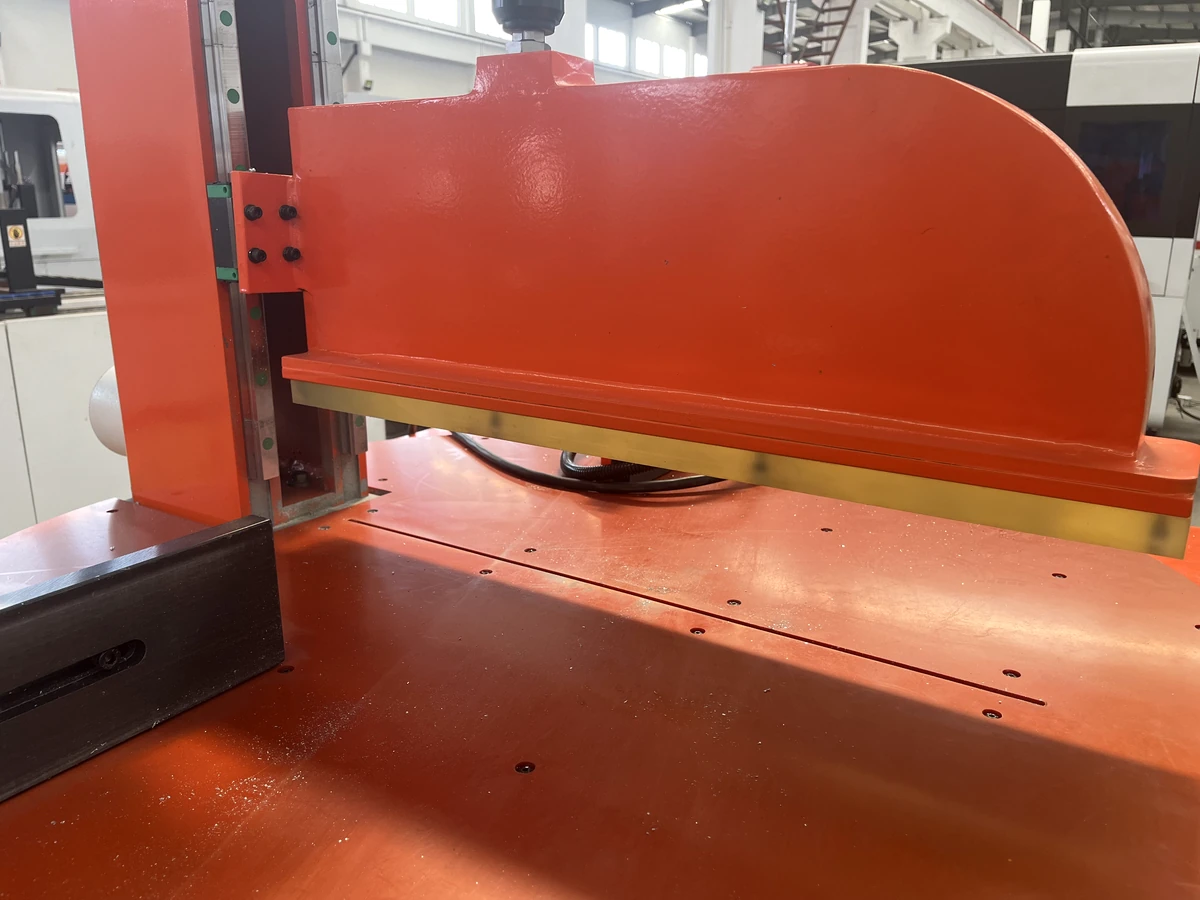
Ask for a layout showing support lengths, the operator side, service access and how the cut part exits. The photographed JR-550Q-family infeed and clamp areas below illustrate the kinds of access and contact points to discuss; they are not evidence that either catalog configuration has been approved for your profile.

Run a side-by-side acceptance matrix
Before placing an order, send one RFQ matrix instead of asking only for the cheapest qualifying model. Include a drawing number and revision for each profile, material grade, nominal dimensions, cut angle and orientation, finished length, edge and surface criteria, expected batch mix, and the assembly or downstream process. Mark the hardest profile in each family. Tell the supplier which conditions are pass/fail and which are negotiable after a trial.
- Fit: Can the proposed model, blade and fixture clear the profile at every required angle?
- Holding: Are support and clamp contacts stable without damaging a protected face?
- Part result: Do measured lengths, angles, burr condition and mating joints meet the agreed inspection method?
- Workflow: Can one operator load, remove and sort parts safely at the intended mix?
- Commercial scope: Are blade, fixture, support tables, installation, training and acceptance conditions named in the quote?
Agree how many samples will be cut, who supplies the stock, and which gauges or assembly checks will be used. Distinguish a feed or positioning specification from finished-part accuracy. A useful trial report records actual part measurements and any adjustments made between pieces. It should also say when the machine was run with a different blade, fixture or material from the eventual order.
When the smaller or larger model is the sensible shortlist
Shortlist JR-550Q when the complete profile family has comfortable clearance in the proposed orientations and the supplier can demonstrate stable clamping, the required angles and acceptable finished parts. The smaller model may be the simpler purchase if the extra catalog envelope has no role in the work. Do not infer lower total cost without the actual quotation, tooling and layout.
Shortlist JR-650Q when one or more real profiles need the additional height or width, or the extra room materially improves support or access at a required angle. Ask the supplier to show that benefit on the difficult profile rather than on a different section. If the part still conflicts with the fixture or blade path, a larger nominal opening is not enough; the process or machine type may need to change.
If neither single-head option meets the part or takt requirement, state the failure mode. It may call for a different fixture, two-end cutting process or automated feed route. Jiurun’s JR-550Q pre-quote trial checklist goes deeper on testing an operator-loaded angle saw. For a separate two-head layout problem, see the JR-550 dual-head installation checklist. These are different purchasing decisions; neither article substitutes for a sample trial.
What to send Jiurun before requesting a final price
Send the current drawings, a short list of representative profiles, the required angle and length schedule, photographs of any delicate faces, expected batches, target inspection method and installation space. Ask Jiurun to return the selected model/configuration, a profile-by-profile fit statement, blade and fixture proposal, scope of support equipment, and a written acceptance trial plan. Request any exclusions explicitly. That exchange lets both parties price the same job and exposes uncertainty before a machine is ordered.
The video below shows general Jiurun equipment footage from the company’s own channel. It is an illustration of machinery only: it does not depict a JR-550Q or JR-650Q trial for the profiles in this guide and does not prove a specified material, model configuration, customer result, cut quality or production rate.
Source: Jiurun Machinery on YouTube. Confirm the equipment and configuration in your own quotation and trial.
Request a profile review: Share your drawings and proposed cut list with JiurunCut through the contact page. Ask for an engineering fit check and a sample acceptance plan before choosing between the two catalog models.