
A mixed-angle order is a harder buying test than a single clean miter. A program can store a number, but the finished parts still depend on which face is against the fence, which end is cut, how the profile is supported, and whether the operator recalls the right setup after the next job. If you are considering the JR-550CNC-CORNER, ask for a witnessed changeover sequence built from your actual part drawings before accepting a quotation. The purchasing decision is whether the quoted arrangement can repeat your required family of cut ends under an agreed inspection method.
This guide focuses on program recall and changeover acceptance. It does not treat a machine photograph, a programmed angle, or a supplier video as proof that your profile has been cut to tolerance. For the broader comparison of what belongs in a multi-angle equipment quotation, see the multi-angle quote-scope guide. Use the checks below to turn that scope into a practical trial for one proposed machine release.
1. Identify the quoted JR-550CNC-CORNER release
Jiurun’s product brochure describes a JR-550CNC-CORNER automatic three-axis angle-cutting arrangement and lists a 30–140° angle range, a maximum section height of 270 mm, width of 170 mm, and a single-feed figure of 4500 mm in its table. Those entries belong to that catalogue description. They are not evidence that every current quotation includes the same head, fixture, feed, control, blade or guard arrangement. Ask the seller to identify the exact release, supplied options and drawing number. Have the supplier mark any difference from the catalogue version in the offer.
Do not convert a feed or positioning figure into finished-part accuracy. A completed miter adds profile contact, clamping, blade condition, angle setting, cutting forces and the buyer’s measurement datum. An axis-positioning test has a different scope from acceptance of the cut component; ISO 230-2:2014 addresses positioning accuracy and repeatability of numerically controlled axes. Write the required finished-part limits on your drawing and verify them on trial parts.
Ask for a plain-language cycle map: where raw stock rests, how each axis is commanded, how the angle is established, where the clamps contact, where the offcut goes, and which actions require an operator. If the proposed setup has a separate support, outfeed or loading table, identify it as included equipment or a buyer-supplied item. A quotation without this boundary is difficult to compare with another machine.
2. Turn the drawing set into a changeover matrix
Choose at least three representative part rows rather than three convenient machine settings. Record the profile identifier and drawing revision, alloy or temper where it matters to the job, section dimensions, visible or protected faces, raw stock length, finished length, end angle and the viewing direction for each end. Mark the datum used for the final length: long-point to long-point, short-point to short-point, or specified functional faces. The two ends of a mitered member can satisfy a programmed angle while producing the wrong assembly length if that datum is misunderstood.
Include one frequent production part, one limiting angle or section, and one short or awkward member. If a part needs its second end cut after a turn or reorientation, say so. Do not silently compare a one-end route with a two-end finished part. The matrix should tell the supplier exactly what will be cut, which row changes a tool or clamp, and what observation will count as acceptance.
For each row, state the lot quantity and the intended order of production. A useful trial is A–B–C–A: run Part A, change to B, then C, then recall A without rewriting the first program from memory. This return to A tests whether the team can reproduce an earlier setup after normal interruptions. If your factory makes kits, add a kit identity so an operator cannot pass by producing attractive but mismatched pieces.
3. Witness program storage, recall and restart
Before cutting, ask the supplier to create or open the agreed program for each part row while your engineer observes. Record the program identifier and revision against the drawing, including angle, length and any compensation or offset. Ask which fields are stored, which values remain manual, and whether a program can be selected under a misleading name. The answer matters more than a claim that the controller has a large program capacity.
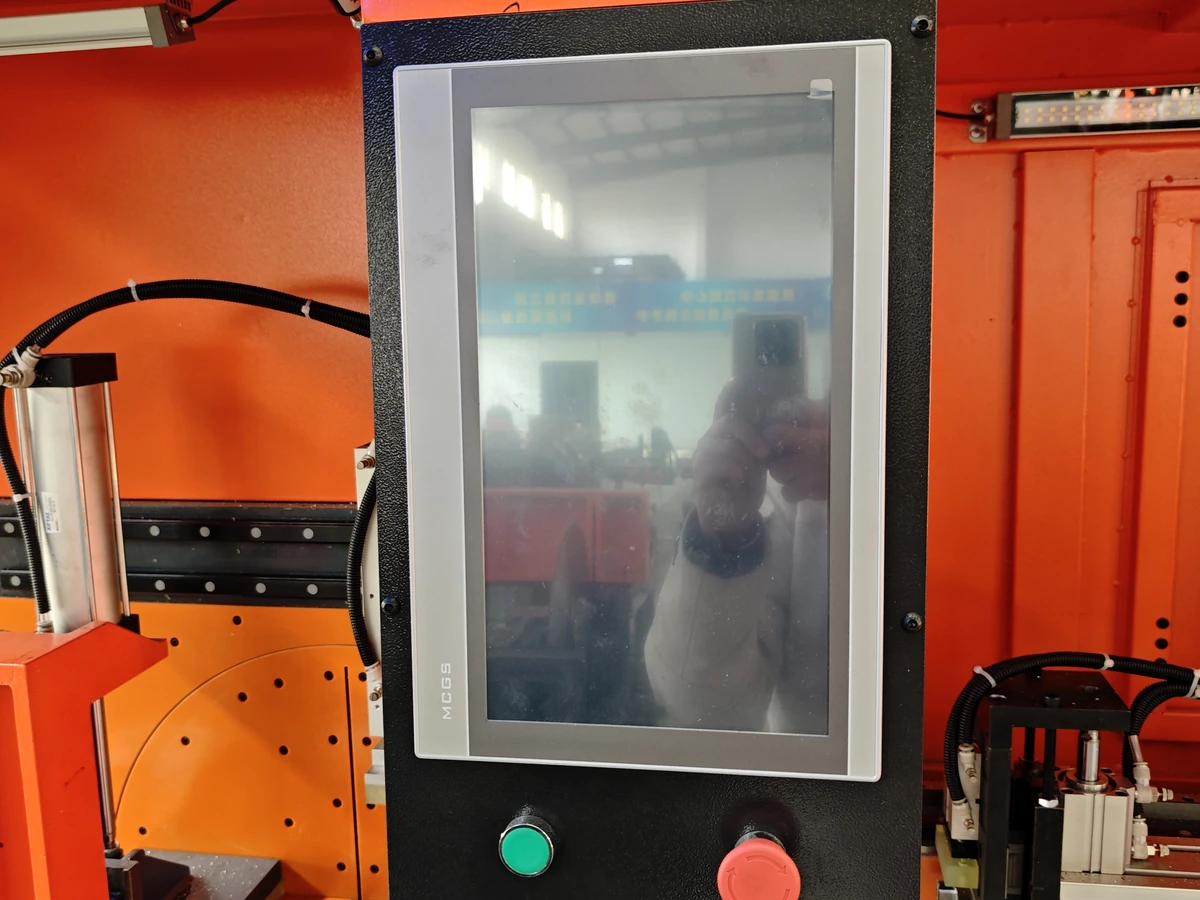
Observe the sequence rather than accepting a screen photograph: call A, confirm the active drawing, cut and label the part; switch to B and C; then recall A and cut again. Have the operator explain which checkpoints are automatic and which require a physical action. Record any fixture, blade, guard or stock orientation change that is needed between rows. If the seller’s actual controller has version control, permissions, program export or barcode selection, ask for a demonstration. Do not assume those functions are supplied because a different controller or catalogue mentions them.
Plan one safe interruption with the supplier. Stop the normal cycle at a defined point, then use the documented restart procedure. Check whether the active program, angle, part identity and sequence count remain clear. A restart should not allow a reversed profile or a repeat cut to pass unnoticed. Keep this step inside the supplier’s operating procedure and machine guarding; the buyer’s team should witness the result, not improvise a control test.
4. Verify profile contact at every angle
A profile can sit securely at one angle yet expose a thin wall or finished face to clamp pressure after a rotation. On the drawing, shade cosmetic faces, seals, cavities and features that must not carry contact loads. Ask the supplier to show actual clamp pads, fence faces and support points for each matrix row. Include the longest profile and the short member when deciding where support is required. If an accessory is needed for one row, place it in the quotation and the trial record.
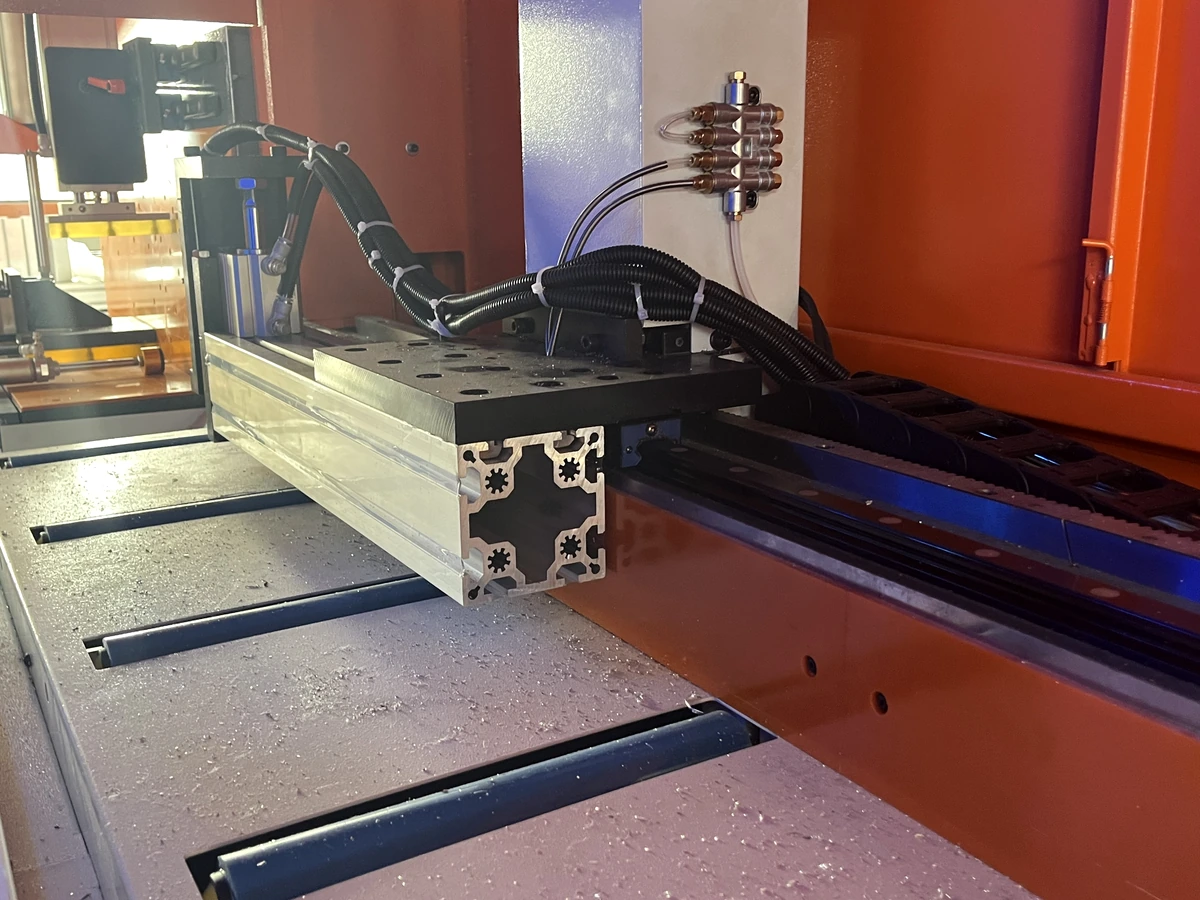
Ask who sets the support or fence after an angle change and how the operator confirms the position. Watch the first part after every changeover, not only the tenth part of a stable run. Record sliding, rotation, chatter, marked faces, trapped offcuts and manual rework as observations. If the supplier adjusts pads or a fixture during the demonstration, write down the change and repeat the affected row so that the acceptance record reflects the final quoted setup.
The catalogue’s stated angle and section range should be tested against the actual profile cross-section and required end geometry. A nominal angle inside the range is insufficient if a particular wall, miter direction or support arrangement cannot be handled safely. The JiurunCut new-energy-vehicle cutting solution likewise frames machine choice around the profile, datum, clamping and downstream operation. Use your drawing rather than the industry label to settle fit.
5. Inspect the returned Part A and the difficult row
Label every sample with its matrix row, program identifier, raw stock identity, sequence number and cut time. Measure the finished-length datum and both end angles with the agreed tools. Examine the cut faces, visible surfaces and assembly interface. If a miter will join another member, try a representative corner or fixture fit. A successful axis command or a smooth cut-face photograph is not a substitute for measured, identified parts.
Compare the first and returned A parts. The practical question is whether the recalled setup, after B and C, produces acceptable finished members without an undocumented compensation change. Record the actual numbers beside the drawing limits, including rejected pieces. Agree who measures and when. If two inspectors use different long-point or short-point references, resolve the measurement method before judging the machine.
For the difficult row, distinguish a machine limitation from a material or fixture issue. Ask for the observed reason whenever a piece fails: wrong profile orientation, insufficient support, visible-face damage, angle deviation, length deviation, or a handling problem. Record any corrective action and its effect on the other rows. A supplier can still propose a workable alternative, but the alternate route and additional equipment belong in the purchasing decision.
6. Define what any “no-tail” claim means on this job
The brochure uses a no-tail description for this model family. That label does not by itself tell you whether the final remnant is reusable, how much stock is lost to saw kerf or clamping, or what happens when the order mixes lengths. Ask the supplier to trace one raw bar through the planned sequence. Classify each output as accepted part, reusable remnant, setup piece or scrap under an agreed rule. If remnant handling affects the quote, request a written cutting plan and a witnessed last-bar demonstration.
Do not treat the channel video below as a scrap-yield or material-saving test. It is equipment context only. Compare actual quantities from your bar lengths, blade and part mix; state the assumptions in the request for quotation. A large saving claim without a recorded sequence and stock balance is not an acceptance result.
Related JiurunMachinery equipment video: this clip shows a general automatic angle-saw machine and parts of its handling area. It does not establish the JR-550CNC-CORNER configuration offered to this buyer, prove program recall, show the buyer’s profile or customer, document a witnessed changeover, or demonstrate finished-part accuracy or yield.
7. Make the changeover trial part of the offer
Attach the drawing revisions and A–B–C–A matrix to the inquiry. Require the quotation to identify the exact machine release, controller and program functions, angle and section limits for that release, blade, clamps, guards, support tables, part discharge, utilities and optional fixtures. Separate equipment included in the price from buyer-supplied stock, extraction, inspection gauges and handling space. Ask for a drawing or schedule that maps each priced item to the trial route.
Set the acceptance method before a purchase order: the rows to be run, sample quantity, measurement datum and gauges, responsible witnesses, recording format, allowed adjustments and the route for retesting a failed row. A useful offer states what the machine can do on the actual part family and which operations must be handled elsewhere. It does not rely on an isolated video, a brochure range or an unmeasured demonstration.
Questions to send with the JR-550CNC-CORNER inquiry
- Which machine release, controller version and options are included in this quotation?
- Which angle, length and offset values are stored in each program, and which require an operator action?
- Can the supplier run and label the A–B–C–A changeover matrix on our drawing revisions?
- What clamp, fence and support contacts are proposed for each profile and protected face?
- How will the returned Part A and difficult row be measured and recorded against finished-part limits?
- What happens to the last bar, setup pieces and reusable remnants under our planned mix?
Send JiurunCut the profile sections, end-cut drawings, protected-surface notes and intended production mix through the engineering contact page. Request a version-specific quote and a witnessed changeover plan. The response should make the priced equipment, test method and remaining assumptions explicit before a buying decision.