
An aluminum handrail saw trial should answer a narrow purchasing question: can the quoted saw, support and clamping arrangement make the approved rail and post blanks that your own connector system can assemble? A clean-looking loose cut is insufficient. The buyer needs a released member schedule, controlled reference faces, a representative sample kit and a fit check using the actual connector and end cap. The trial does not certify the finished handrail, its anchorage or compliance with a building or accessibility code.
This guide is for a factory that cuts straight aluminum extrusion members before separate drilling, finishing or assembly. If you buy complete prefabricated railing panels, specify the supply boundary first: a saw trial for loose profiles may not represent panel trimming or on-site installation. If the product uses curved members, mixed materials or a proprietary joining process, place those families in a separate test plan. For the broader equipment-purchase scope, see our aluminum handrail cutting buyer guide.

Aluminum handrail saw trial: freeze the rail kit before comparing saws
Start with the approved drawing revision and bill of materials for one real handrail family. List each top rail, lower rail, post, return and cover that the factory actually intends to cut. Give every member an ID, cross-section, stock condition, cut length datum, end form, visible face and finish state. Identify left- and right-handed pieces where a connector or corner changes the end orientation. Record which ends are supplied pre-machined and which operations happen after sawing. Otherwise, two suppliers can appear to quote the same rail while one is evaluating only plain straight blanks.
Keep the mating hardware with the sample kit. Feeney’s own DesignRail installation instructions distinguish top-rail cuts, end caps, butt splices and corner joints. C.R. Laurence’s aluminum railing instructions likewise connect rail lengths to posts, top caps and connector blocks. These are examples of why the approved product system controls the trial; their dimensions and hardware details must not be copied into a different customer’s drawing.
Choose representative members, not an easy substitute
A useful trial matrix includes the longest and shortest released straight members, the smallest and largest relevant cross-sections, a visible finished face if it is processed in that state, and any left/right or mitered ends in the quoted scope. Add a difficult but approved hollow section that may deform under clamp contact. If a post and rail are different extrusions, bring both. Mark the stock with its batch or sample ID so the inspection record can be traced back to the material actually cut. Do not treat an unrelated round tube or generic T-slot profile as proof for a shaped handrail.
Ask the supplier to state the proposed machine configuration, blade, support points, clamp-pad contact and infeed/outfeed method for this matrix. The trial needs the same practical support arrangement that the quotation includes. A special fixture used only for the demonstration should be identified and priced if the buyer needs it in production. The saw may have a documented feed-position repeatability figure, but that figure does not by itself establish finished cut-part accuracy; inspect the parts against the released drawing.

Inspect the cut at the datum and the mating end
Before cutting, agree which face and end establish each measurement. A top rail can have a cover-facing surface, a post-facing surface and a connector pocket; choosing an arbitrary edge after the trial can hide a wrong setup. For each sample, record the member ID, setup, intended length and angle from the approved drawing, the actual measured result using a suitable inspection method, and whether the end orientation is correct. If the drawing specifies a tolerance, use that tolerance. Do not invent one from a marketing claim or from another rail system.
Review the complete cut perimeter. Look for burrs that interfere with a connector or cap, tearing on a thin wall, collapse from clamp pressure, chips trapped in a cavity, and marks on a visible finish. State whether deburring is part of the saw delivery, a downstream operation or a buyer task. Check both ends of short pieces, since a single acceptable first cut does not show that the second-end datum is controlled. Keep inspection photos tied to the sample ID and drawing revision, without presenting photographs alone as dimensional evidence.
Use a dry assembly to expose connector problems
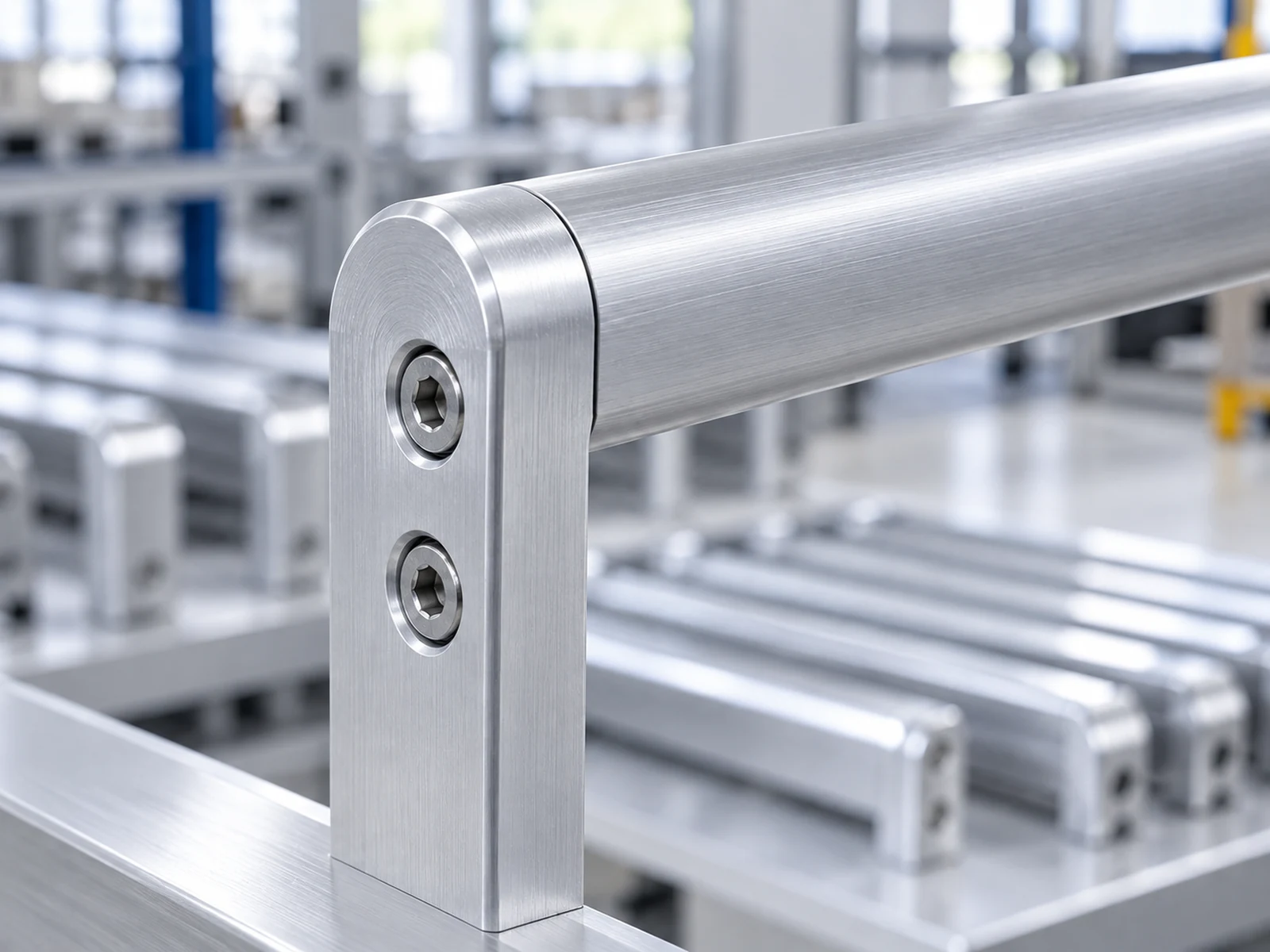
Bring a released post, rail, connector and cap for a bench-level dry assembly. Check whether the rail slides or seats as the approved design expects, whether the end face contacts the intended stop, and whether the cap or cover clears the cut end. Check the visible joint and any handed orientation. A supplier can produce a square-looking blank that fails this fit because the wrong surface was used as the cut datum, the profile rotated in the clamp or the length excluded the connector’s engagement. Record the fit outcome separately from the dimensional readings.
Trex’s Select aluminum railing installation guide shows that panel cuts are set relative to actual posts and brackets. It is a product-specific illustration of the interface problem, not a universal cut allowance. In the Jiurun saw evaluation, the buyer’s own released rail, post and hardware define the check. Final anchor selection, load capacity, code approval and site installation remain separate engineering and compliance decisions.
Test repeat setup and changeover, then decide
One pass on one rail is only a setup demonstration. After the first approved sample, repeat a small run using the same released stock and record individual results. Then change to another profile or length in the planned family, document the adjustments, and return to the first member. The buyer can see whether reference faces, pad positions and program identification are recoverable without an expert improvising each cycle. Do not quote a cycle-time or scrap-rate guarantee from this exercise unless those metrics are defined, measured under a representative configuration and agreed in the purchase contract.
Use three distinct decisions. Accept the saw-stage method only if the drawing-based dimensions, end condition, finish protection, repeat setup and dry fit meet the buyer’s signed criteria. Revise and retest if a fixture, blade, support or process step changes; a changed setup is a new trial condition. Reject or narrow the scope when the proposed machine cannot handle the released profile or the supplier’s demonstration omits a required member. A completed handrail assembly may require many checks beyond sawing, so a passed saw trial is not a finished-product approval.
What to send in the RFQ and acceptance record
Send a concise but complete pack: approved profile sections and drawing revisions; annual and peak member mix; stock lengths and finish state; cut list with datums, angles and handed ends; planned upstream and downstream operations; connector, cap and post samples; available floor and handling constraints; and the inspection method and sign-off owner. Ask the supplier to return the proposed model and actual included configuration, fixture and blade assumptions, what is outside the saw-stage scope, a sample matrix, changeover procedure, and a record template. The purchase decision should compare the quoted route with buying pre-cut member kits as well as with retaining in-house cutting, including handling, inspection and rework responsibilities.
For more context on equipment and production planning, review the broader handrail cutting guide. If your released drawings show a very different post, connector or curved member, ask for a separate evaluation instead of assuming this straight-rail trial covers it.
General Jiurun equipment footage
The following watched video from the Jiurun Machinery YouTube channel shows general aluminum-saw equipment and material support. It is only a process illustration. It does not document the handrail profile, the model or configuration proposed for your RFQ, a customer, a handrail trial, a measured cut result or performance.
Play general Jiurun aluminum-saw equipment video
Video note: the moving machine footage is a general equipment example. Request a separate trial on your released rail and post kit before drawing a conclusion about fit, cut condition or production capability.
Ask for a trial on your released handrail kit
Share your approved rail and post sections, connector/end-cap details, cut list, material and finish state, and expected member mix through the JiurunCut contact page. Ask which saw, support and fixture configuration could be evaluated, which samples to bring, and which acceptance measurements the supplier can demonstrate. Treat the resulting proposal and sample record as inputs to your own engineering and purchasing sign-off.