
Aluminum saw trial failed is an incomplete buying conclusion. A rejected sample may reveal a cutting problem, a measurement disagreement, an unrepresentative setup, or a requirement that was never agreed in measurable terms. Before you approve a different machine or repeat the entire demonstration, identify the exact failed criterion and the evidence that would change the decision. This guide gives buyers a controlled retest path, from the first disputed part to a documented accept, hold, or reject decision.
1. Name the failed requirement precisely
Write the failure as a testable statement: the drawing or purchase requirement, the inspected feature, the agreed measuring method, the result, and the allowed range. “The cut was poor” cannot direct a retest. “The measured cut length on identified sample A exceeded the agreed upper limit using the specified gauge and datum” can. Record whether the issue concerns length, squareness, burr, cut-end appearance, deformation, throughput, handling, or another requirement. Keep each criterion separate; a clean cut end does not establish length acceptance, and a length result does not prove the cut end is suitable for the next operation.
Ask whether the requirement itself was agreed before the run. If a pass/fail rule, part orientation, measuring location, or acceptance sample was left open, label the outcome undetermined until the parties agree on a method. Do not retroactively invent a tolerance or call an unknown result a pass.
2. Freeze the sample, setup and raw record
Before anyone adjusts the saw, preserve the trial conditions. Identify the machine and its actual trial configuration; blade and clamping arrangement; material grade, profile drawing and batch; stock length and condition; program or cut list; operator; cut sequence; and each sample ID. Keep the unedited readings and photographs with the samples. Record which dimensions were measured, where the datum was placed, and what instrument was used. If the trial was remote, establish who had custody of the stock and who measured the returned parts.
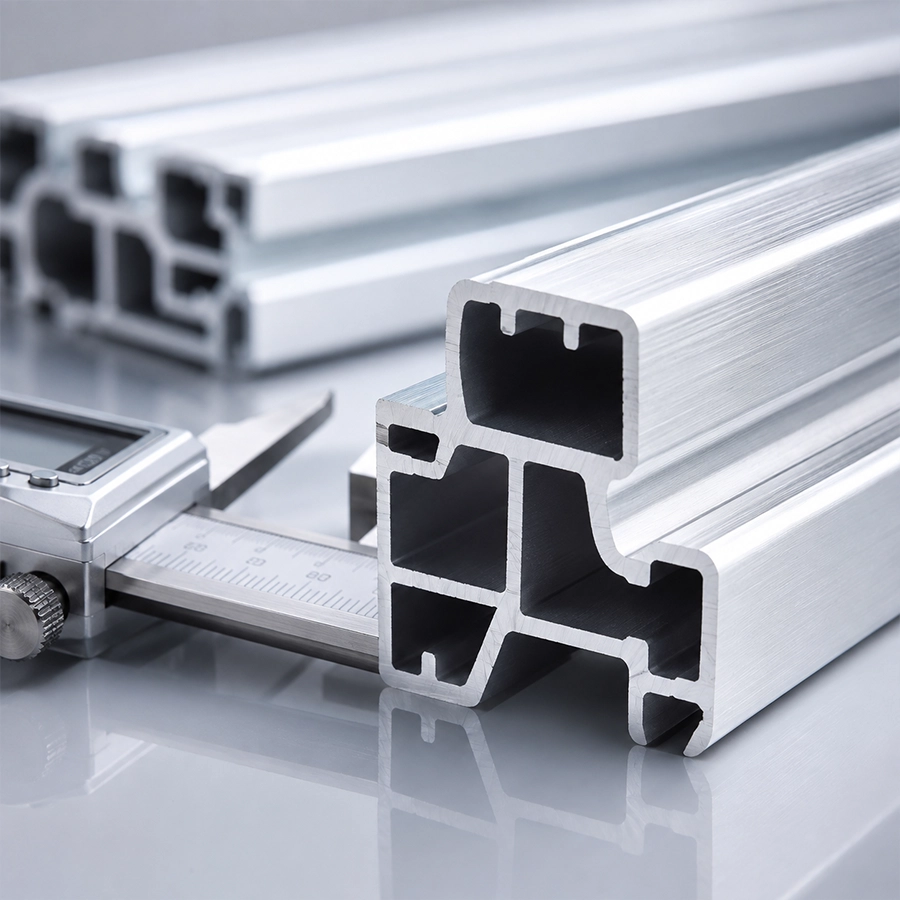
This is a comparison baseline, not a claim that any particular Jiurun configuration will meet your specification. The photographs on this page illustrate inspection context; they are not evidence of a failed customer trial, a particular material grade, or a retest result.

3. Check the decision rule before blaming the cut
A disputed borderline reading can come from the part, the instrument, the method, or the decision rule. Repeat the measurement on the same identified part with the agreed datum, temperature and instrument condition where relevant. Have the parties record the actual values rather than replacing them with “good” or “bad.” If the buyer and supplier use different gauges or measure different points, compare methods before making another cut.
For a tight tolerance, decide in advance how measurement uncertainty affects conformity. The NIST glossary definition of a decision rule connects a conformity statement to measurement uncertainty. It does not supply a universal allowance for aluminum saw parts. The buyer and supplier must agree on the applicable rule, and a saw’s stated feeding accuracy must never be substituted for verified finished-part accuracy.
For cut-end appearance, take a consistent photograph with sample ID, orientation and lighting. If the downstream process requires deburring, welding, sealing or visible finish, define what that process actually needs instead of treating a photograph alone as a functional test.
4. Separate a correctable setup issue from an unsuitable process
Use the failed criterion to make a short cause list. For inconsistent length, review the stock reference, feeding and outfeed support, clamping sequence, program, and measuring method. For a damaged or distorted profile, review stock condition, support and clamp contact. For burr or finish concerns, review blade specification and condition, lubrication and removal expectations. These are investigation prompts, not a promise that a setting change will fix the result. Only trained personnel should alter a machine or cutting process under the supplier’s instructions and site safety procedures.
The ASQ problem-solving guidance recommends defining the problem, analyzing possible causes, selecting a solution and verifying the result. Apply that discipline to the buying decision: note the proposed change, its reason and what observation would disprove it. Do not silently change blade, fixture, stock and measurement method at once; you would lose the ability to attribute any improvement.
5. Make the retest narrow and comparable
Agree on a retest sheet before cutting another sample. It should state the acceptance criterion, sample and stock identity, baseline result, single planned change or clearly bounded change set, machine configuration, measurement method, number and sequence of parts, who witnesses or records the run, and the result that would count as success. Choose a sample count and run duration based on the real production decision; this page does not prescribe a universal number. Include the shortest and longest relevant cuts, critical profile orientation, and any transition condition if those were implicated by the failure.
Repeat the baseline measurement where possible. Preserve individual readings, not only an average. A retest that changes the product drawing, material batch or target cycle can answer a new question, but it does not close the original failure unless the buyer formally changes the requirement. If a process adjustment solves one criterion but creates another defect or slows the required output, record both effects.
For a remote demonstration, also use the chain-of-custody checks in our remote aluminum saw trial guide. Those checks help keep stock, parts, video and measurement records attributable to the same run.
6. Decide accept, hold or reject from the retest evidence
Accept when the agreed criteria are met on the specified configuration and the parties have retained enough readings, part identity and process context to support the conclusion. Hold when a criterion is still ambiguous, the measurement systems disagree, the proposed correction was not tested, or a condition critical to production was omitted. Assign an owner and a deadline to each open point. Reject or change the procurement scope when a critical requirement still fails under an agreed, representative method, or meeting it would require a configuration, operating cost or workflow outside the acceptable purchase case.
Keep the commercial decision aligned with the technical one. A quoted blade, fixture, support device, automation step or inspection method may differ from the trial setup. Ask for a revised configuration list and price before treating a corrected result as the performance of the original quotation. Distinguish a supplier’s proposed improvement from a verified retest result, and put any acceptance condition in the order documents.
A one-page retest request to send the supplier
- Failed criterion: drawing reference, limit, datum and original raw result.
- Evidence: sample IDs, stock lot, photographs, instrument and measurement record.
- Trial configuration: machine, blade, fixture, support and program actually used.
- Proposed change: what changes, why, and what stays fixed for comparison.
- Retest plan: representative stock, cut sequence, sample quantity, witnesses and decision rule.
- Decision: pass, conditional hold or reject; open actions, owner, cost and due date.
Video below shows general Jiurun aluminum cutting equipment footage from the Jiurun Machinery YouTube channel. It is an equipment illustration only. It does not document the material, model configuration, customer, failed trial, retest or performance discussed in this guide.
If you are comparing an aluminum cutting machine after an unsatisfactory trial, send JiurunCut your drawing, stock description, failed criterion and available raw measurements. We can review what a meaningful demonstration request should specify; any machine capability must be confirmed against the proposed configuration and an agreed acceptance test.