
Buying a saw for aluminum pull handle blanks begins with a deceptively simple question: what exactly will the saw deliver? A straight length of extruded bar, a pre-cut tube for a later bending operation, and a finished U-shaped handle have different suppliers, dimensions and inspection points. If the request for quotation calls all three a “handle,” the cutting machine may be blamed for fit problems created in forming, finishing or assembly. This guide separates those routes and turns the drawing into a practical cutting RFQ.
First identify the product state at the saw
An aluminum pull handle may be an extruded straight grip with separate mounting posts. Another design begins as straight stock and is bent or otherwise formed into a U-shaped body. A purchased finished handle may already include mounting features and surface finish. The saw’s task is to cut the incoming stock to a specified blank length; it does not by itself bend the body, drill the mounting pattern, anodize the surface or establish final installed dimensions. State which operations happen before and after cutting.
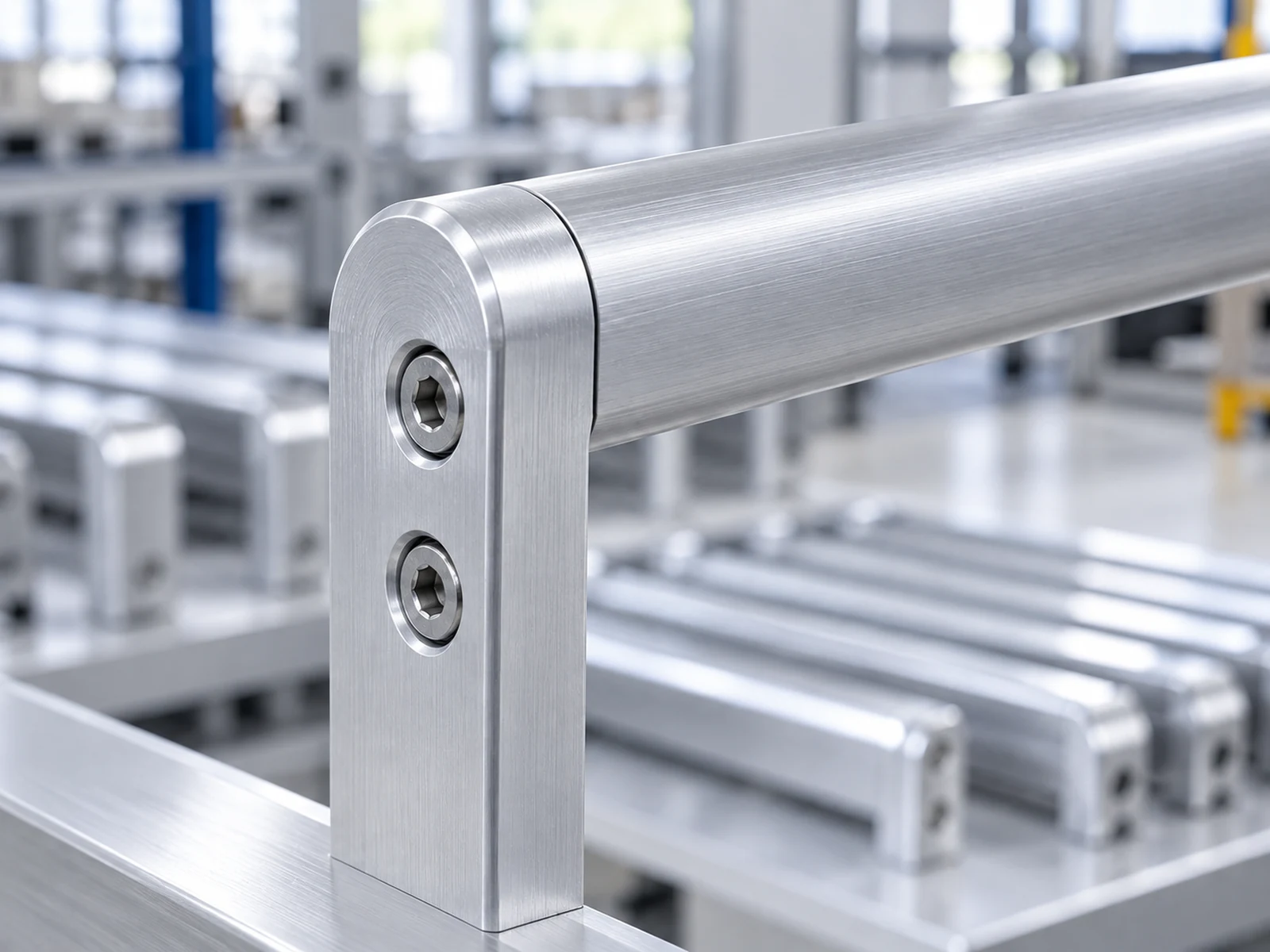
For example, a bent cabinet U-handle described by Ganter is a formed profile product. 80/20’s extruded handle illustrates a different supply route using an extruded handle component and mounting hardware. These are product examples, not evidence that either maker uses a Jiurun saw or that a pictured handle is a customer’s part.
Three sourcing routes that should not be mixed
| Route | What the saw receives | What the saw delivers | Next operation to define |
|---|---|---|---|
| Straight extrusion plus posts | Extruded grip bar or tube | Straight cut lengths | End preparation, fastening and assembly |
| Formed U-handle body | Usually straight profile stock before forming | Blanks to a forming allowance | Bending, hole making and finishing |
| Finished purchased handle | A completed component | Often no saw operation at all | Incoming inspection and installation |
The third route matters in make-or-buy decisions. If the factory only installs completed handles, an aluminum cutting saw may be irrelevant to this part. If the factory makes the grip in-house, identify the exact intermediate that passes through the saw and the party responsible for each downstream feature.

Choose dimensions that belong to the blank
Put the cut length on the blank drawing, together with its tolerance, units, reference datums and required end condition. Do not substitute a finished handle’s overall installed width, mounting-center distance or outside projection for the straight stock length. On a bent design, the relationship between blank length and final geometry depends on the actual profile, bend radius, tooling and process. Ask the forming supplier to establish that allowance and validate it with a production sample before fixing the saw program.
For a straight bar and separate-post design, confirm whether the grip’s nominal length is measured between end faces, between visible shoulders, or over installed hardware. The post center spacing may be controlled by drilling or assembly rather than the saw. Where end caps or fasteners hide a cut edge, that does not excuse an unspecified burr: state whether the end must be deburred, faced, cleaned or protected before assembly.
Define the incoming extrusion, not just “aluminum”
Send a section drawing or a representative stock sample. The saw supplier needs the outer envelope, wall thickness or solid section, cross-sectional asymmetry, available stock length, alloy and temper as specified by the component designer, and whether the surface is bare, painted or anodized at cutting. Thin walls and decorative faces may call for different support and handling from a solid bar. A hollow profile may also require a support approach that avoids distortion under clamping.
State which face must remain cosmetic and whether protective film may stay on during cutting. Include allowable scratches, dents and edge chips as inspection criteria rather than asking for a vague “perfect finish.” If the section has internal ribs or a nonuniform grip shape, show where the fixture may contact it. A photograph alone cannot replace the dimensioned section and material designation.
Separate cutting capability from downstream fit
Use a small first-article batch to check the cut operation itself: blank length across the required range, end squareness if relevant, burr condition, cosmetic damage and repeatability after changeovers. Then inspect the finished handle after bending, hole making, coating and assembly. A mounting mismatch in the final assembly can originate in any of those operations. The RFQ should make each acceptance point visible, with a named owner.
When a mounting post or bracket is supplied separately, request its interface drawing and fastener details. Confirm which dimensions are inspected on the loose bar and which are inspected on the assembled handle. Ganter’s handle fastening sets illustrate why hardware can be a separate decision; they do not establish a universal mounting arrangement for your part.
What to ask a saw supplier to demonstrate
A practical machine trial uses your own representative stock and the proposed process conditions. Ask the supplier to identify the blade and fixture arrangement, feed method, target blank lengths, offcut handling and inspection method. Request measured first-article results for length and the end condition you actually need. Do not infer finished-part accuracy from a feed-positioning specification; downstream bending, drilling, finishing and assembly have their own variation.
If there are several handle sections, include the smallest and largest relevant cross-sections and both short and long blanks. This exposes fixture changeover, support and scrap issues that a single easy sample may hide. State the required throughput only after the operation sequence is clear: loading, clamping, cutting, unloading and any secondary finishing may all affect the cell cycle. Ask which steps are included in a quoted cycle time.
The video below is general Jiurun machinery footage. It shows an aluminum profile cutting saw as an equipment/process example only. It does not show the handle stock, model configuration, customer, trial conditions or performance discussed in this article.
RFQ checklist for aluminum pull handle blanks
- Identify the route: straight grip, blank for forming, or purchased finished handle.
- Supply the actual section drawing, alloy/temper designation and surface condition of the incoming stock.
- Dimension the cut blank independently from finished mounting centers and installed size.
- Assign forming allowance, drilling, finishing and assembly to named processes and suppliers.
- Specify burr, squareness, cosmetic-face and packaging requirements for the cut blank.
- Provide the range of profiles and lengths, order quantities and expected changeover mix.
- Agree on a representative trial and measured acceptance criteria before approving a machine.
For another assembly where cut aluminum members and connector fit interact, see our aluminum handrail cutting guide. The geometry differs, but the discipline of separating blank dimensions from installed dimensions is similar.
For aluminum pull handle blanks, send JiurunCut the section drawing, blank-length range, end and surface criteria, and the downstream operation map when requesting a saw review. We can discuss a representative cutting evaluation for your specified stock and clarify which result the saw can be expected to deliver. Contact our team with the actual part information rather than relying on an illustrative image or generic video.