
Before asking for a saw quotation, identify the aluminum bronze stock that will actually enter the machine. C95400 and C95500 are distinct cast copper-alloy designations. A request that says only “aluminum bronze” leaves both the material decision and the physical cutting task open. A supplier can discuss a possible machine family at that stage, but a useful equipment response must state what was assessed and which facts remain unconfirmed.
This guide is for a purchaser preparing a nonferrous circular-saw inquiry, not for selecting an alloy for a finished component. Keep the design authority’s required material, the stockholder’s offered material, and the saw supplier’s equipment assessment as three separate decisions. Connect them with the same drawing revision, delivery or sample identity, and intended cut. That connection lets you compare quotations without mistaking a catalog designation for a verified production trial.
What C95400 and C95500 tell you
The Copper Development Association’s cast-alloy UNS table groups C95000–C95999 as copper-aluminum-iron and copper-aluminum-iron-nickel alloys. Its entries distinguish C95400 from C95500 particularly by the listed nickel range. The table describes designation chemistry; it does not identify a delivered lot or establish cutting performance on a particular saw.
C95400: The CDA table lists nickel at a maximum of 1.5%, aluminum at 10.0–11.5%, and iron at 3.0–5.0%. Ask the material provider to identify the actual offered stock and its supporting record.
C95500: The CDA table lists nickel at 3.0–5.5%, aluminum at 10.0–11.5%, and iron at 3.0–5.0%. Do not approve substitution merely because the aluminum and iron ranges look alike.
The CDA table notes that its nickel figure includes cobalt. These are reference ranges, not a measurement of your delivery. Copy the designation required by the controlling part specification exactly; if an offered material differs, ask the responsible engineering or material authority whether the alternative is permitted. Jiurun cannot approve a material substitution on the basis of a saw inquiry.
Separate the material decision from the saw decision
Two questions often arrive in one email: “Is this the correct alloy for our part?” and “Can this stock be cut for our order?” They need different owners. The part designer or material authority decides which designation, condition and deviations are acceptable. The stock supplier identifies what will actually be delivered and supplies the applicable material record. The equipment supplier can then review the defined cutting task against a proposed configuration. An affirmative equipment discussion is not a material approval; a correct alloy name is not proof that an unspecified bar, tube or casting will fit a machine.
Where the required and offered designations disagree, keep both entries visible in the RFQ. Record who must resolve the difference and what decisions remain provisional. Do not silently relabel a sample, edit a drawing to match an offer, or treat a percentage copied from a reference table as a lot certificate. A preliminary machine discussion can still proceed if the open material question is clearly marked.
Build one consistent material-to-task record
Create one inquiry record for each stock and output combination that needs assessment. Start with the controlling part drawing or specification and revision. Add the stockholder’s offer, the supplied form and condition, and the lot, delivery or sample identifier available. Then define the physical item presented for review, the cut lengths and quantities, and the acceptance features of the output. If a drawing covers several parts or revisions, identify which ones the proposed saw must serve rather than attaching a mixed folder without a scope note.
The diagram below is an original purchasing illustration. It shows how a required designation, an offered delivery and an assessed object should be linked; it is not a photograph of a Jiurun machine or proof of a cutting result.
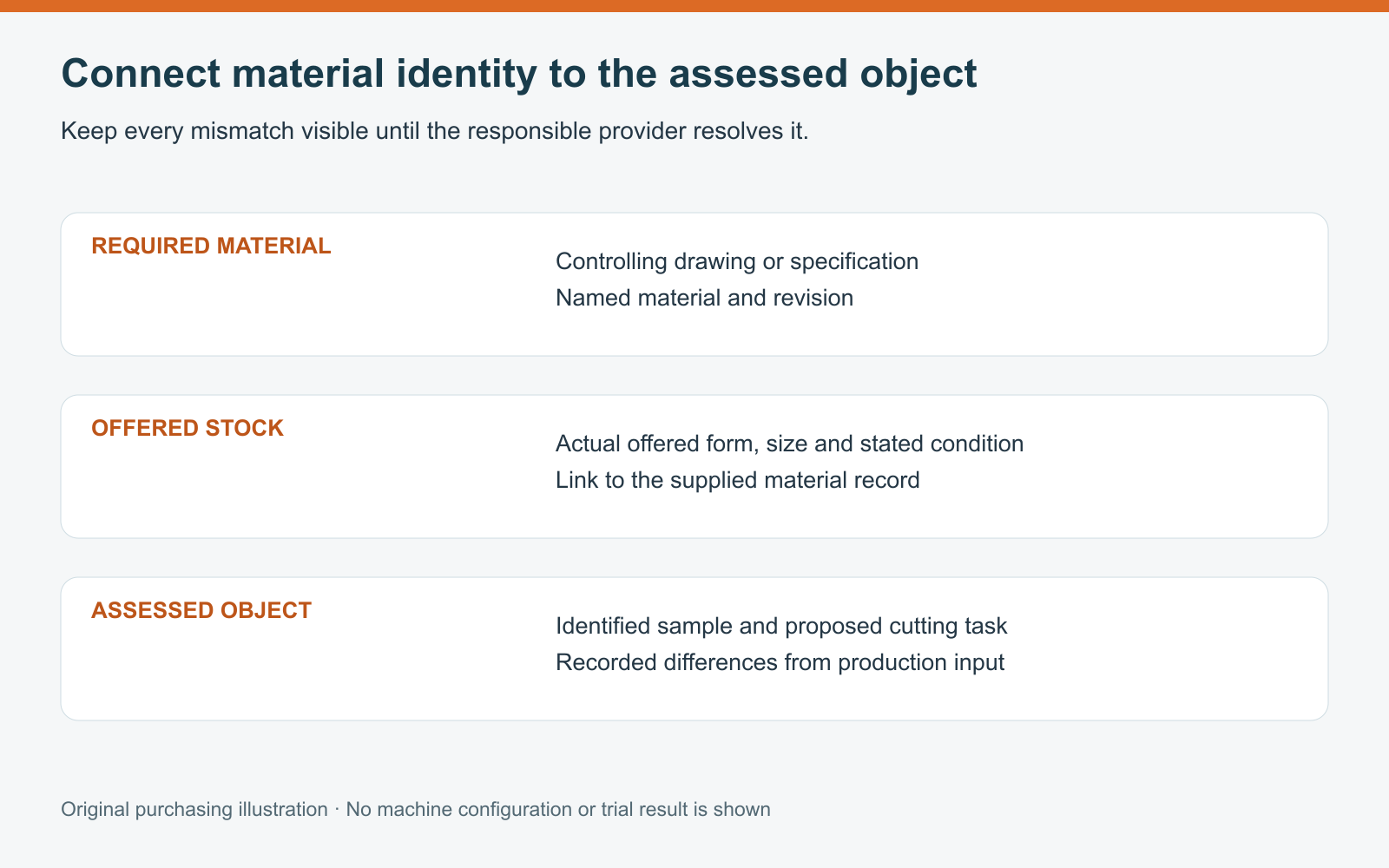
When a certificate or supplier document is available, ask the material provider which identified delivery it covers. If only a label or purchase order exists, send that as limited evidence and say what it cannot establish. A photo can clarify cross-section and surface condition, but it cannot independently identify C95400 or C95500. A small, accurately labeled evidence set is more useful than a large collection of unlinked files.
Define what physically reaches the saw
Before comparing machines, describe the input as an object, not just an alloy name. State whether the actual supply is a solid bar, hollow tube, near-net casting or another specified form. Give the section drawing or measured outer size and, where relevant, wall or bore information. State the incoming length, available straight portion, surface condition, variability between lots, and whether a sample represents the production input. Identify the datum for finished length and the features to be judged after sawing.
General Jiurun JR-455Q equipment footage illustrates a circular-saw handling process. It does not show C95400 or C95500 stock, a bronze cutting trial, or a configuration approved for this inquiry.
Also distinguish a rough blank from a finished component. If a later process creates the final bore, face or tolerance, mark that boundary. Do not ask a saw supplier to guarantee a feature that will be created elsewhere. Conversely, if the cut end itself is an acceptance surface, supply the relevant drawing and inspection method. Required output per shift or order can help evaluate a configuration, but it should be tied to the actual mix of cut lengths, handling and inspection, not to an isolated brochure cycle figure.
Jiurun manufactures industrial circular-saw equipment for aluminum and nonferrous cutting applications. This general product scope is a reason to discuss a defined job, not a promise that either bronze grade or every casting form has already been proven on a particular model. Fixture, blade, feed and finished-part performance require an application-specific review; this article gives no operating settings.
Two hypothetical disagreements worth catching early
Different material: A drawing specifies C95400, while an offer is labeled only “aluminum bronze” or names C95500. Even if both appear in the same alloy family, the purchaser should not treat them as interchangeable. Ask the material provider for the exact offer and ask the design authority to accept or reject it before the machine quotation presents the material as settled.
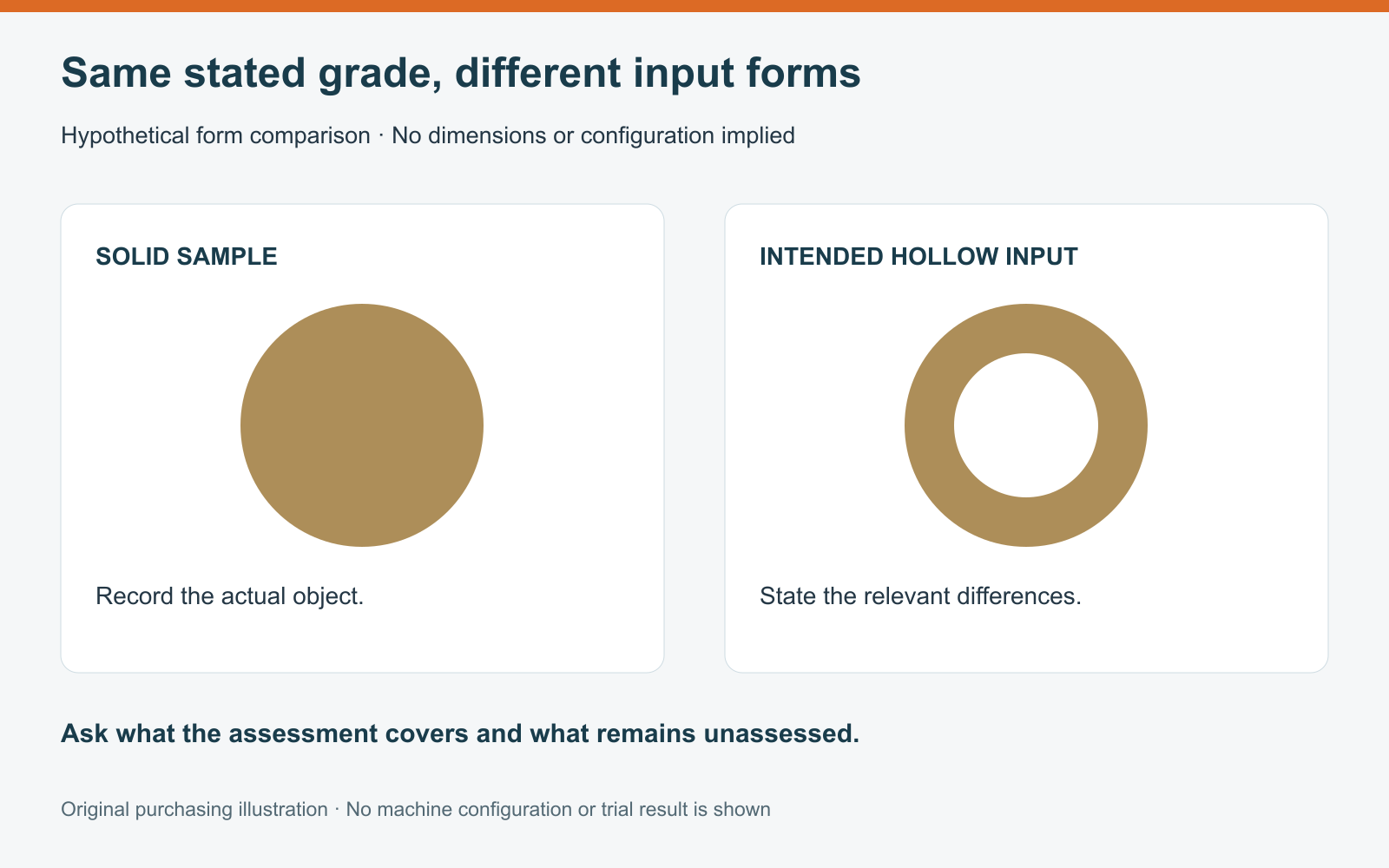
Different object: A small solid offcut is sent for discussion, but the production input will be a hollow form with a different section and cut-length mix. The offcut may start a conversation. It does not establish that an assessment covers the intended hollow input. Record the sample’s identity and differences, then ask which representative input the equipment provider needs to review. Both examples are invented purchasing situations, not Jiurun customer trials.
Ask for an equipment response with a defined basis
A useful reply identifies the exact input and output considered, the proposed machine and included handling or measuring scope, and any information still needed. Ask the supplier to distinguish an initial fit discussion from a review using drawings, a representative sample, or a witnessed evaluation. If the supplier proposes a test, agree in advance which stock and configuration it covers, how the pieces will be identified, which cut features will be inspected, and who accepts the result. A video, general nonferrous claim or feed-repeatability value cannot stand in for measured finished-part results on your material.
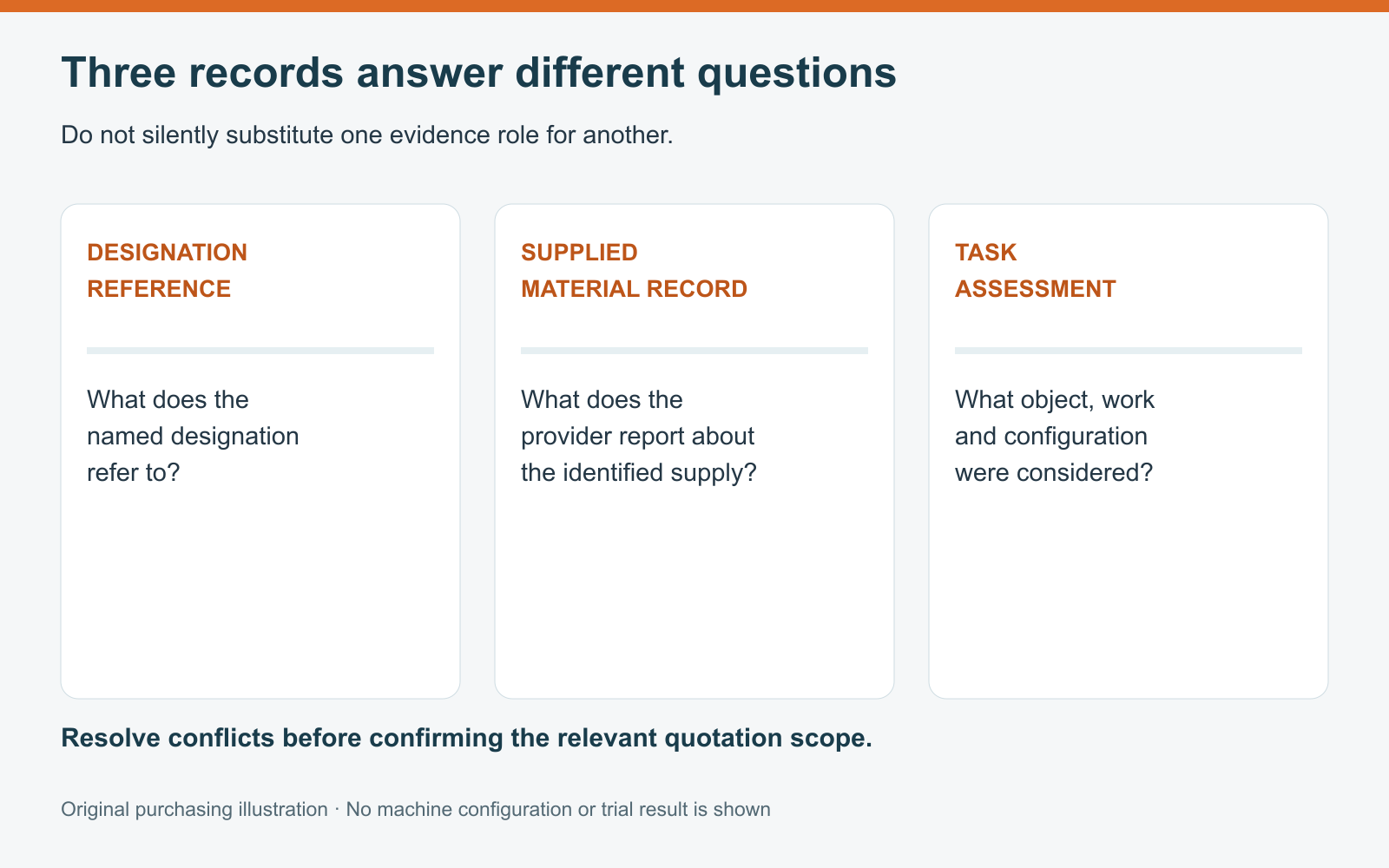
The three evidence roles below help keep that response honest. A designation reference answers what a named alloy means. A supplied material record connects an offer to an identified delivery. A task assessment describes the physical object and equipment scope considered. None substitutes for the others.
A copyable RFQ checklist
- Required material: Send the exact designation, controlling specification and drawing revision; name the person who approves alternatives. This prevents a machine reply from being mistaken for material approval.
- Offered stock: Give the supplier’s exact designation, form, condition, section, incoming length and material-document or lot reference. This links the offer to a physical delivery.
- Representative object: Identify the sample, its dimensions and differences from intended production stock. This shows what an assessment can and cannot cover.
- Cut task: State required lengths and range, cut orientation, quantity mix, rough versus finished output, and acceptance features. This defines the work the equipment must address.
- Inspection: If a trial is proposed, agree the drawing features to check, measurement method, sample count and accepting party. This avoids an undefined “good cut” conclusion.
- Quotation boundary: Ask for the machine model and actual configuration considered, included handling, remaining assumptions and open questions. This makes competing proposals comparable.
If your RFQ has no CAD file yet, start with photos, a sketch and a part list, then identify the missing material and inspection fields. Our separate aluminum alloy and temper inquiry guide illustrates a similar document-linking principle for a different material system; its aluminum-temper examples must not be copied into a cast bronze specification.
When to pause the purchase decision
Pause a final equipment commitment if the required and offered materials conflict, the sample cannot be tied to the production lot, the intended stock form is still unknown, or the output acceptance criterion is missing. Resolve the material question with the responsible supplier and design authority. Resolve the equipment question with a task-specific proposal and any agreed evaluation. Do not turn an unresolved field into a hidden assumption simply to complete a quotation.
Once the records agree, send JiurunCut your material and cutting inquiry. Include the exact C95400 or C95500 designation being proposed, the available stock and drawing information, and a list of differences or unknowns. Ask which configuration, evidence and representative sample would be needed for a meaningful assessment. The response can then state its scope clearly instead of implying an unverified universal bronze-cutting capability.