
An aluminum saw for lighting fixture manufacturing belongs in the housing production route. It should be selected from the aluminum work your factory actually retains, the housing families it must change between and the condition that assembly requires. A lamp order is not automatically a saw order: it can contain bought housings, separately processed diffusers, end caps, mounting parts and electrical assemblies.
Start with the released product mix and a route for each housing family. Then decide whether to buy finished aluminum components, outsource defined fabrication or bring assessed cutting into the factory. This guide helps a manufacturer compare those alternatives and specify an industrial saw purchase. It addresses manufacturing scope rather than choosing lighting for a room or qualifying the electrical performance of a luminaire.
1. Identify the aluminum work behind the finished fixture
A finished linear fixture may look like one long component, but its production records can contain several different purchased and fabricated items. Write down the metal housing, diffuser or lens, end components, mounting arrangement and any separate internal carrier shown in your own released bill of materials. Do not infer that every item passes through the aluminum saw simply because it appears in the assembled product.
The LEDSON aluminum channel catalog illustrates why the product family matters. That supplier organizes channels by installation method, including surface, recessed and suspended versions, and lists accessories such as lenses, end caps, connectors and mounting brackets. This is an example of one supplier’s product range, not confirmation that its components fit Jiurun equipment or that your factory uses the same construction.
Establish what arrives at your factory. If the housing supplier delivers finished, prepared components, the retained work may begin at assembly. If you receive approved long extrusions, cutting may be followed by feature machining, cleaning, finishing or other released operations. If you sell only cut housing components, your delivery boundary differs again. These routes need different investment comparisons.
For each route, name the accepted output. A saw-cut aluminum blank, a prepared housing ready for assembly and a qualified finished light are three different outputs. Agree which one the equipment quotation covers. This prevents a fast cutting demonstration from being mistaken for complete fixture production.
Keep the production decision with the responsible people. The product designer defines the released housing construction, the manufacturing team defines the retained route, and the equipment supplier assesses a stated cutting task. A generic catalog photograph cannot replace any of those records.
2. Build a housing-family map before choosing automation
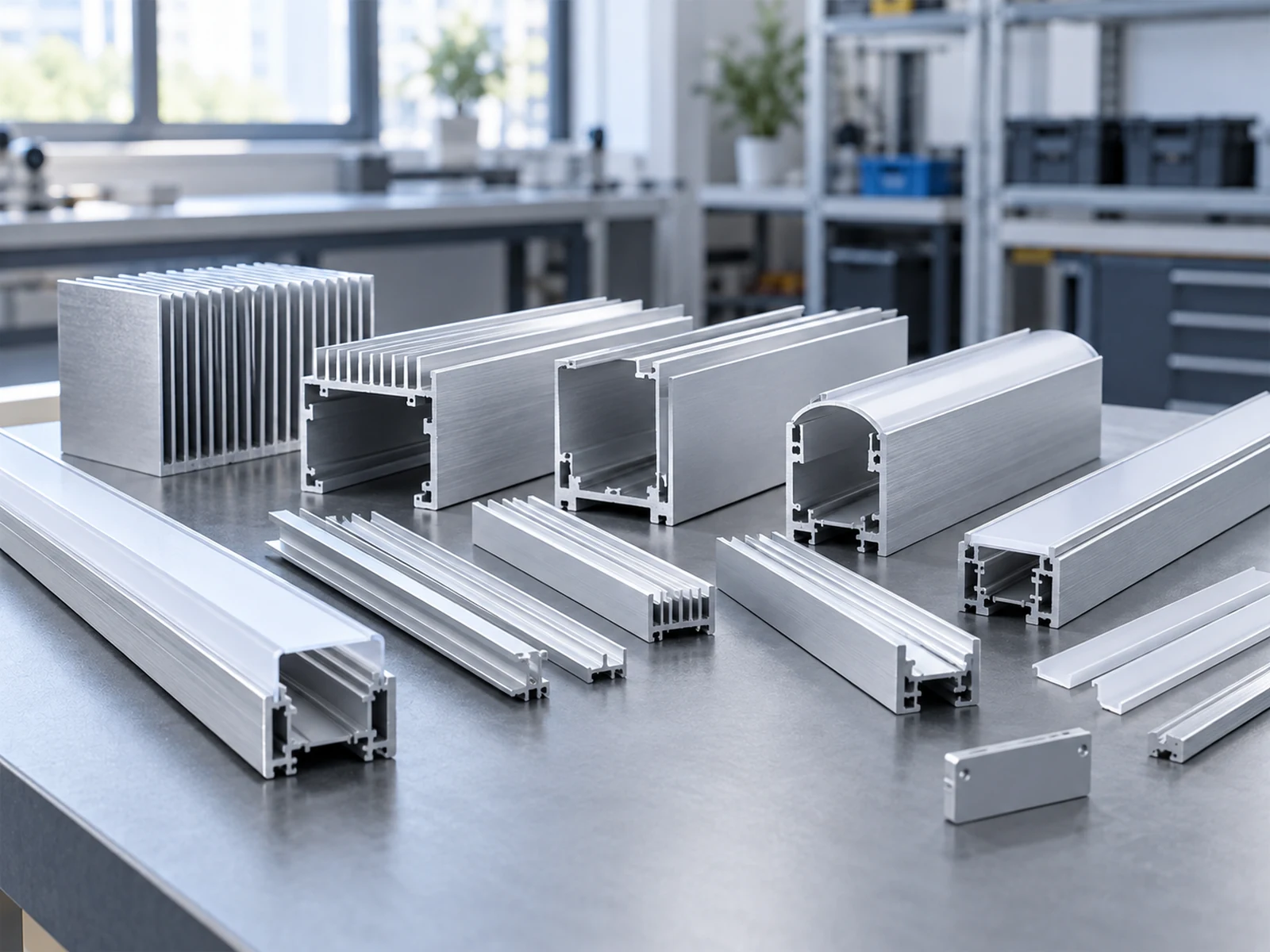
A useful family map groups the work that changes the cutting assessment. Include the actual profile designation, section drawing, incoming condition, required ends, length range and receiving operation. Keep finish and product revision attached to the family. One maximum width and height cannot describe a range containing open channels, closed housings, fins and differently placed internal features.
Identify which models are bought finished and which are fabricated internally. Then show the quantity and timing of the retained work. A factory assembling many fixtures can have little aluminum cutting if its supplier provides prepared housings. Conversely, a component supplier serving several lighting brands may retain substantial cutting without assembling a single complete lamp.
Map the changing conditions explicitly. A repeated straight-cut family and a family requiring different released end angles are separate assessment rows. So are a short housing requiring a different collection arrangement and a longer housing requiring additional stock support. Grouping them under “lighting profiles” conceals the exceptions that may determine the equipment choice.
| Family record | What the buyer supplies | What the offer should resolve |
|---|---|---|
| Incoming aluminum | Section drawing, identity, stock length and condition | Assessed support, holding and feeding scope |
| Required cut output | Released ends, length reference and receiving requirements | Confirmed family and observation evidence |
| Product change | Next section, length, angle or finish condition | Actual change work and quoted functions |
| Later fabrication | Named retained operations and their receiving condition | Included equipment versus separate work |
| Assembly release | Accepted housing identity and matching component list | A defined delivery boundary beyond gross cut count |
Do not select automation from the longest production run alone. Review the families and changes that could make the purchase unsuitable. A suitable repetitive feeding arrangement for one family does not confirm another section, every short output or every end condition. Obtain a model- and configuration-specific response to each material row that matters.
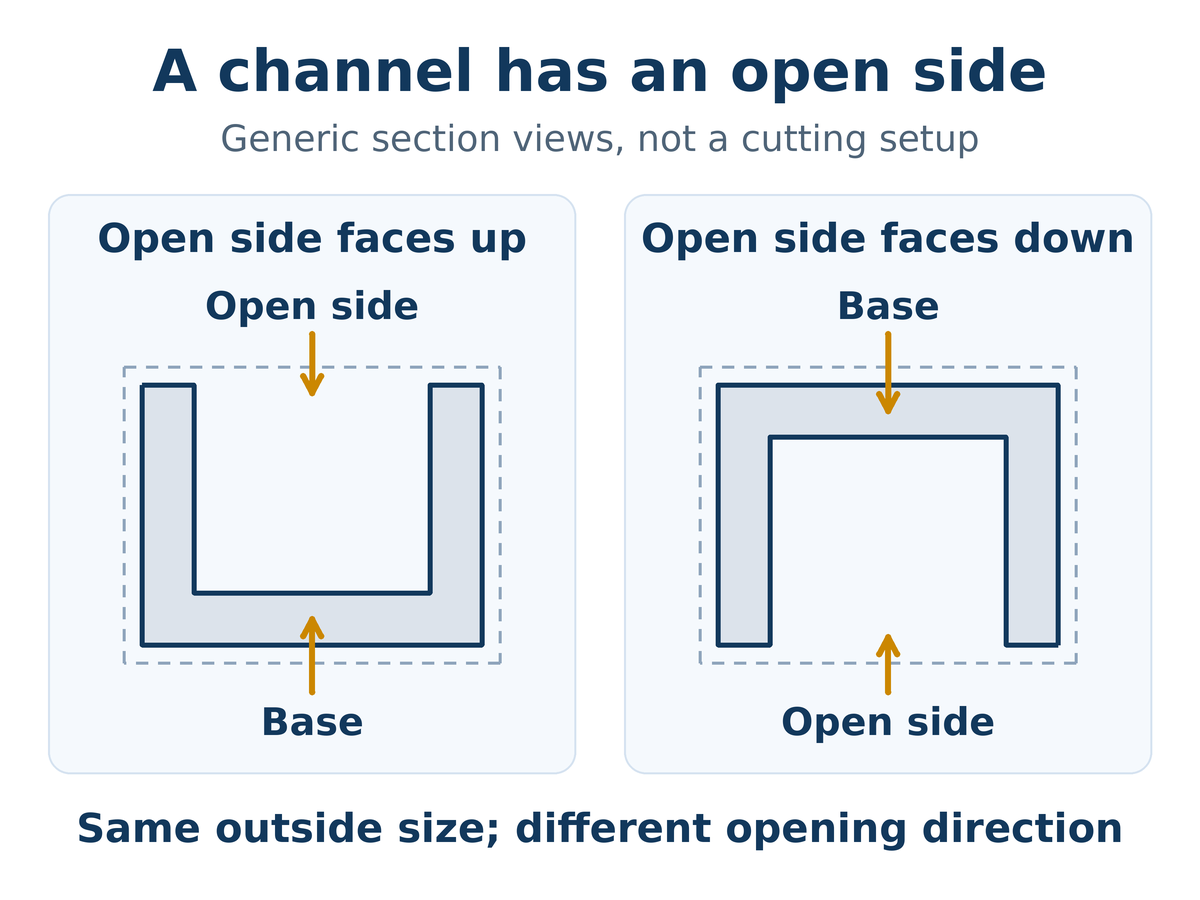
For an open channel, retain the opening direction and relevant faces in its released section view. The generic views below show why identical outside envelopes do not identify those faces. They prescribe no machine holding position; the supplier must assess the actual lighting housing.
3. Keep diffuser and accessory routes separate
The metal housing and the light-transmitting component can have different materials, supplied conditions and fabrication instructions. Record each route independently. Do not assume the aluminum cutting setup is approved for a diffuser, or that equal finished lengths require identical preparation. Use the responsible component drawings and supplier instructions to establish the actual requirements.
The same applies to end caps and mounting accessories. State whether they arrive finished, require a retained operation or form part of another supplier’s assembly. Their availability and identity affect housing handover, but that does not make them outputs of the saw. A complete equipment offer should identify its boundary without absorbing unrelated processes into a vague “lighting production line.”
When the released design uses a removable cover, groove or other interface, identify the relevant housing faces and the actual mating components. The LED housing blank specification guide addresses the individual blank record. For the machine purchase, collect those records across the families and connect them to the complete retained production route.
Plan how parallel routes meet at assembly. A checked housing can wait for its assigned diffuser or end components; it is not automatically a complete fixture. Show the receiving quantities, identity and disposition in your own production records. Resolve mismatched component supply with the appropriate supplier rather than interpreting it as insufficient saw capacity.
Keep electrical qualification, optical performance and thermal approval separate from the cutting assessment. This article supplies no LED loading limit, electrical test method or thermal-performance claim. The responsible product and compliance processes must establish those requirements. A cut housing observation is evidence about that housing task, not approval of the assembled light.
4. Compare bought housings, outsourced fabrication and retained cutting
Compare all three routes against the same housing specification and delivery boundary. A bought finished housing may include operations and acceptance work absent from an outsourced cutoff quote. An in-house saw price may exclude the later preparation your assembly team needs. Put those differences in the comparison before treating the lowest initial price as the lowest production cost.
For bought finished components, obtain the actual included state and ordering conditions from the housing supplier. For outsourced work, define who supplies the extrusion and who owns the later operations. For retained cutting, identify the machine, tooling, stock support, collection and buyer-provided activities. Use confirmed offers and your own observed work records for economic inputs.
A mixed route may be appropriate to evaluate. Your factory could retain recurring families while buying a different prepared housing. The important point is to make the boundary explicit, not to prescribe that arrangement. Avoid counting externally supplied housings as work the new saw must perform or attributing their later assembly acceptance to its output.
Jiurun manufactures industrial circular-saw equipment for aluminum and nonferrous materials. Send the actual retained housing map for assessment. Confirm the offered model, supplied configuration and supported job conditions. A general equipment description does not establish suitability for all lighting extrusion families, and feeding repeatability does not guarantee finished housing accuracy.
Request specific answers about the offered functions. Programmed lengths, job records, marking or collection features must be confirmed where needed. A CNC label alone does not establish automatic diffuser matching, finish-lot allocation or fixture-order tracking. A separately performed factory process is a valid part of the route when it is identified honestly.
5. Preserve finish, visible faces and order allocation
Record whether the incoming housing is unfinished, anodized, coated or supplied with another stated surface condition. Name the faces that remain visible in the product and the handling restrictions in the released manufacturing record. An assessment using unfinished stock does not by itself settle a finished housing family.
Keep cosmetic acceptance tied to the actual product requirement. Do not invent a universal scratch allowance or promise that a saw will never mark a profile. Ask how the offered support, holding and collection arrangement will be assessed for the supplied condition. If another operation follows cutting, identify whether the observed face is final or will be processed later.
Order allocation can also matter. Two housings with the same geometry may belong to different finish lots or released product revisions. Maintain that identity through fabrication and collection when the actual order requires it. Mixing them to create a larger cutting run may leave the assembly team with the wrong components even if the quantity is correct.
Do not turn this requirement into an unconfirmed software claim. If the supplied equipment has a relevant identification function, obtain its assessed scope. Otherwise identify the factory’s separate labeling and record process. The purchase comparison should show where the task is performed and by whom.
Use the representative observation to examine the actual handover. A profile held in the proposed arrangement and collected as intended provides more relevant evidence than loose sample pieces displayed after cutting. Preserve the stock and finish identity with the result so the next team can decide whether it corresponds to the required housing.
6. Assess an aluminum saw for lighting fixture manufacturing across the product mix
Choose a meaningful fabrication campaign for the evidence plan. Include the released families and transitions that could change the decision: another section, a short housing, a different end condition or a protected finish. Repeating the simplest housing at one length can be useful, but it should not stand in for the complete retained workload.
Agree the observation’s entry and exit before comparing results. A report of repeated cutting motions differs from a report covering stock preparation, setup, changed families, checking and collection. Request the missing boundaries when suppliers report different activities. Keep estimates labeled as estimates and measured observations associated with their actual conditions.
Record the machine configuration, tooling, supplied stock, part revision and responsible observation method. Include the receiving decision for later housing preparation if that operation is part of the plan. If a function or family remains conditional, keep that condition visible in the offer rather than treating the rest of the demonstration as confirmation.
Use the released schedule to state the required completion date. Preserve the concentration of different orders, not only a monthly housing total. A workload spread evenly over a month differs from the same quantity released shortly before a required assembly handover. The supplier needs the actual scenario your production team intends to assess.
Capacity evidence should remain scoped. An observed campaign does not guarantee every future order, staffing arrangement or material condition. Ask the supplier to address relevant differences between the demonstration and your intended factory route. This creates a usable assessment without inventing guaranteed output or reducing the entire decision to one advertised rate.
7. Reconcile cut output with assembly-ready housing quantities
Gross saw output and released housing output can diverge when later operations or receiving decisions remain outstanding. Track those states separately. This is especially useful when comparing a saw-only offer with a route that supplies prepared housings. The comparison needs the same accepted output, not merely the same number of cutting motions.
Invented production example: a released order needs 40 housings of family A and 30 of family B. The saw produces 40 A blanks and 30 B blanks. A later retained operation releases only 36 A housings; four remain held. All 30 B housings are released. The route has 66 released housings, not 70 assembly-ready outputs. Producing extra A blanks would not establish the disposition of the four held items.
Now suppose the released A assembly requires one diffuser and two end caps per housing. The receiving team has matching components for 36 A assemblies except that only 68 approved end caps are available. That supports 34 complete A component sets, leaving two released A housings awaiting four end caps. The saw did not create that accessory shortage, and another saw cycle cannot resolve it.
The numbers are examples of record relationships, not Jiurun performance figures or a customer result. Use your own actual requirements and dispositions. Keep held outputs and replacements associated with their original order rows so the same housing requirement is not counted twice when a replacement is produced.
Where you sell housing components rather than complete fixtures, use the appropriate delivery boundary instead. The assembly component example must not impose downstream work your business does not retain. A clear output definition allows the buyer to evaluate the correct saw investment while leaving unrelated operations with their responsible owners.
8. Send an inquiry that can produce a comparable offer
Send the retained housing-family map, released section and part drawings, incoming stock condition and the planned fabrication campaign. State which housings are bought finished, which are outsourced and which the proposed saw must produce. Add the required receiving condition and completion date for the retained route.
Ask for an offer naming the model, supplied configuration, confirmed families, tooling, support and collection scope. Identify separately quoted later operations and buyer-provided work. Request the representative evidence needed for conditional rows. Compare competing routes against the same released housing requirements and accepted delivery state.
Focus the next exchange on the unanswered question that affects the purchase. It could be a housing family not yet assessed, a finish condition not represented, a changed-family observation or a later operation absent from the price. More footage of the easiest cut does not close those gaps.
Contact Jiurun with your lighting housing production map to request an aluminum circular-saw assessment. Include the actual aluminum work retained in your factory and the output it must hand over. Confirm the application and offered configuration before selecting equipment, while keeping component compatibility and finished-fixture qualification with the responsible product processes.
See the metal cutting stage in context
This Jiurun video provides a general aluminum cutting-stage context. It does not show a lighting-product qualification, confirm every housing family or prove the invented production example. Review your actual retained housing task separately.